

I’m spending the day with a fantastic group of artists, youth organisation representatives, researchers and arts experts for a workshop at the Scottish National Portrait Gallery, aiming to collaboratively explore and develop ideas for a project to explore the potential of contemporary art to raise awareness, provoke thought and motivate change in relation to youth inequalities. I’ll post some notes and other materials later, but we’ll be using the hashtag #artineq.
The other organisers of the event are Marlies Kustatscher and Alan Brown.
via jenrossity
A paper based on the research conducted as part of the Dissertations at Distance project has just been published in Teaching in Higher Education. The paper introduces the idea of the ‘campus imaginary’ as a way of accounting for the tendency of online students to attribute difficult or challenging experiences of independent research to their distance from the campus.
[Campus imaginaries portray] the imagined institution and those in it as approachable, sociable, and a space more amenable to the sorts of activities interviewees found themselves undertaking as part of their dissertation. In part these imaginaries draw on assumptions about the advantages of ‘in-person’, as opposed to virtual, contact which are far removed from the experiences described in the literature on campus-based students’ independent research experiences. A number of interviewees, even those whose overall experiences of their online programmes were extremely positive, appeared to ascribe negative experiences to their status as online distance students. For example, issues such as unexpected obstacles, troubles with motivation, difficult supervisory relationships, lack of time and space to focus, and feelings of isolation and doubt were interpreted as features of the online dissertation process specifically. As we will see, however, these issues are common features of transitions from taught courses to independent study; the nature of supervisor-student dynamics; and the inherent challenges of conducting research, particularly for newer researchers.
Ross, J., & Sheail, P. (2017). The ‘campus imaginary’: online students’ experience of the masters dissertation at a distance. Teaching in Higher Education, 0(0), 1–16. http://www.tandfonline.com/doi/full/10.1080/13562517.2017.1319809
via jenrossity
I was delighted to give a keynote talk at the Digital Day of Ideas here at the University of Edinburgh on 17 May 2017. Here are the slides, notes and references from my talk.
“Learning with Digital Provocations”
Abstract: One of the most significant tensions in the convergence of technology and education is how the promise/threat of ‘disruption’ comes up against theories, practices and structures of formal and informal education. Disruption in educational technology contexts has come to be aligned with neo-liberal discourses of efficiency, enhancement, personalisation, scale and automation; and we can be forgiven for cynicism about its critical and creative potential in education. This talk aims to reanimate the debate by reframing disruption in terms of inventiveness, provocation, uncertainty and the concept of ‘not-yetness’. Focusing on the recent AHRC-funded Artcasting project, and with other examples drawn from the work of the Centre for Research in Digital Education at the University of Edinburgh, it argues that inventive digital approaches can help us develop critical responses to assumptions about the role of the digital in contexts including higher education, museums and galleries.
Slides:
Notes:
This talk brings together several ideas I’ve been working on over the past few years, alongside the best colleagues anyone could hope for, some of whom are in the room today. The message I’ll leave you with is ultimately a hopeful one, so you can look forward to that. But before we get there, I need to talk about the challenges of teaching and researching in the context of other things that are going on in the sphere of educational technology. I’m going to start by telling you about the concept of ‘disruption’ and why, for a lot of us teaching and researching in digital education, it’s become a dirty word. You can play along if you know what to look out for.
So: next time you read a news article about educational technology, see how well you do in disruption bingo:
Harvard Business School professor Clay Christensen has been an important promoter of ideas about how education is fundamentally broken and in need of disruption through technology. We’re not going to dwell on him for long, but his framing of disruption has been very influential. Here’s Professor Christensen writing in 2014 about massive open online courses – the huge, free courses offered by universities through platforms like Futurelearn, Edx and Coursera.
“In 2013, we witnessed aggressive discounting strategies as well as schools experimenting with lowering net — not sticker — prices in an effort to recruit students.”
“Free access to content from prestigious institutions revealed that content didn’t need to be proprietary.”
“Faculty have been forced to reassess how and why they teach the way they do.”
…“Many colleges and universities resist the idea of training students for jobs. Yet it is employers who are truly the ultimate consumers of degree-holders.”
The first three points might or might not seem objectionable to you, but I do want to draw attention to the fourth, which was buried rather far down in the article, right near the end. The idea that students are the product and employers are the consumers is a rather striking point from which to disrupt/fix/reimagine education, don’t you think?
When you see headlines like this – “many universities are resisting online learning” – I would encourage you to consider that resisting educational technology and online learning, at least in the form it’s being offered by thinkers like Christensen and the companies, institutional actors and others that embrace these types of philosophies, might be a highly principled position. We’ll come back to this.
Another common line of reasoning in the disruptive technology for education genre is the analogy to failed business models in other sectors. A well-known one was Clay Shirky’s analogy of how napster destroyed the music industry, and why universities need to take note of this. Here’s another one – Blockbuster. Where is blockbuster today? And what does this have to do with education? Well, according to Sheninger, incremental change is not enough to save the education system. Only disruptive strategies will save education from being the next Blockbuster.
There is literally no area of education that is immune from the idea that technology will disruptively improve it. This is from this year’s Future EdTech conference web site:
Digital Disruption in Education: Institutions have far understood that traditional means of communications are not efficient anymore when engaging with generation Y. Reaching out to recruits, current students and alumni, positioning your brand and communication can be massively assisted with the use of new tech that offers unprecedented insights and opportunities to personalise communication.
Note the corporate language and the appearance of generation y and personalisation to talk about communicating with students.
Pervasive rhetoric of disruption makes those in the education technology sector especially open to ‘the next big thing’, whatever it might be. As an example that emerged on the scene last year, I want to talk about the emergence of the concept of ‘blockchain’ for education.
Bitcoin is a digital currency in which transactions can be performed without the need for a credit card or central bank… The blockchain is a public ledger of all transactions in the Bitcoin network. – https://blockchain.info/wallet/bitcoin-faq
Blockchain is really fascinating, and if you want to learn more about it, you might like to check out Professor Chris Speed’s ESRC project called ‘after money’ (http://aftermoney.design ).
There are some big promises being made for what blockchain could do for society:
let’s put health records, voting, ownership documents, marriage licenses and lawsuits in the blockchain. Eventually, every dataset and every digital transaction could leave a “fingerprint” there, creating an audit trail for any digital event throughout history, without compromising anyone’s personal privacy. [blockchain] could introduce a level of democracy and objective “truth” to the digital world that even the physical world can’t match. Its promise involves a future in which no one has absolute power online, and no one can lie about past or current events. (http://recode.net/2015/07/05/forget-bitcoin-what-is-the-blockchain-and-why-should-you-care/ )
Education is no exception. This is a design fiction, based on what the creators called ‘edublocks’. This video was made by the Institute for the Future and the Act Foundation to generate discussion and debate, so we can assume it is aiming to be at least a bit controversial. Bear that in mind as we enter a world where ‘learning is earning’.
Controversial or not, the concept of blockchain for education has caught on, and Tapscott & Tapscott assure us, disruption is sure to follow.
“the blockchain represents nothing less than the second generation of the Internet, and it holds the potential to disrupt money, business, government, and yes, higher education.”
Big players are getting into this. Last year Sony moved into ‘blockchain for education’, and two weeks ago Google announced that its Classroom platform will be opened up so that ‘anyone’ can become a teacher. The infrastructure, the funding and the desire is lining up behind making edublocks, or something like them, a reality. What does it mean to work critically in such a space?
I think that pervasiveness of the discourse of disruption means that it is something educators and educational researchers have to grapple with. I’ve hinted at some of the difficulties I have with the underpinning values being expressed through the concept of disruptiveness. Now I want to make explicit what we need, as digital educators, scholars and researchers, to take into account if we want to reconfigure this debate.
Neil Selwyn offers a useful set of critical questions we can ask when faced with calls for disruptive educational technology:
What is actually new here?
What are the unintended consequences or second-order effects?
Who is pushing these ideas in education? What are their reasons for doing so? What wider agendas are attached to these conversations?
What is being said about education that might be useful? What is being said about education that teachers might wish to challenge and talk back to?
(Selwyn 2015, p183)
We shouldn’t necessarily take claims about disruption at face value – I would argue, with Sian Bayne, that a lot of the current ideas about disruptive technology in education are popular not because they are so radical, but precisely because they leave what she calls ‘deeply conservative assumptions’ about education in place:
[Technology Enhanced Learning] carries with it a set of discursive limitations and deeply conservative assumptions which actively limit our capacity to be critical about education and its relation to technology. At the same time, it fails to do justice equally to the disruptive, disturbing and generative dimensions of the academy’s enmeshment with the digital. (Bayne 2015, p.7)
Rhetoric of disruption, like that of enhancement, doesn’t often signal a willingness to grapple with what is genuinely ‘disruptive, disturbing and generative’. Lesley Gourlay suggests that one of the big ‘disruptive’ ideas in education technology, openness, often carries with it some really troubling fantasies, including one of moving away from engagement with contestable knowledge, towards access to content:
“The fantasy [of openness] appears to be one of total liberation from the perceived constraints of formal study, the rigours of assessment and engagement with expertise and established bodies of (contestable) knowledge, all of which are activities deemed hierarchical and repressive of creativity. The emphasis is instead reduced to access and the online generation of ‘content’ – which carries with it a further powerful fantasy of unfettered human potential which can be unlocked unproblematically in informal lay interaction. (Gourlay 2015, p.8)
(Jeremy Knox has also done excellent work around the problems of framing openness as ‘access alone’ – see references for more on this.)
Audrey Watters – talking about Sebastian Thrun (Udacity for-profit educational platform founder), and the context of market demands, precarious labour and automation – has a lot to say about the ‘uberification’ of education. As she points out, Universities are holding on to accreditation and other protections… for now (but see blockchain above).
Too often, what we see when we go digging into disruption is an impulse for change that isn’t honest about its assumptions, and that can be destructive. That’s why, for me, the most important thing about working in scholarly areas that focus on the digital is how we bring together sharp and critical analysis with creativity. That is: how do we work in a way that shows how things are, but also makes space to actively explore how they might be otherwise? What kinds of provocations can help us do this? I think what we need are approaches that are more surprising, and subversive, and imaginative.
I first started thinking seriously about the role of provocation in 2011, when my colleagues and I were working on a project about online writing, assessment and feedback. We thought about writing some principles, but we decided that what was needed in our field at that time was not ‘principles’ or yet another version of ‘best practice’, but something altogether more provocative – a manifesto. The 2012 and 2016 versions of the manifesto for teaching online have been really important sources of discussion, debate and inspiration for us and our students, colleagues and others in the field. The series of short statements are grounded in our own and others’ research, and they open up a range of critical questions and ideas about digital education, framing these in active ways (we tried not to simply repudiate everything). This video interpretation of the manifesto, made by our excellent colleague and PhD student, James Lamb, gives a good way in.
The Manifesto for Teaching Online (2016) from james858499 on Vimeo.
The manifesto and an invitation it generated in 2012 led directly to meeting Dr Amy Collier, now at Middlebury College in Vermont. Amy and I have been working for the past few years on what we’ve found to be a generative way of thinking about the future of educational technology. As Neil Selwyn points out:
‘technologies are subjected continually to complex interactions and negotiations with the social, economic, political and cultural contexts into which they are situated.’(Selwyn 2012, 214–15)
The category of ‘emerging technologies’ is especially complex, since it brings the future into the equation. Our colleague George Veletsianos talks about these as “not yet fully understood” and “not yet fully researched, or researched in a mature way” (Veletsianos 2010, 15). Amy and I have coined the term ‘notyetness’ to capture something of this complexity and uncertainty:
Practices, identities, pedagogies and technologies can be marked by this ‘not-yetness’ (Ross & Collier 2016)
Not-yetness works in the service of a messier understanding of what constitutes higher education, and how technologies act in this space; and it engages with complexity, uncertainty and risk, not as factors to be minimised or resolved, but as necessary dimensions of technologies and practices which are unknown and in flux. We want to continually centre this complexity, mess and uncertainty when we think about the future of education and its technologies.
For me, that applies equally to research, and I’ve been developing my own understanding of what that means over the past few years. It’s helping me understand what ‘creatively critical’, provocative methods can do when applied to digital education. The best way I’ve found so far to think about this is through the lens of speculative method. These methods are increasingly used in design disciplines, and they include approaches like design fictions. They’ve also been taken up in the social sciences in a range of conceptual and empirical ways. Speculative (or inventive method)
For me, three key elements to speculative method are epistemology, temporality and performativity. I’ve written about this in a recent journal article in Learning Media and Technology which you might like to check out if you want to read more.
These methods challenge linearity and replicability – and they are explicitly about the kinds of questions being asked. Questions about the future, provocative questions, questions that create their own conditions of answerability – conditions that didn’t exist before:
the ‘answerability’ of a problem is introduced by crafting a method specifically to address that problem. (Lury & Wakeford 2012)
Wilkie, Michael, and Plummer-Fernandez (2015) argue that methodology itself is ‘a process of asking inventive, that is, more provocative questions’ (p.4)
Speculative methods are also, in their focus on the future, very enmeshed in ideas about time. Visions of the future generate effects in the present, and our fictions and inventions are shaped by issues we inherit, and closed off from futures we can’t yet imagine. Furthermore, the effectiveness of inventive methods ‘cannot be secured in advance’ (Lury & Wakeford 2012).
Importantly, speculative method relies on engaging with and provoking various kinds of publics – and how those publics, or audiences, or participants respond to ‘objects to think with’ determines the nature of the problem and its answerability.
I’m going to spend the last part of my talk sharing some examples of projects in the Centre for Research in Digital Education that have used speculative method to introduce creative criticality into areas that really needed it! I’m going to mention two briefly, then talk in a little more detail about the third, the Artcasting project.
The first of these projects tackled automation and the role of the teacher. This was the ‘teacherbot’ project, led by Sian Bayne, with colleagues from Digital Education, Informatics and Design Informatics. In this project we worked together to create an automated twitter bot that would respond to participants on the E-learning and Digital Cultures MOOC. Its responses were written by the course team and triggered by particular keywords that appeared in the #edcmooc hashtag. Participants engaged with it in all kinds of ways, both playful and serious. Teacherbot helped us explore, alongside MOOC participants, responses to automation and different ways of thinking about how humans and machines might teach together.
The second project I want to mention is the “learning analytics report card”, or LARC, project, led by Jeremy Knox: https://larcproject.wordpress.com . LARC was designed to explore how Universities can develop critical and participatory approaches to educational data analysis. It did this by creating an interface for data from the Moodle virtual learning environment, where students could chose the types of reports they wanted to have generated about them, and would get ‘plain english’ results that we’ve seen from engaging in them with students can be really generative and thought-provoking. By revealing data that is usually hidden, and presenting it in playful and provocative ways, the project is getting people more critically engaged with ideas around algorithmic culture and educational policy.
Finally, I want to tell you about the Artcasting project. This was an AHRC funded project that set out to find more inventive ways of evaluating how visitors engage with artworks. We did this by designing and trialling a mobile method for inviting, capturing and analysing people’s connections between art and place through an app we called artcasting. The academic team was Chris Speed, Claire Sowton, Jeremy Knox and me, with Chris Barker providing the software engineering, and we worked with National Galleries of Scotland, Tate and the ARTIST ROOMS programme over the course of a year.
ARTIST ROOMS:
Evaluation is a really thorny issue in the cultural sector at the moment, and there has been a lot of critique of instrumental approaches to evaluation and to measuring engagement, learning and impact. Belfiore and Bennett are two of the key people working on this, and they are pretty stark about the issues at stake.
with the present levels of knowledge around aesthetic reception, it is not possible to make any meaningful broad generalization about how people respond to the arts, and if or how they might be affected by the experience. Even less plausible is the possibility of actually “measuring” any of these aspects. (Belfiore & Bennett 2010, p.126)
Claire Sowton brought these and a lot of other critical perspectives on evaluation to the project from her doctoral work.
Galleries and museums are generally good at thinking about how people get to the building, but other kinds of movement are less visible. We were hugely interested in understanding museum and gallery learning from a theoretical perspective that took into account social, spatial and technological mobilities. We saw the movement of artworks, people, ideas, inspiration and technologies as a really central part of what it means to understand the impact of art on visitors.
So we built this app as a way of testing out whether more inventive ways of approaching evaluation could be productive for visitors and for gallery professionals. Artcasting was developed as a methodology that could capture articulations of engagement with artworks. We tested it out in two exhibitions – Robert Mapplethorpe at the Bowes Museum in Co Durham, and Roy Lichtenstein at the National Galleries of Scotland. Read more about how Artcasting worked: https://www.artcastingproject.net/what-is-artcasting/
In total we ended up with about 170 casts that we could work with to try to understand what this approach could do. Here are a few examples of the kinds of artcasts people sent.
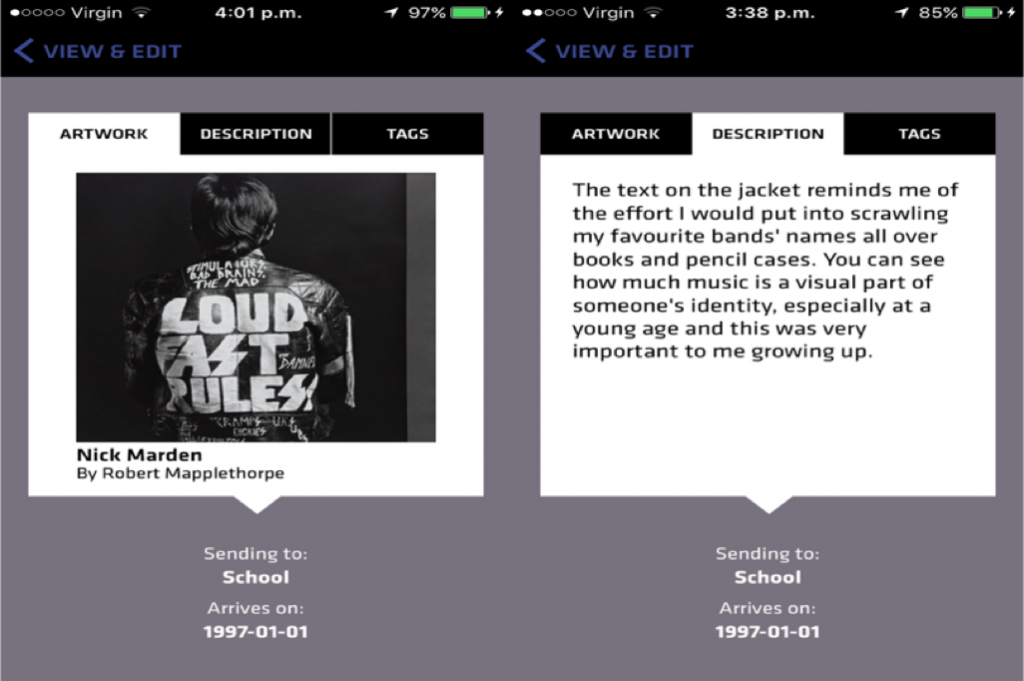
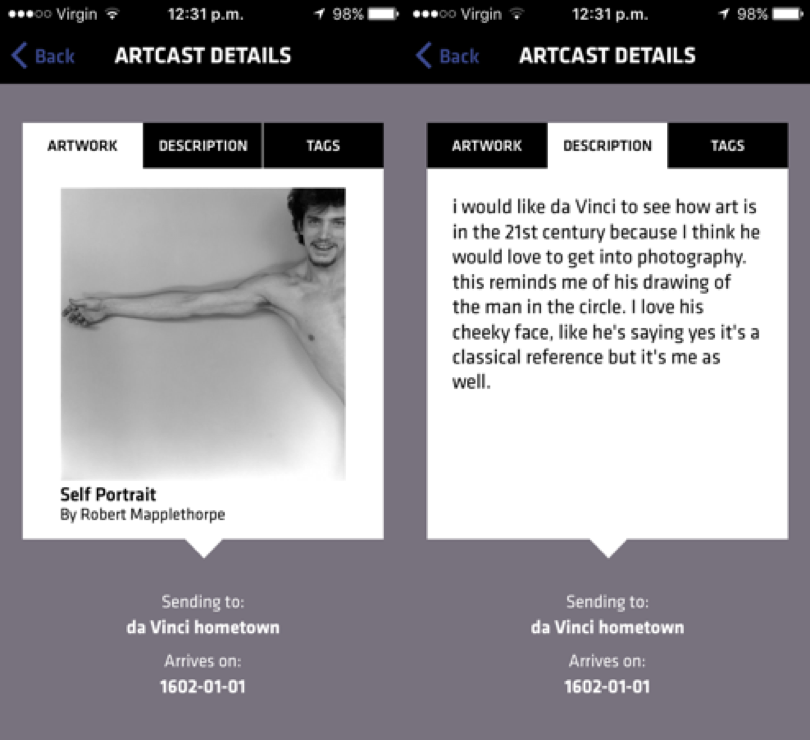
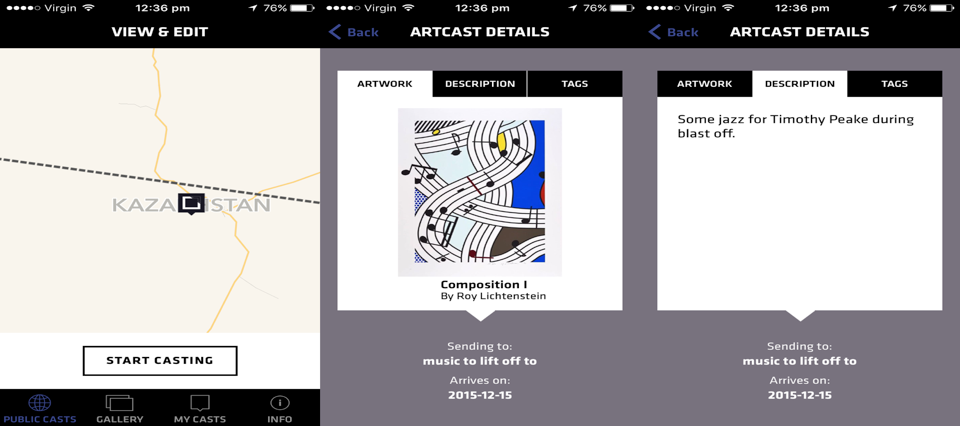
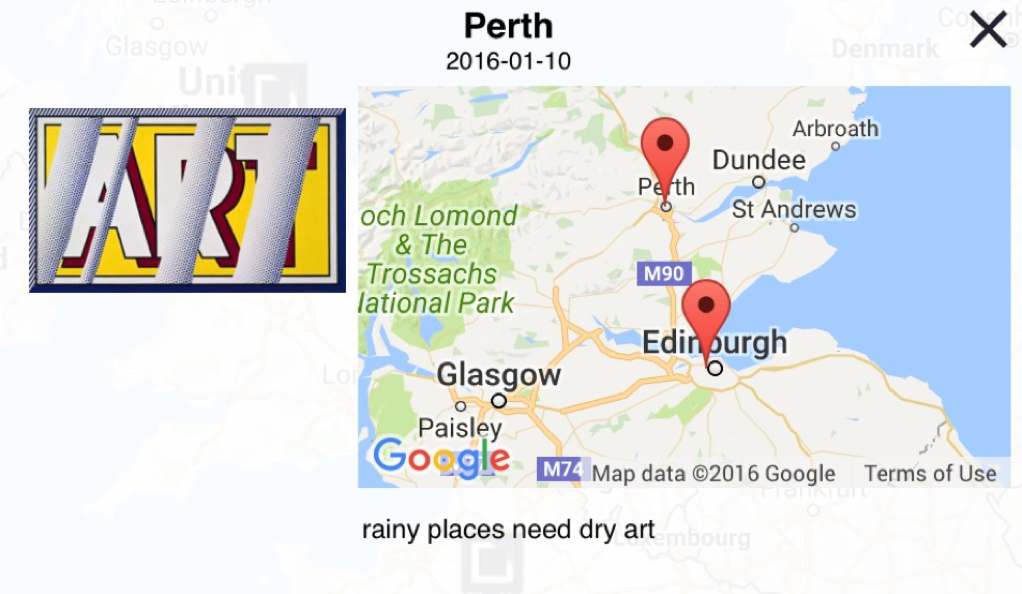
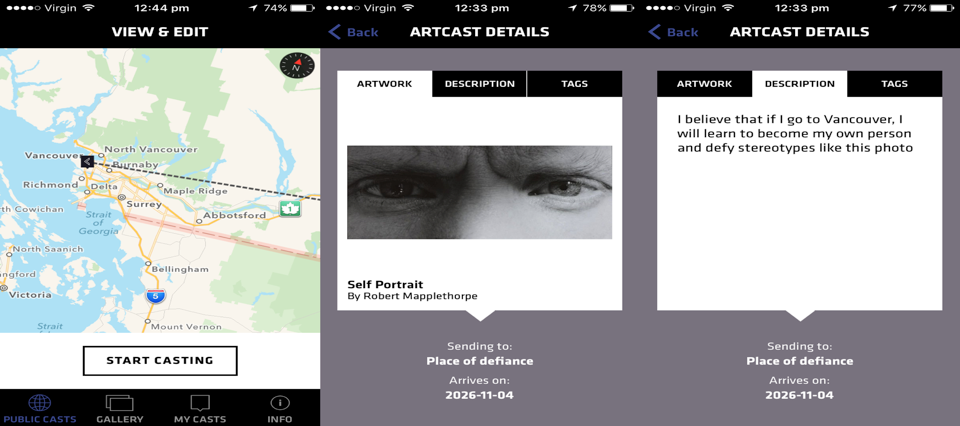
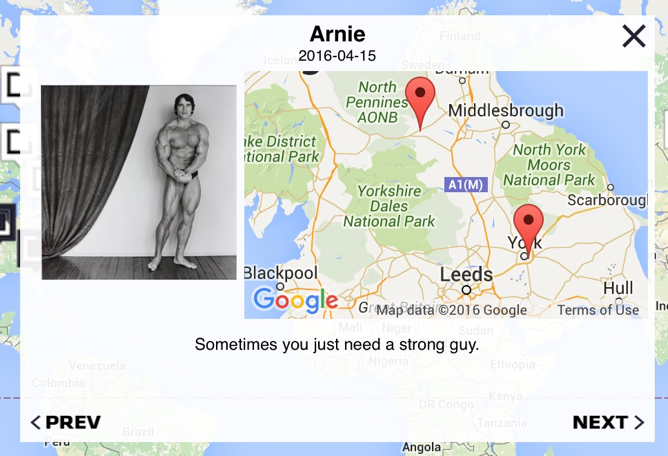
The Artcasting data could be seen collectively as more or less stable ‘traces’ of memory, insight and message. But we also explored how those traces can be a volatile assemblage of engagement that can move in multiple directions away from a single point (for example a single artwork cast to many places and times). Interpretation, like the objects that spark it, is ambiguous and shifting – and the impacts that artworks and galleries have are never going to be easy to pin down.
“it is always possible to take an individual object and place it in a new framework or see it in a new way. The lack of definitive and final articulation of significance keeps objects endlessly mysterious – the next person to attach meaning to it may see something unseen by anyone else before.” (Hooper-Greenhill 2000, 115)
This is really consequential for how institutions talk about and engage with evaluation, and this project has helped us and our partners and others in the sector to think more imaginatively about these issues.
I’ve also been working on how to conceptualise ‘digital co-production’, using ideas about artcasting as a stimulus. Artcasting content is requested and is able to be interpreted by gallery professionals for accountability, audience development, and other purposes. But artcasting is also a form of public interpretation of the artwork, and visitors are creating new encounters with art in new places and times. The guest becomes the host of a new exhibition. This has implications for what I’m calling ‘digital co-production’, which
There is a lot we can say in 2017 at a digital day of ideas about how some of the digital ideas that we’ve been engaging with over the years look pretty scary when socio-political landscapes shift. (digital labour is another context where the rhetoric and practices of digital disruption are wreaking havoc – I’d refer you to the excellent work of our colleague Karen Gregory for more on this)
For me, this makes it even more important that we use technology provocatively rather than instrumentally, to explore big questions and possible futures, and to challenge assumptions. Some of those assumptions seem to be baked right into the DNA of devices, services, and organisational policies, but I believe there is (in the immortal words of Leonard Cohen) a crack in everything, and that’s how the light gets in. I’d like to encourage us all to keep working on how to keep being creative, to keep doing things, making things and trying things – as a way of bringing criticality to the urgent and interesting questions we are facing.
References:
Bayne, S. (2015). What’s the matter with ‘technology-enhanced learning’? Learning, Media and Technology, 40(1), 5–20.
Bayne, S. (2015). Teacherbot: interventions in automated teaching. Teaching in Higher Education, 20(4), 455–467.
Belfiore, E., & Bennett, O. (2010). Beyond the ‘Toolkit Approach’: arts impact evaluation research and the realities of cultural policy-making. Journal for Cultural Research, 14(2), 121–142.
Collier, A., & Ross, J. (2017). For whom, and for what? Not-yetness and thinking beyond open content. Open Praxis, 9(1), 7–16.
Gourlay, L. (2015). Open education as a ‘heterotopia of desire’. Learning, Media and Technology, 40(3), 310–327.
Hooper-Greenhill, E. (2000). Museums and the Interpretation of Visual Culture. Abingdon: Routledge.
Isard, A., & Knox, J. (2016). Automatic Generation of Student Report Cards. In The 9th International Natural Language Generation conference (p. 207).
Knox, J. (2016). Posthumanism and the Massive Open Online Course: Contaminating the Subject of Global Education. Routledge.
Knox, J., & Ross, J. (2016). ‘Where does this work belong?’ New digital approaches to evaluating engagement with art. Presented at the MW2016: Museums and the Web 2016, Los Angeles. Retrieved from http://mw2016.museumsandtheweb.com/paper/where-does-this-work-belong-new-digital-approaches-to-evaluating-engagement-with-art/
Lury, C., & Wakeford, N. (2012). Inventive Methods: The Happening of the Social. London: Routledge.
Ross, J. (2016). Speculative method in digital education research. Learning, Media and Technology, 0(0), 1–16.
Ross, J., & Collier, A. (2016). Complexity, mess and not-yetness: teaching online with emerging technologies. In G. Veletsianos (Ed.), Emergence and Innovation in Digital Learning: Foundations and Applications. Athabasca University Press.
Ross, J., Sowton, C., Knox, J., & Speed, C. (in press). Artcasting, mobilities, and inventiveness: engaging with new approaches to arts evaluation. In L. Ciolfi, A. Damala, E. Hornecker, M. Lechner, & L. Maye (Eds.), Cultural Heritage Communities: Technologies and Challenges. London: Routledge.
Selwyn, N. (2015). Never believe the hype: questioning digital ‘disruption’and other big ideas. Teaching and Digital Technologies: Big Issues and Critical Questions, 182.
Selwyn, N. (2012). Ten suggestions for improving academic research in education and technology. Learning, Media and Technology, 37(3), 213–219.
Veletsianos, G. (2010). Emerging Technologies in Distance Education. Athabasca University Press. Retrieved from http://www.aupress.ca/index.php/books/120177
Watters, A. (2017). Driverless Ed-Tech: The History of the Future of Automation in Education. http://hackeducation.com/2017/03/30/driverless
Wilkie, A., Michael, M., & Plummer-Fernandez, M. (2015). Speculative method and Twitter: Bots, energy and three conceptual characters. The Sociological Review, 63(1), 79–101.
via jenrossity
Amy Collier and I have been writing and talking about the concept of not-yetness for a few years now – most recently at the Educational Futures and Fractures conference in Glasgow in February.
On Friday a new article was published in Open Praxis (open access):
Collier, A. and Ross, J. (2017). For whom, and for what? Not- yetness and thinking beyond open content. Open Praxis, 9/1. https://openpraxis.org/index.php/OpenPraxis/article/view/406
This article started life as a presentation at the 2015 Open Ed conference in Vancouver – here are our slides from that talk.
Thanks in part to the discussions at the conference (some reflections on these by @cindyu , David Kernohan), we’ve been continuing to develop these ideas, and this article is the result. It takes a range of critical perspectives on openness as its starting point, and offers the concept of ‘not-yetness’ as a productive lens for examining meanings of openness that go beyond instrumentality, uniformity, and content.
via jenrossity
I’m just back from a wonderful research visit to Sydney, Canberra and Melbourne. I was invited by the fabulous Angelina Russo, who was the most amazing host, and made my trip truly unforgettable.
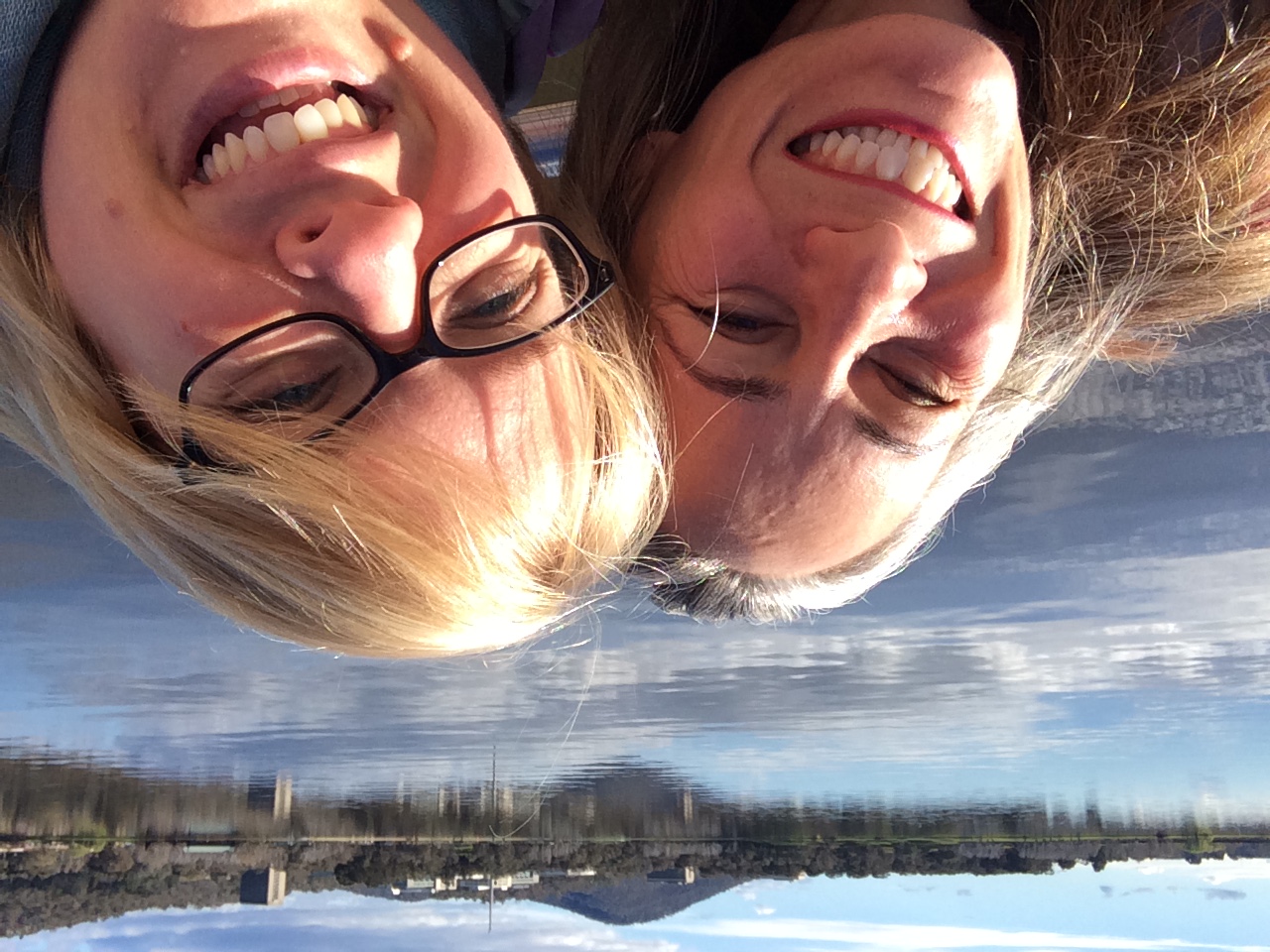
I spent most of my time in Sydney, staying in the visiting scholar’s flat at the Women’s College, which was a really good base for writing, visiting and seeing the city. There I gave a seminar for the new Centre for Research in Learning and Innovation, heard Pippa Yeoman talk about her research, met with Amani Bell and some of her colleagues to talk about educational innovation, and had an excellent discussion about cross-centre collaboration with CRLI’s director, Peter Goodyear. I also had a chance to meet with Mike Michael, whose work on speculative method has greatly informed my own.
Also in Sydney I gave a talk to Lynda Kelly and her colleagues at the Australian National Maritime Museum (what an amazing space!). Lynda’s blog post expands on the rich discussion we had about artcasting, evaluation and engagement. Lucila Carvalho and I met with Paul Donnelly and his colleagues at the Sydney University Museum to talk about plans and possibilities for them as they combine their locations into one new museum building (I also got to see the Alpha & Omega exhibition, which was the perfect blend of eccentric and informative). Paul, Angelina and I went to the launch of the Powerhouse’s Out of Hand exhibition, which I loved. I had an entertaining chat there with one of the makers, Mitchell Whitelaw. His weather bracelet and cup were definitely highlights of the show.

I visited Canberra for a couple of days, mainly to attend the 2016 Whisper Workshop. The workshop was chock full of amazing people, some of whom I knew online and was delighted to meet in person (Kylie Budge; Narelle Lemon; Kate Bowles; Megan McPherson). It was great to meet Inger Mewburn again and to get to know Jonathan O’Donnell & Tseen Khoo. I was especially pleased to meet Tamson Piestch, whose work on the histories of higher education has made its way to the top of my reading list. I spent some time reflecting on Australia’s fraught histories in the National Museum of Australia, and my visit ended on a happy note, when Tracy Ireland and I picked up our conversation where we’d left off in Montreal at the Critical Heritage Studies Conference.
My last few days in Australia were spent in Melbourne, doing some more in-depth research planning with Angelina. We also met with Phil Pond from RMIT to talk about methods of tracing digital activities and objects; and with Seb Chan to learn about how the Australian Centre for the Moving Image has incorporated co-working spaces as a way of bringing new ideas and insights together with the work of the Centre. We went to part of the Digital Ethnography Research Centre’s ‘refiguring techniques in digital-visual research’ symposium. I especially liked the talk given by Alison Young; and was pleased to say a quick hello to Neil Selwyn and visiting scholar from my side of the pond, John Potter.
I loved Australia – there is an energy and a talent for networking and building partnerships there that I found really inspiring. Everyone was incredibly welcoming, and I’ve come back with new ideas, connections and perspectives. I also loved the bird life!

via jenrossity
I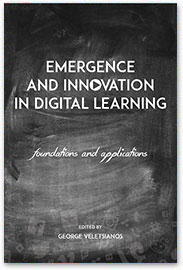 ‘m really pleased to share my latest open access publication – a jointly authored chapter with Amy Collier (Middlebury College, US) – which defines and explores the concept of ‘not-yetness’.
Ross, J. and Collier, A. (2016). Complexity, mess and not-yetness: teaching online with emerging technologies. In G. Veletsianos (ed), Emergence and Innovation in Digital Learning: Foundations and Applications. Athabasca University Press.
You can download the chapter directly and for free from http://www.aupress.ca/index.php/books/120258 (go to the “Free PDF” tab).
Amy and I have been writing and speaking about not-yetness for a couple of years now. Here are some related blog posts and other materials:
We are just finishing up a paper based on our OpenEd15 talk, and will be submitting this soon – stay tuned!
via jenrossity

I’m delighted to share my new journal article, which has just appeared online in Learning, Media and Technology. The article is available completely open access, so it’s free for everyone to download and share.
The article, titled ‘Speculative method in digital education research‘, explores the concept of ‘speculative’ (or ‘inventive’) methods, commonly found in art and design disciplines but also increasingly in the social sciences, and argues that digital education researchers need these kinds of approaches if we’re to engage critically and imaginatively with issues in our field. Such an approach, as Lury and Wakeford put it:
is explicitly oriented towards an investigation of the open-endedness of the social world.?…?the happening of the social world – its ongoingness, relationality, contingency and sensuousness. (Lury and Wakeford 2012, 2)
In the article I argue that the current educational research climate is at best ambivalent, if not actually hostile, to open-endedness. Work with Amy Collier on our concept of ‘not-yetness’ (see Amy’s recent blog posts on ‘not-yetness and learnification‘ and ‘not-yetness and love‘ for more on her latest thinking about the concept; and stay tuned for our chapter in George Veletsianos’ edited collection, coming in May) was helpful here in framing future directions for digital education research:
in such a sphere of not-yetness, we must work with approaches to research which aim beyond determining ‘what works’, to engage in ‘intelligent problem solving’ (Biesta 2010) and ‘inventive problem-making’ (Michael 2012). These approaches can produce valuable insights and contribute to a flourishing ecosystem of knowledge practices that can respond flexibly to not-yetness. (p.1)
The article draws on three examples of speculative method, coming from work in the Centre for Research in Digital Education:
Let me know what you think! And please do share the paper.
Speculative method in digital education research
Jen Ross, Digital Education, University of Edinburgh
The question of ‘what works’ is currently dominating educational research, often to the exclusion of other kinds of inquiries and without enough recognition of its limitations. At the same time, digital education practice, policy and research over-emphasises control, efficiency and enhancement, neglecting the ‘not-yetness’ of technologies and practices which are uncertain and risky. As a result, digital education researchers require many more kinds of questions, and methods, in order to engage appropriately with the rapidly shifting terrain of digital education, to aim beyond determining ‘what works’ and to participate in ‘intelligent problem solving’ [Biesta, G. J. J. 2010, “Why ‘What Works’ Still Won’t Work: From Evidence-Based Education to Value-Based Education.” Studies in Philosophy and Education 29 (5): 491–503] and ‘inventive problem-making’ [Michael, M. 2012, “‘What Are We Busy Doing?’ Engaging the Idiot.” Science, Technology & Human Values37 (5): 528–554]. This paper introduces speculative methods as they are currently used in a range of social science and art and design disciplines, and argues for the relevance of these approaches to digital education. It synthesises critiques of education’s over-reliance on evidence-based research, and explores speculative methods in terms of epistemology, temporality and audience. Practice-based examples of the ‘teacherbot’, ‘artcasting’ and the ‘tweeting book’ illustrate speculative method in action, and highlight some of the tensions such approaches can generate, as well as their value and importance in the current educational research climate.
http://www.tandfonline.com/doi/full/10.1080/17439884.2016.1160927
Ross, J (2016). Speculative method in digital education research. Learning, Media and Technology. Online First, Open Access. http://www.tandfonline.com/doi/full/10.1080/17439884.2016.1160927
via jenrossity
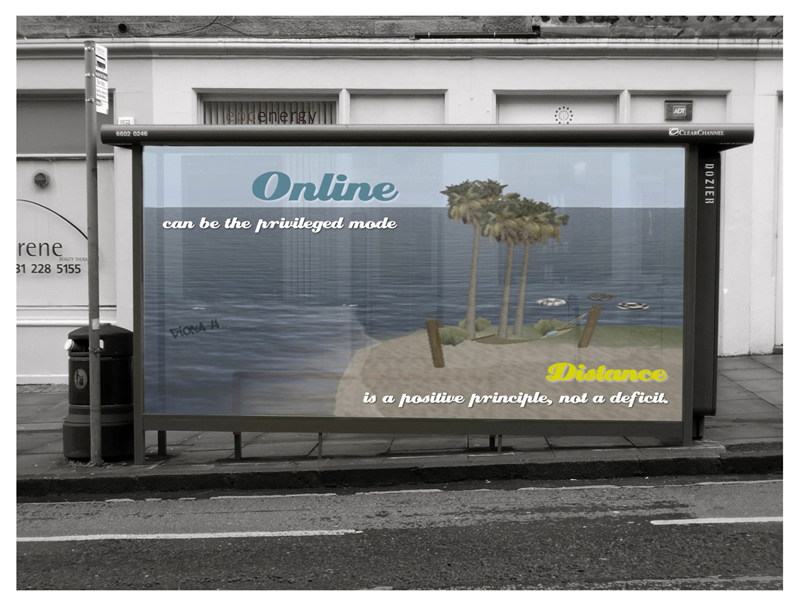
The Manifesto for Teaching Online is a series of short statements first written in 2011 by the Digital Education group at the University of Edinburgh. It was designed to articulate a position about online education that informs the work of the group and the MSc in Digital Education programme. It was also intended to stimulate ideas about creative online teaching, and to reimagine some of the orthodoxies and unexamined truisms surrounding the field. Each point was deliberately interpretable, and it was made open so that others could remix and rewrite it. In 2015, we revisited and reassembled the manifesto ourselves. The new manifesto text can be found here:
https://onlineteachingmanifesto.wordpress.com
I’m really looking forward to discussing and debating the new manifesto!
via jenrossity
The Artcasting project is a collaboration between Digital Education and Design Informatics at the University of Edinburgh, Scotland. Working together with the National Galleries of Scotland, Tate, and the ARTIST ROOMS Research Partnership, the project team is developing a new digital and mobile form of evaluation of arts-based engagement, in the context of ARTIST ROOMS On Tour.
Along with developing and testing artcasting, the project will engage with the cultural heritage education community to share and generate ideas about evaluation, digital engagement and learning.
Funding for artcasting comes from the AHRC, and the project runs from May 2015-April 2016.
via jenrossity
Last spring, Amy Collier and I gave a talk at the Emerging Technologies for Online Learning conference in Dallas, called ‘Mess in Online Education‘. We were delighted to then be invited by George Veletsianos to contribute a chapter on a related theme to the second edition of his ‘Emerging Technologies in Distance Education’ edited collection, currently in press (due late 2015). In the first edition, George defined emerging technologies as being, amongst other things, ‘not yet fully understood’ and ‘not yet fully researched, or researched in a mature way’ (Veletsianos 2010, p.15). In writing our chapter, Amy & I landed on the idea of ‘not-yetness’, and this has turned out to be a fantastically useful and generative concept for us.

Our chapter focuses on not-yetness as it relates to complexity and mess in teaching online:
digital practices contribute to the fruitful mess that characterises education, casting new light on issues of power, responsibility, sustainability, reach and contact. …a key element of emerging technology is its not-yetness: there is so much we do not know when we engage with these technologies. We must therefore choose to dwell as teachers in [a] state of radical and enduring uncertainty …We need practices that acknowledge and work with complexity to help us stay open to what may be genuinely surprising about what happens when online learning and teaching meets emerging technologies. (Collier & Ross, in press)
We’ve since separately been talking about not-yetness at conferences and events, and for each of us the concept has begun to send out new roots and shoots. Amy blogged eloquently about her take a few days ago:
Not-yetness is not satisfying every condition, not fully understanding something, not check-listing everything, not tidying everything, not trying to solve every problem…but creating space for emergence to take us to new and unpredictable places, to help us better understand the problems we are trying to solve.
– http://redpincushion.us/blog/teaching-and-learning/not-yetness/
She describes ‘the play, the fun, the opportunity in complexity and not-yetness’, and argues that ‘the ill-defined, the un-prescribed, the messy can lead to the unexpected, the joyful’.
Not-yetness has become an important part of my thinking this year about digital education practice and research. As I’ve moved towards the end of my time as programme director of the MSc in Digital Education, I’ve been inspired by the idea of the ‘edges’ of digital education: where I think we need to stay to make sure that what we do remains distinctive and relevant as the educational ground continually shifts. At our MSc away day last year, we grappled with the edges of digital education in a team session which went on to generate the Online Professional Learning Incubator, a ‘micro credits’ course called Open Themes in Digital Education which is currently working its way through the university approval process, and new collaborations and projects on playful analytics and MOOC reuse. These edges require not-yetness, and the openness to uncertainty and surprise it brings.
Then I was invited to give a plenary talk at a seminar in Limerick, Ireland called ‘Building an evidence base for enhanced digital pedagogy for online learning‘, and in thinking about evidence-based practice and the nature of evidence more generally, I found not-yetness a useful critical tool for considering what happens at the edges of digital education research.
I’m exploring that further in an in-progress journal article about how we can do research that helps us engage in ‘intelligent problem solving’ (Biesta 2010) and ‘inventive problem-making’ (Michael 2012) in digital education, where we have a particular need for methodological approaches that can grapple with not-yetness. One such set of approaches is known as ‘speculative design’, ‘speculative method’, or ‘design fictions’. These approaches are aimed at envisioning or crafting particular futures or conditions which may not yet currently exist, to provoke new ways of thinking and to bring certain ideas or issues into focus. Wilkie, Michael and Plummer-Fernandez (2014) describe a speculative method involving the creation of a series of ‘Twitter-bots’ to participate in exchanges about environmental issues, and they characterise these bots as:
methodological interventions that are overtly constitutive of the material that is gathered, but in ways that are open, ambiguous or troublesome. In triggering such responses, the aim is to access new and emergent formulations of the ‘issues at stake’… (p.2)
This is, I think, a lovely way of understanding not-yetness. And in fact my own experience with twitterbots this year (the EDCMOOC teacherbot, generated from a project led by Siân Bayne) echoes this concern with new ways of formulating ‘issues at stake’, in this case the nature and role of the digital teacher.
Now I’m about to put not-yetness into practice in a different context, as May sees the start of a new research project (Artcasting, funded by the AHRC and working with the ARTIST ROOMS research partnership partners, including National Galleries of Scotland and Tate) that will use mobilities theories and speculative design approaches to examine and help to rethink how gallery educators can evaluate visitors’ engagement with art.
I look forward to seeing how not-yetness keeps evolving in light of the experiences we’re having and feedback we’re receiving as we discuss and work with this concept.
References:
Biesta, G.J.J., 2010. Why “What Works” Still Won’t Work: From Evidence-Based Education to Value-Based Education. Studies in Philosophy and Education, 29(5), pp.491–503.
Collier, A. & Ross, J., in press. Complexity, mess and not-yetness: teaching online with emerging technologies. In G. Veletsianos, ed. Emerging Technologies in Distance Education, 2nd edition. Athabasca University Press.
Michael, M., 2012. “What Are We Busy Doing?” Engaging the Idiot. Science, Technology & Human Values, 37(5), pp.528–554.
Veletsianos, G., 2010. Emerging Technologies in Distance Education, Athabasca University Press. Available at: http://www.aupress.ca/index.php/books/120177
Wilkie, A., Michael, M. & Plummer-Fernandez, M., 2014. Speculative method and Twitter: Bots, energy and three conceptual characters. The Sociological Review, 63(1), pp.79-101.
via jenrossity
In late 2013 the Digital Education group was invited to produce a spotlight issue of the journal TechTrends. This has just been published! You can find it here:
http://link.springer.com/journal/11528/59/1/page/1
As Sian and I wrote in our editorial:
We were delighted to be invited to create a spotlight issue of TechTrends, bringing together research from the Digital Education research group at the University of Edinburgh, Scotland. This group includes members involved in the online Masters in Digital Education programme, MOOC developments at the University of Edinburgh, including the E-learning and Digital Cultures MOOC, authors of the Manifesto for Teaching Online, as well as our Children and Technology group, and Learning Analytics strand.
The group is diverse, and this diversity is reflected in the contents of this spotlight issue. From app design for children with autism, to how reflection is changing in information-dense environments, to students’ views of academic writing in the digital age, to patterns of participation in MOOCs, this spotlight issue is held together not by a single theme or a topic, but by a shared curiosity about what is happening to learning and education as more and more of our experiences are mediated by digital practices and technologies.
The other key thing that brings the articles in this issue together is this: the authors strongly believe that those of us who are immersed in and excited by the possibilities of technology and education are uniquely placed to ask critical questions about it. As knowledgeable insiders, we can and must examine our own and others’ practices, and challenge assumptions and oversimplifications about educational change in a digital age. These papers share this critical take, and aim to treat emerging technology trends as a generative site for asking big questions.
One key source of big questions is ‘big data’. In this issue, Hamish Macleod, Jeff Haywood, Amy Woodgate and Mubarak Alkhatnai examine some common assumptions made about MOOCs, and find these are not always backed up by participation data from the University of Edinburgh’s massive courses. Jeremy Knox experimented with sensors to explore the boundaries between the human and non-human in the production of data, with interesting implications for future directions for learning analytics. Dragan Gaševi?, with his co-authors Shane Dawson and George Siemens, challenge the educational usefulness of measurement and prediction of student outcomes through learning analytics, where these analytics are not well-grounded in educational theory and practice. And big data of a different kind – the digital artifacts we collect and learn with – is the focus of Tim Fawns’ exploration of how we engage with information online. He argues that the scale of these collections, and their importance in our lives, now require approaches which combine selectivity and digital creativity to make reflection central to our strategies for coping with information overload.
Another important dimension of learning and technology is how established practice and theory might be challenged and changed by the incursions of the digital. Philippa Sheail argues that the taken-for-granted concept of the ‘meeting’ undergoes some profound transformations when applied to different sorts of digital environments. Andrew Manches, Pauline Duncan, Lydia Plowman and Shari Sabeti take a close look at the development of children’s games to incorporate them into an emerging Internet of Things (IoT). They examine how children engage with IoT-enabled toys linked to the popular games Skylanders and Disney Infinity, and reflect on the ethical and practical implications of changing children’s relationships with everyday things. Peter Evans’ research into professional learning in social media environments shows how these technologies challenge concepts of autonomy and learner control usually thought of as central to personalisation.
Finally, what is still emerging hasn’t yet become routine and invisible, and so can be particularly useful in defamiliarising our world as educators. Once things become ‘black-boxed’ (ref), they disappear from view, and examining new educational technologies, concepts and practices can sometimes crack that box open, letting us make the familiar productively strange. Christine Sinclair takes student perspectives on academic writing as a starting point for exploring the changes which might be coming in scholarship and rethinking the idea of ‘dialogue’ for a digital context. Sue Fletcher-Watson provides an analysis of the development of mobile applications for children with autism, questioning traditional relationships between researchers and developers in the process. She proposes ways for academic researchers, families and consumers, and commercial developers to work together to ensure that both the evaluation and development of these emerging technologies make use of the best available evidence.
As we have engaged as editors with the papers in this spotlight issue, we have come to feel that the different topics, approaches and concerns of our colleagues accurately reflect the richness and diversity of the field of digital education itself. Psychology, cultural studies, literature, sociology and organisation studies are all in evidence as disciplinary perspectives here. We hope that you will find, as we have, that this bringing together of perspectives is invigorating and inspiring, and offers you some fresh insights into your own matters of concern.
via jenrossity
My latest paper, just published in Computers & Composition, has been made available by the publishers on an open-access basis until 1 December 2014, using the link below.
Ross, J. (2014). Engaging with “webness” in online reflective writing practices. Computers and Composition, 34, 96-109. http://authors.elsevier.com/a/1PvdMV6mkzOlZu
The article argues that online reflective practices in higher education produce tensions around ownership, control, and safety. Reflective writing pedagogies, commonly grounded in a humanist philosophical tradition, often value coherence and authenticity. Writing online, however, opens students and teachers to the sorts of questions and uncertainties about subjectivity, ownership of data, privacy, and disclosure that characterize the online context. This is the case no matter how much teachers try to protect students or deny the “webness” of their reflective practices. The article draws on qualitative data from interviews with students and teachers in higher education in the United Kingdom. It argues that engaging with digital traces calls for a different approach to reflection, and proposes the “placeholder” as a way to privilege fragments, speed, and remixability in a reflective writing context.
via jenrossity
Next week I’m fortunate to be involved with two digital education conferences, and wanted to post about them both, because they’re both very dear to me.
From Monday 7th, my colleagues and I are proud to be the local hosts of the Networked Learning conference in Edinburgh. This is, in my opinion, the best conference for hearing about new approaches to networked/digital/online education theory. This year the keynotes (from Neil Selwyn and Steve Fuller), symposia, and papers look outstanding. I’m missing my own symposium on Wednesday, on ‘the spaces of networked learning‘ which is upsetting, because it’s going to be amazing. But Phil Sheail, my paper co-author, is planning an excellent short talk based on our paper: Disrupting the illusion of sameness: the importance of making place visible in online learning.
The reason I’m missing it is because I’m heading to Dallas, USA, for my third year of Sloan-C’s Emerging Technologies for Online Learning. I have this conference to thank for introducing me to some wonderful collaborators, including Amy Collier, with whom I’m giving a plenary talk on Friday morning: Mess in Online Education – How it is, how it should be. I’m also getting the opportunity to think about my career (!), as I join a panel discussion about ‘the role of faculty and professors in educational technology’.
So – an eventful week, the end of which will find me with my dear sister, the other Dr Ross, exploring the sights of DC. I’m promised cherry blossoms.
If we’re overlapping next week in Edinburgh or Dallas, I look forward to seeing you!

http://upload.wikimedia.org/wikipedia/commons/3/3c/Newark_cherry_blossoms.jpg
via jenrossity
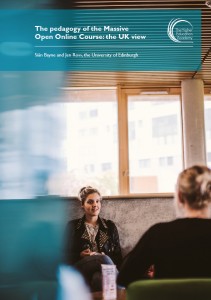
Last autumn, Sian and I were commissioned by the Higher Education Academy in the UK to write a report about MOOC pedagogy. The report has been published today, and is available to download.
The report details the UK MOOC landscape, and shares findings from interviews with MOOC teachers.
The three key concluding messages the report emphasises are:
via jenrossity
I decided in the end to make a new space for the parliament engagement fellowship – it can be found at http://onlinelearningscotland.tumblr.com . It’s mainly reflections and observations about my public/parliament engagement experiences. But I’ll also post news there of the projects I’m working on during the fellowship.
via jenrossity
I wanted to share links to the PDFs of the National Museums Online Learning Project ( http://www.vam.ac.uk/about_va/online_learning/index.html ) research reports, produced by the research team at the University of Edinburgh.
The final report coincided with the end of the project in Spring 2009. The NMOLP resources - WebQuests and Creative Spaces - continue to be developed, however, and the final report takes this into account.
Bayne, S., Ross, J., Williamson, Z. (2009) National Museums Online Learning Project final report. University of Edinburgh. http://www.malts.ed.ac.uk/staff/sian/nmolp/finalreport.pdf
Here are the earlier reports:
Bayne, S., Ross, J., Williamson, Z. (2007) National Museums Online Learning Project Stage one report. University of Edinburgh. Viewed 25 April 2009. http://www.malts.ed.ac.uk/staff/sian/nmolp/stage1.pdf
Bayne, S., Ross, J., Williamson, Z. (2008) National Museums Online Learning Project Stage two report: part 1, Creative journeying: portraits of our users. University of Edinburgh. Viewed 25 April 2009. http://www.malts.ed.ac.uk/staff/sian/nmolp/stage2creativespaces.pdf
Bayne, S., Ross, J., Williamson, Z. (2008) National Museums Online Learning Project Stage two report: part 2, Watching, gaming, learning: webquest contexts of use. University of Edinburgh. Viewed 25 April 2009. http://www.malts.ed.ac.uk/staff/sian/nmolp/stage2webquests.pdf
We would welcome any comments!
[Update 20 July] - Should have put links to the resources in the first time! There is an entry point for each resource from each of the nine partner sites, but these will get you started:
Creative Spaces: http://www.vam.ac.uk/activ_events/adult_resources/creative_spaces/index.html
Webquests: http://www.vam.ac.uk/school_stdnts/schools/pupils/webquests/index.html
This is a call for applications for a PhD studentship at the University of Edinburgh: co-supervised by Sian Bayne, the principal investigator on the National Museums Online Learning Project research strand.
School of Education, University of Edinburgh, UK
Royal Commission on the Ancient and Historical Monuments of Scotland (RCAHMS), UK
This studentship, fully funded by the UK Arts and Humanities Research Council, with additional funding from the collaborating partner, will support three years of full-time study. The student will investigate how the internet is changing the way users engage with, and learn from, the collections of cultural institutions, with supervision provided by Dr Sian Bayne (University of Edinburgh) and Ms Rebecca Bailey (RCAHMS).
Basing the study on the online education and outreach activities of RCAHMS, the broad remit of the project is to explore how new online media environments change and challenge the curatorial and outreach responsibilities of museums, galleries and archives.
The studentship covers all UK fees, and includes an allowance of £12,940 per academic year, plus an additional annual £1,500 maintenance payment provided by the AHRC and RCAHMS. Students may also be eligible for UK study visits and one overseas study visit as well as one overseas conference for the duration of the award. For eligibility criteria, see the AHRC web site at: http://www.ahrc.ac.uk/apply/postgrad/postgrad_details_d/eligibility.asp
For fuller details of the proposed project, and the application procedure, please see: http://www.education.ed.ac.uk/e-learning/ahrc.pdf.
To discuss the project informally, please contact Mrs Pam Holgate, University of Edinburgh (0131 651 6120, pam.holgate@ed.ac.uk) or Ms Rebecca Bailey, RCAHMS (0131 662 1456, rebecca.bailey@rcahms.gov.uk).
Applications should be submitted by 13 June 2008, and we anticipate that interviews will be held during the week of 7th July.
University of Edinburgh: http://www.ed.ac.uk
Royal Commission on the Ancient and Historical Monuments of Scotland: http://www.rcahms.gov.uk
I had to miss Wednesday, the last day of the conference, but had an action-packed final day myself on Tuesday.
The first presentation I saw was on museum learning and virtual worlds. I felt the presenter (Lea Kuznik, from the University of Ljubljana) could have taken time to link her theoretical framework (Gogola's experiential pedagogy and 'peak experiences') to her overview of virtual worlds. I think it could have been a fascinating paper about what a 'peak experience' might be in such a digital environment. I hope she carries on with this research - I'd like to hear about it again when it's a bit further down the road.
I was tremendously impressed by Edith Doron's paper (she is doing her doctoral research at the University of Aberdeen) on "building a Sukkah for the museum". It was about how a children's museum can engage in a responsibility to the other - a responsibility she described by quoting Edmond Jabès:
"On this side of responsibility there is solidarity. On the other, hospitality."
Her talk was largely about hospitality, and what it might mean for the museum to be a stranger among strangers, rather than a facilitator of discussion "between us about them". A Sukkah (I learned) is a booth or hut (purposefully rickety) which Jewish families build after Yom Kippur - a temporary ritualised dwelling space. The Sukkah celebrates harvest and commemorates the exodus of Hebrew slaves, and it architecturally stages the act of hospitality. It has to be an exposed space where there is an inevitability of encounter with strangers. Families have to leave the solidity of home and dwell in uncertain space. The other is not invited in by the 'potis' (master), but is invited in by an exile: the "turn toward outside is from the outside". She argued that such a metaphorical (or real, in the case of the Brooklyn Children's Museum, where Edith worked, or the Jewish Museum in Berlin) space can help museums to rethink belonging and otherness, and their place in the communities they serve.
For me the link here to the online museum is strong: the online museum itself could be a Sukkah. Rather than attempting to regulate or dominate digital space, museums could allow themselves to be in exile along with their online communities. Perhaps to treat the web as a distinctively strange and different space, rather than a bolted on, lesser version of the material museum, would be to engage with old (new) notions of hospitality in something of the way that Edith described.
I also had a number of good conversations with various interesting people on Tuesday, which is why I don't have many papers to report on! That and the repeated cancellations of things I was going to. I haven't written about everything, though, and I may find time to write more over the next few days.
Emerging into the sunshine I discovered something new had sprung up during the day.

I'm working on a paper for the Inclusive Museum conference in Leiden in June. The paper will focus on inclusive online museum learning, and the National Museums Online Learning Project in particular. It's structured around four key concepts: reach, relevance, relationship and recontextualisation, and touches on themes of the digital vs physical museum, the shift in museum learning from a focus on objects to a focus on users, what 'quality' means in online learning, tensions in schools between creativity and performativity, and social media and its relationship with institutional authority - all themes which have emerged so far in our research with the NMOLP.
Our experiences with this project have highlighted a number of creative tensions around openness and authority, insiders and outsiders, and control (who has it, who wants it...). It's interesting to think about how these issues might evolve as social media and user-generated content make their way from the margins to the centres of cultural institutions.
I really enjoyed Ross Parry's semantic web session at Museums and the Web in Montreal - the idea of the machine-readable web (web 3.0?) is pretty compelling and exciting. But even more interesting (to me! and sad, perhaps), is thinking about how institutions (museums, universities, schools) might use/co-opt/learn from/change/be changed by the digital environments they venture into. I often find that conversations about the digital/social/user-generated content in institutions - even those which start off innocently enough - end up being about the nature and purpose of those institutions. That's why I find e-learning such an exciting field to be involved in, I think.
I think today was about the personal for me. It started with a really nice chat over breakfast about people's personal attachment to museums and museum spaces - I shared a story from one of our recent NMOLP research reports with the president of ICOM - eep! - which probably got me thinking along these lines to begin with.
Then I went to Marcus Wood's keynote. He gave a moving and complex talk about museum narratives of the mass trauma of slavery, and their focus on the wounded slave body and instruments of torture, followed by the heroic story of emancipation and abolition. He contrasted this with the National Great Blacks in Wax Museum in Baltimore, Maryland, with its extremely explicit, intimate and creative depictions of mass trauma. He focussed in particular on an installation about lynching, and drew some interesting parallels between strategies the curators used in their exhibit and other artistic and cultural moves both past and present. He then linked this to Brazilian museums' approaches to the display of memory of slavery and their syncretic use of religious iconography and images of slavery, and the transformation of everyday objects (Barbie as Yemanja was particularly cool). I went afterwards to his "garden session" (held in a 2nd floor lobby...), where the conversation about the Martins, who created the NGBiWM, and their passion and commitment to telling this story and to their 'family of ancestors', got me thinking about how powerful the urge to collect, interpret and narrate is for some people. The web may make it easier for some to do this, but the impulse is not new. I already knew that, but sometimes it takes a concrete example before I Know it.
I got three more examples before long, in a talk by Donald Lawrence from UBC called "vernacular practice in the personal museum". His main examples were two personal museums in the Netherlands (both fascinating stories!), but he started off by talking about Sir John Soane's museum in London, which is one of the partners in the NMOLP and a place I really loved when I visited it. Of course Soane had buckets of money with which to indulge his passion for collecting, but the other personal museum creators I heard about today definitely didn't. This is real DIY stuff - uncomfortably chaotic, messy, and 'ugly' (as Lina Bo Bardi would have it, I learned today!).
Also today Elizabeth Mix talking about Fred Wilson's interventions in museum spaces - bringing pieces from collections together in new ways, and offering critiques of museum practice in the form of jarring juxtapositions, retitling, addition of artefacts and changes of staging. Her talk was full of great examples and interesting connections. However, a curator in the audience asked what lessons should be taken from Wilson, and Elizabeth's answer (that labels and barriers should be rethought, objects grouped differently) seemed to me to miss a point I took from what I saw of his work: that there is always an intervention, a reorganisation to be done, gaps and silences to fill in - not that there is a 'right' way to stage an exhibition, or that we should all follow Wilson's example... anyone else have a view about this?
I'm going to go out and find something nice to eat, now. Hopefully I'll fancy something besides pancakes...
At Lynda's suggestion, I thought I'd make a few notes here for those unlucky enough not to be in glorious Leiden at the first International Conference on the Inclusive Museum.


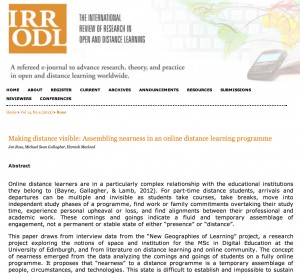
This short paper was written in the context of the “New Geographies of Learning” project, and draws on data generated ininterviews with participants on the MSc in Digital Education at the University of Edinburgh. It was written with Michael Sean Gallagher and Hamish Macleod.
The IRRODL journal is open access, so you can read the paper in full on the web site.
http://www.irrodl.org/index.php/irrodl/article/view/1545
via jenrossity
I’m delighted to have been appointed as a Beltane Parliament Engagement Fellow in the autumn. I’ll be developing engagement events for Members of the Scottish Parliament (MSPs) and other parliamentary colleagues, on the topic of “Distance and online learning for an innovative and inclusive Scotland”. The fellowship will be starting at the end of September, and will run til the end of March. I got to attend a working dinner at the Parliament back in June, and started to get a sense of the many interesting topics and issues that the fellowship will raise.

MOOCs were on the agenda, of course, but also the Scotland’s Futures Forum 2025 project, and broad questions about what quality online education really means, and what Scotland should be doing to achieve it. I’ll start a project blog closer to the time, but in the meantime, feel free to be in touch if you’d like to discuss anything further re this.
Another fun thing on the horizon: my colleagues Hamish and Sian and I are taking part in the Cabaret of Dangerous Ideas – part of the Edinburgh Fringe. Our event is on 22 August at 3:30pm, and our topic is “The Disembodied University”. We’d love to see you there!
via jenrossity
I’m hastily blogging this ‘placeholder’ idea before I forget about it in the whirlwind that is #et4online.
The EDCMOOC teaching team has been discussing how to make the peer assessment process better. One thing we know we want is for people to be able to give feedback on the feedback they receive from peer markers.
At the same time I’ve been reading Accelerando (Charles Stross) – part of the premise of that book is a future society based on economics of reputation (Cory Doctorow writes about this as well in Down and Out in the Magic Kingdom – and maybe others that I can’t remember at the moment).
So, the bare bones of the idea as it sits at the moment is to:
a) let people gain reputation throughout the MOOC, and display this next to feedback they provide on peer assignments, so that those receiving the feedback would have one way of ‘reading’ that feedback.
b) give people with high reputation scores the ability to vet/filter/’assess’ peer feedback before it is delivered – perhaps returning comments to the feedback provider, or even asking them to expand, or rephrase…
Challenges I can think of immediately include:
– how can all the activity of the MOOC (which for us includes a lot of social media, blogging, twitter activity) contribute to a reputation score?
– how can a reputation score be meaningful in learning terms? Could people gain reputation on a number of metrics (constructive; challenging; insightful; knowledgeable)? Need to find out more about different approaches to this…
Amy Collier (sitting at the table across from me at this moment!) tells me that Venturelabs is working with reputation in their group-based MOOC platform, so there is a basis for this in MOOC developments.
Ideas or comments very welcome…
via jenrossity