

Along with the other teachers on the E-learning and Digital Cultures MOOC (#edcmooc), I’ll be blogging for the next five weeks at http://edcmoocteam.wordpress.com – our thoughts on the MOOC as it evolves, the first-time MOOC teacher’s perspective, and whatever else strikes us as relevant.
The MOOC has been gathering steam for the past couple of months, as participants began to meet, network and build support structures to make the most of their time on course. Now that the MOOC has launched, with 40,000 people enrolled, the way that these networks are starting to engage with the content we have developed is bound to be fascinating. I’m also very interested to see how these networks expand to welcome newer participants, and how those newer people experience that welcome.
One of my favourite participant-built environments so far: the EDCMOOC map – which has had to be locked for the time being because there were too many pins!
via jenrossity

Quite inadvertently, I’ve become immersed, and interested, in MOOCs this year. It started with the work of Jeremy Knox, whose PhD research I’m supervising, and who’s doing some fascinating work around open online education. He’ll be in various places over the next few weeks, including #ir13 tomorrow for an ignite session; and at the forthcoming SRHE/University of Edinburgh event “Critical Perspectives on Openness in the Digital University“. I like how Jeremy is applying critical and posthumanist perspectives to the MOOC, and I really like how he’s working to put his research in the path of his posthumanism: developing creative and interesting ways to let elements of his learning network – like books and rooms – contribute to the data his project is generating.
I’m also part of a team developing one of the first MOOCs at the University of Edinburgh – E-learning and Digital Cultures, which will run for the first time in January 2013. Along with developing a great MOOC (of course) which is based on some of the ideas from our MSc in E-learning course of the same name, we’ve been working hard to understand what the MOOC can – and can’t – accomplish; what scale and the ‘massive’ might be good for; and how we should think about the role of the teacher in “MOOC pedagogy“. As my colleague has said, the powerful hype around MOOCs can make it difficult to sort out what is actually going on here. More research – and a variety of kinds – in this area is clearly needed. (in that vein, I’ve been very fortunate to have met and had some delightful conversations with Amy Collier at Stanford University, who (along with her doctoral students) is beginning what seems like important work in analysing MOOC data.)
People are already lamenting the MOOC as a flash-in-the-pan, but that doesn’t trouble me (then again, I still love what we do with our students in Second Life, so maybe I welcome the stage after super-hyped-ness). It’s clearly making a new sort of space for what continue to be vital conversations about what contact means, about presence and pedagogy, and about the nature of higher education, and these are things I like to think and talk about.
via jenrossity
I’m heading to Las Vegas today for the Sloan-C Emerging Technologies for Online Learning conference. I’ve been invited to run an unconference workshop for making a manifesto, which will be great fun, and a fantastic opportunity to build on what we learned in developing our manifesto for teaching online. The unconference is happening on Friday afternoon, 12:30-3:30pm (EST). Along with the details on the conference site, there’s also a Google+ unconference page with the latest news. Conference participants are all invited to attend – virtually or face-to-face.
Once I get to Vegas, I’ll be spending my time meeting people and attending sessions, of course, but also chatting to people about teaching with emerging technologies, and what it means to be, or have, a teacher in these new contexts. If you’re at the conference, and have something to say about that, tweet me (@jar), message the unconference page (+et4ol unconference) or find me in person!
(ps – another post to follow soon, about the Coursera MOOC that my wonderful colleagues and I are developing – it’s emerging from a popular MSc in E-learning course that I’ve taught for the past three years. In the meantime, read more about the University of Edinburgh’s MOOCs.)

via jenrossity
For the benefit of those who weren’t able to be there (and for my own use later), I liveblogged John Urry’s talk at the ProPEL conference in Stirling on 10 May 2012.
http://www.propel.stir.ac.uk/conference2012/speakers.php
New Mobilities Paradim, John Urry, Centre for Mobilities Research at Lancaster University.
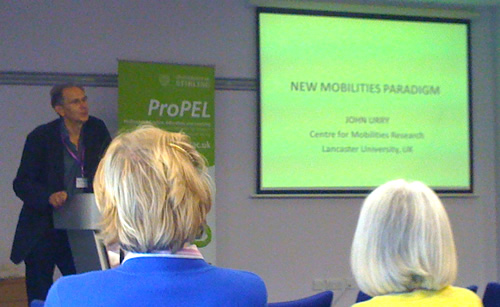
John’s work has been about trying to mobilise the social sciences and develop a mobilities turn, to draw out how so many aspects of social life presuppose intermittent mobilities.
However, some of the empirical processes involved are problematic – will mobility as we understand it continue forever, or is it of a specific moment?
Tolstoy on “other contrivances” for transporting people – but “never able to commit anything but evil” in the process.
In 1800 people people in the US travelled 50 metres a day, by foot, horse and carriage. Now they travel 50km a day, mostly by car and air. But distance does not necessarily = time – a bit more than an hour a day gets you further than it used to.
World citizens move 23 billion km each year. This may quadruple by 2050.
How did this come about?
1839-41 – new and interdependent systems came into play, mainly in England and Scotland: telegram; national post; first railway age; first package tour (Thomas Cook); first Baedeker guide; first scheduled ocean steamship service; invention of photography. Forms of mass movement – not just technical, but coming together in a system. Systemness is particularly striking. A shift in the way in which environments were understood and experiences as land –> landscape (influenced by the tourist gaze).
The pleasures and uses of movement are interestingly interlinked.
Mobilities paradigm:
1. all social relationships involve diverse ‘connections’, some at a distance.
2. these stem from five interdependent ‘mobilities’: corporeal travel of people; movement of objects; imaginative travel; virtual travel; communicative travel (telephones, SMS, letters, etc.). These different forms of movement intersect.
3. physical travel involves lumpy, fragile, aged, gendered, racialised bodies.
4. on occasions and for specific periods of time face-to-face connections are made. There is still something significant about this. Five processes generate face-to-faceness: legal, formal obligations to attend; social obligations to meet and converse, often involving strong expectations of presence and attention (Goffman); obligations for co-presence to sign contracts, work on or with objects, written or visual texts; obligations to be in and experience a place directly; obligations to experience a live event.
5. many kinds of social practices that presuppose movement.
6. distance generates many problems for the sovereignty of states (groups on the move are particularly problematic)
7. part of what produces the heterogeneity of social life are material objects
8. crucial to these is the idea of affordances
9. the significance of systems for organising mobilities
10. mobility-systems are organised around processes that circulate people, objects and information at various spatial ranges and speeds
11. these various mobility-systems and routeways linger over time (canals)
12. mobility-systems are based on increasingly expert forms of knowledge
13. mobilities presuppose ‘immobilities’. Some people have to be immobile so other people can move around.
See journal “Mobilities” for examples of taking up and elaborations of these characteristics.
Some trends:
People’s lives are more spread out, so scheduled visits and meetings become more important (and meetings about meetings about meetings; a whole technology of meetings, diaries, calendars). Proliferation of locations, tech and systems to facilitate meetings.
Social networks are accomplishments, in process, weaving together material and social.
People are traveling further to accomplish their meetings.
Relational commitments are crucial to travel choices.
The greater the distances traveled, the longer the meetings will last.
Overall, “friendship miles” “family miles” “business miles” and so on become necessary in order to be a *good* social actor. These set up really strong obligations – “the gift of travel time” that shows your commitment to the people/group in question.
Zygmunt Bauman: “Mobility climbs to the rank of the uppermost among coveted values” – stratifying factor (Liquid Modernity) –> leads to the concept of “Network Capital” (Urry). In order to be good at networking, that presupposes an array of material and other resources, people to visit, movement capacities, ability to locate information, meeting places (including places en route), communication devices, time to manage and co-ordinate (especially when things go wrong). There is a large array of mobilities (many modalities) – much more complicated than govt statistics (business vs leisure) would indicate.
So: what are the future challenges for mobilities? 3 issues: Oil; climate change; China. These issues will be transformative of mobility systems.
OIL: Almost all mobility systems are dependent on one resource. 95% of transportation energy is oil-based. “almost free” resource transformed the US. Oil uniquely makes possible our mobilities. It also has made possible the movement of goods and the manufacture of goods (including food); heating. And it is running out. Continued growth of mobility processes becomes much more complicated.
CLIMATE CHANGE: increases in temperature make mobility systems more complicated and increase costs.
CHINA: China’s emissions are small per person, but growing rapidly; private cars are rising 22% each year and growing. 200 people/vehicle (1990) –> 48 (2004)
But is a reversal underway? A modest decline in US vehicle miles travelled in 2008. “Peak travel” – long term continued increase in scale and rate of movement may not continue forever. Are lots of things peaking? eg: young people in western countries are less likely than previously to have a driving license or own a car.
It takes a lot of time to introduce new energy systems – only once a century (historically) (US National Intelligence Council)
James Lovelock: “So is our civilisation doomed, and will this century mark its end with a massive decline in population, leaving a few survivors in a torrid society ruled by warlords on a hostile and disabled planet?” (will it be like Mad Max 2?)
QUESTIONS:
A remark: If US citizens wouldn’t buy so many military style vehicles, the wouldn’t depend on oil imports… why do people want to drive these things? John: the US system has been characterised (by George Bush) as ‘addicted’ to a particular lifestyle. Disagrees that oil import would be eliminated in this way, though. But the data about young people is interesting – this is not their ambition – maybe a tipping point. But in China the tipping point is going the other way – large vehicles are particularly desired.
Question: Latour discussed how geologists have named our time ‘anthropocene’ – instead of being concerned with the post-human, we should be concerned with post-nature. What implications does this have for our research strategies? John: originally this term was to do with the use and extraction of fossil fuels. The significance of energy for social thought and theory has not been explored enough (but special issue of Theory, Culture and Society addressess this). The rise of the west was dependent on fuel – ‘societies beyond oil’ – we need to think about what comes after… maybe it’s nothing.
via jenrossity
I was due to present a paper at the recent Networked Learning conference in Maastricht – one of my favourite conferences! – but unfortunately at the last minute wasn’t able to attend. However, the paper is available on the conference site, so I thought I would link to it. It’s based on the conclusion of my PhD thesis, and is about how we might think about reflective practices in a specifically digital context. It introduces the idea of the ‘spectacle’ and the ‘placeholder’ as useful concepts for reflection’s digital futures. I really want to do more work in this area, so this is definitely a future research direction for me. I’d like to hear from others who are interested in theorising digital reflective practices.
http://www.networkedlearningconference.org.uk/abstracts/ross.html

via jenrossity
One of the outputs from the Student Writing Online Project was our manifesto for teaching online. It’s a set of statements that try to capture something of what is generative and exciting about teaching at a distance, and in digital environments.
The manifesto has had some press in the past few weeks, and it’s been exciting! Its web site is at http://onlineteachingmanifesto.wordpress.com/
Here’s a video interpretation of the manifesto, created by James Lamb.
via jenrossity
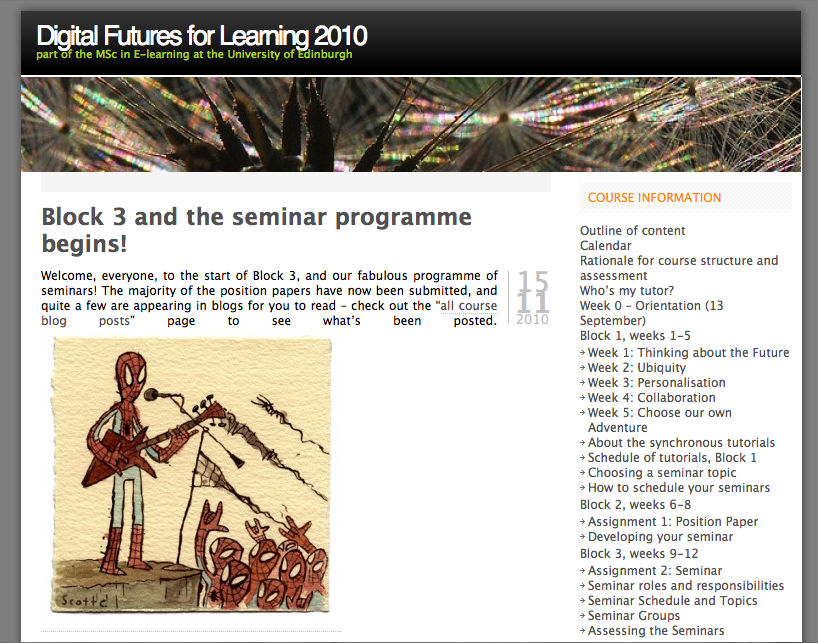
My option course on the MSc in E-learning is called “Digital Futures for Learning“. It’s a great course (if I do say so myself!) which is designed around student-developed and peer-assessed online events on topics relating to the core themes of the course. It means that we always have a chance to learn about and discuss the very latest developments in the field, as students are developing their events and position papers about 2 weeks before they lead them.
The course runs every two years, and it’s due to run again in September. Last time (in 2010) it was built on three broad themes:
ubiquity
personalisation
collaboration
and we read about issues related to mobile learning, the internet of things, remix, the politics of personalisation, and so on. Students produced amazing seminars on topics including the ethics of research in augmented environments, augmented reality and blended learning, ‘rip mix burn’ and learning, and controller-free technology. One of the seminar archives is here.
This year, I’m thinking that the themes might be ubiquity and openness (to bring in edupunk, Open Educational Resources, big data and so on) – wondering if we need a third, as these two cover so much ground. Still considering – comments welcome!
via jenrossity
Here is the Prezi from a presentation I gave this week at the IT Futures conference in Edinburgh.
It’s based on this book chapter. Of course I can’t take credit for the cartoons! But the student and teacher quotes are all (anonymised) from my PhD interview data.
via jenrossity
It’s been a while since my last post, but in the interim I had my viva (examination) and am pleased to say that it went well! And I’m even more pleased to say that it’s all over. Hooray!

Very early on in my research I started to explore the idea of the ‘mask’ as a useful metaphor for high-stakes online reflection. A mask is artificial, in the sense that isn’t a natural part of the body, but it has a profound relationship with identity and with the idea of the face. That relationship has been explored in theatre, anthropology, sociology, literature and culture. Like the experiences of students and teachers, the mask turned out to be complex, and by the time I came to analyse my data I had identified six mask ‘genres’. These have structured my thesis. I’ve written about them a bit in this blog, and there’s a recently published paper of mine that describes them in some detail. In this post, I’ll describe how the mask metaphor worked, and what issues I focused on in the research.
The six mask types I used were: performance, trace, disguise, protection, discipline and transformation. Each of these helped me think in a different way about my data, and about what I was trying to do in arguing for a different kind of approach to online reflective practices.
Here’s a brief rundown of how I used the masks:
performance – masks worn to portray a character, for the benefit of an audience. In my thesis, I used this mask to explore how students perform particular sorts of reflective identities, and their awareness of different sorts of audiences.
trace – death masks, which are commemorations of a person who has died, and are more or less faithful representations, or “traces”, of that person, formed from an impression of their face after death. I asked how we might see digital archives and databases, which store the reflective writing of students, as traces, and what this implies about control and ownership.
disguise – masks that are intended to hide a person’s identity. I applied the metaphor of the mask as disguise to reflective practices themselves, showing how ‘authenticity’ and ‘development’ disguise practices of surveillance and confessional (in the Foucauldian sense* of constructing and legitimising certain kinds of knowledge as “truth”).
protection – strong masks worn to protect the face and head while doing dangerous work. I argued that the way online reflection is taught and structured through digital templates can protect students from the vulnerability of confession, but at the cost of limiting and constraining other possibilities of expression.
discipline – masks with two purposes: to restrain or injure the wearer, and to display the consequences of unacceptable behaviour to the wider community. I suggested that reflection in professional education produces identities through processes of repetition and training, with the aim of shaping the practice of would-be professionals.
transformation – masks worn during rituals or ceremonies to produce transformative effects on the wearer and the community. Reflection is intended to transform practice and selfhood through contemplation over time, but I explored how online reflection can make use of speed, risk and fragmentation to produce different kinds of identity or subjectivity shifts.
*I think it would be a good idea in the next post to talk a bit about how I used the theories of Michel Foucault to make certain kinds of arguments about reflective practices. That will be fun to write!
Here’s the paper that describes some of the conceptual issues in my research, including the masks:
Ross, J. (2011). Traces of self: online reflective practices and performances in higher education (PDF). Teaching in Higher Education, 16/1.
Mask images copyright info:
[1] Creative Commons licensed work by Giant Gingkgo, http://www.flickr.com/photos/giantginkgo/162974551/
[2] L’Inconnue de la Seine, http://commons.wikimedia.org/wiki/File:Inconnue.jpg. Retrieved 6/8/11.
[3] Stock image by Brasil2, http://www.istockphoto.com
[4] Stock image by KeithBinns, http://www.istockphoto.com
[5] © 2005 David Monniaux; http://en.wikipedia.org/wiki/File:Branks_dsc05369.jpg. Retrieved 6/8/2011.
[6] Stock image by stellalevi, http://www.istockphoto.com
via jenrossity
 In the last post, I explained the idea for my research – to look at the increasing use of assessed and online reflection in higher education. Not many people seemed to be talking about this particular combination of factors and how they might play out in practice. I really wanted to know how teachers and students were negotiating what I saw as a tricky dilemma: reflective writing is supposed to be authentic and personal, but assessment and being online pull it in other directions, towards an awareness of an audience and a fear of losing control.
To find out more, I interviewed 12 teachers and 20 students from across six higher education programmes in the UK. All had been involved in assessed (or what I’ve been calling “high-stakes”) online reflection for a year or more (1 teacher was no longer doing so, but all the rest of the interviewees were at the time of the interviews). A range of subject areas were included in the research, but all of them were professional or vocational in focus, which seems to match the way that online and assessed reflection is being adopted. Half the programmes were at undergraduate level, and half at postgraduate. Some were online, some campus-based, and one was a blended programme where students spent blocks of time on campus and other blocks interacting online.
I wasn’t sure what to expect from my interviews. Would any students or teachers describe a problem with high-stakes online reflection? If not, what would they say? If they did, how would they get past it in order to do what needed to be done? What strategies did they use to make sense of their practices?
Here are some examples of the kinds of questions I asked students and teachers in my interviews.
For students:
For teachers:
I also asked interviewees to describe or draw a metaphor for their e-portfolios or blogs. I got some really funny and insightful responses this way. Here’s one, where a student describes her e-portfolio as being like a “ball and chain restricting my thoughts”, and like a “tick box exercise”:
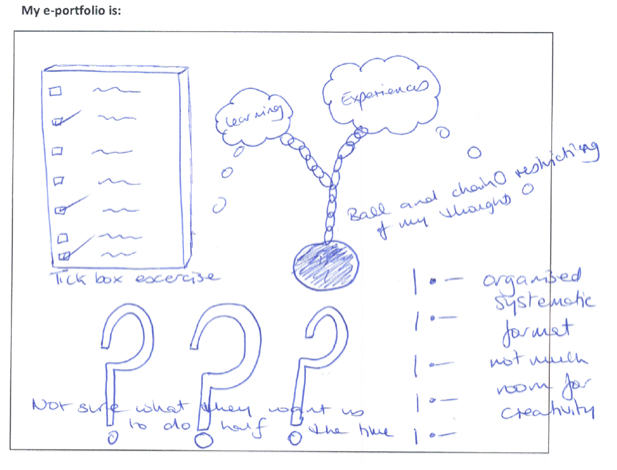
It turns out I was right to think there were some tensions around these practices. Different people experienced them differently. For example, some students very straightforwardly wanted to do what was required of them, but didn’t know how. Others understood what was expected, but felt constrained by those expectations. Some of their teachers felt uncomfortable about the possibility that they exercised power over their students through assessing reflection, but at the same time believed that they could help their students be empowered through reflection.
Many students worried about what to say, and what not to say, in their online reflections. Some teachers worried about that, too, and wondered what consequences online disclosure might have for students down the road. They tried to address this by doing things like policing students’ reflections, or producing very structured templates for students to fill in. Both teachers and students sometimes imagined they weren’t actually doing things “on the web”, in order to feel safer.
Some teachers saw reflection as a way of ensuring that students were “fit for practice” in their chosen profession, and welcomed more visibility of students’ learning processes. But students often struggled to produce the sorts of reflective writing that their teachers wanted, which was often very different from other kinds of writing they’d had to do before.
In short, there was a lot going on, and a lot that wasn’t really being discussed or even necessarily acknowledged. It seemed to me that certain kinds of practices and concerns were being “masked” or disguised by the way that high-stakes online reflection was being understood and explained to students.
In the next post, I’ll talk about the way that I ended up using the metaphor of the mask – which I’ve been talking about for a few years now – to structure the PhD.
via jenrossity

So, I said I would write some blog posts about my phd research – what it was about, what I did, and what conclusions I’ve drawn from it. This is the first one of those. It explains what provoked me to do this research. I’ll follow it up with explanations about the questions I was trying to answer, the arguments I made, and what I’ve learned and concluded – that will be for future posts.
The idea for the research came back in 2005/06 because I wanted to understand more about a practice that seemed to be increasingly common in higher education courses in the UK at least: assessing online reflection. There’s still not a lot of evidence that shows exactly how widespread this is, but some research that the Centre for Recording Achievement in the UK has done over the past few years indicates that it is a fairly common practice, especially in professional programmes (like teaching, medicine, social work and law).
If you’re wondering what ‘reflection’ means in this context, so was I. A fairly standard definition of reflection is that it’s a way of deliberately looking back at things you’ve experienced, done or thought in the past to understand and know yourself better. Writing reflections down might also allow you to capture and review how you change over time. Different people say that the point of this self-knowledge is: to become more authentic; to be more aware of how you’ve been shaped by external influences; to be more flexible and able to develop yourself; to become a better professional; to make your learning more personal; to learn more effectively.
So, why assess reflection? One explanation is that students won’t willingly engage in anything that doesn’t ‘count’ in assessment terms. The argument is that they need the motivation of marks in order to make them do this thing – reflection – that is good for them. Giving something a mark also shows that teachers value it, and that’s important, especially as university education gets more time-pressured for both teachers and students.
But what effect does assessment of reflection have? Questions have been debated in a few academic articles about the relationship between self-development and external requirements, about how to prevent students from censoring themselves or trying to write to please their assessors, and about how something as individual as reflection might be assessed fairly. The most interesting questions for me were: aren’t there really profound tensions between assessment and the concept of self-motivated, personal, authentic reflection? How do teachers and students negotiate those tensions, and what does reflection become in those circumstances?
What about doing reflection online – what were the issues there? When I started my research, online environments, like e-portfolios, were being talked about a lot as a wonderful development in helping students record their development through reflection and also through storage of ‘evidence’ of learning and achievement. These environments were often visually attractive, offered a lot of support and structure, and they were trendy and digital. Doing reflection online could also solve practical problems like storage of and access to reflections.
Some people were concerned about the effect of having reflection stored on the web – they were worried about surveillance, about privacy, and about accidental disclosure of things that were confidential or too personal. So online reflection as a concept seemed to involve a delicate balance between disclosure (which is the whole point of reflection) and caution and control (which you need because the web is ‘dangerous’). In attempting to deal with these new concerns, some of the earlier unanswered questions about assessment and reflection seem to have been abandoned.
I wanted to know: what happens when you throw all of this stuff together – reflection, assessment, and the web? That’s what my phd research was about.
If you’re interested reading more about some of this, I suggest these references:
Ayala, J. (2006). Electronic portfolios for whom? Educause Quarterly, 29(1). Retrieved: 21 July 2011. http://www.educause.edu/apps/eq/eqm06/eqm0613.asp?bhcp=1
Boud, D. (2001). Using journal writing to enhance reflective practice. New Directions for Adult and Continuing Education, 2001(90), pp. 9-18.
Creme, P. (2005). Should student learning journals be assessed? Assessment & Evaluation in Higher Education, 30(3), pp. 287–296.
Kimball, M. (2005). Database e-portfolio systems: A critical appraisal. Computers and Composition, 22(4), pp. 434-458.
Strivens, J., Baume, D., Grant, S., Owen, C., Ward, R., & Nicol, D. (2009). The role of e-portfolios in formative and summative assessment: Report of the JISC-funded study. Wigan: Centre for Recording Achievement. Retrieved: 26 July 2011. http://www.jisc.ac.uk/whatwedo/programmes/elearningcapital/studyontheroleofeportfolios.aspx
Strivens, J., & Ward, R. (2010). An overview of the development of Personal Development Planning (PDP) and e-Portfolio practice in UK higher education. Journal of Learning Development in Higher Education, Special Edition: Researching and Evaluating Personal Development Planning and e-Portfolio Practice, pp. 1-23. Retrieved: 26 July 2011. http://www.aldinhe.ac.uk/ojs/index.php?journal=jldhe&page=article&op=view&path[]=114
via jenrossity
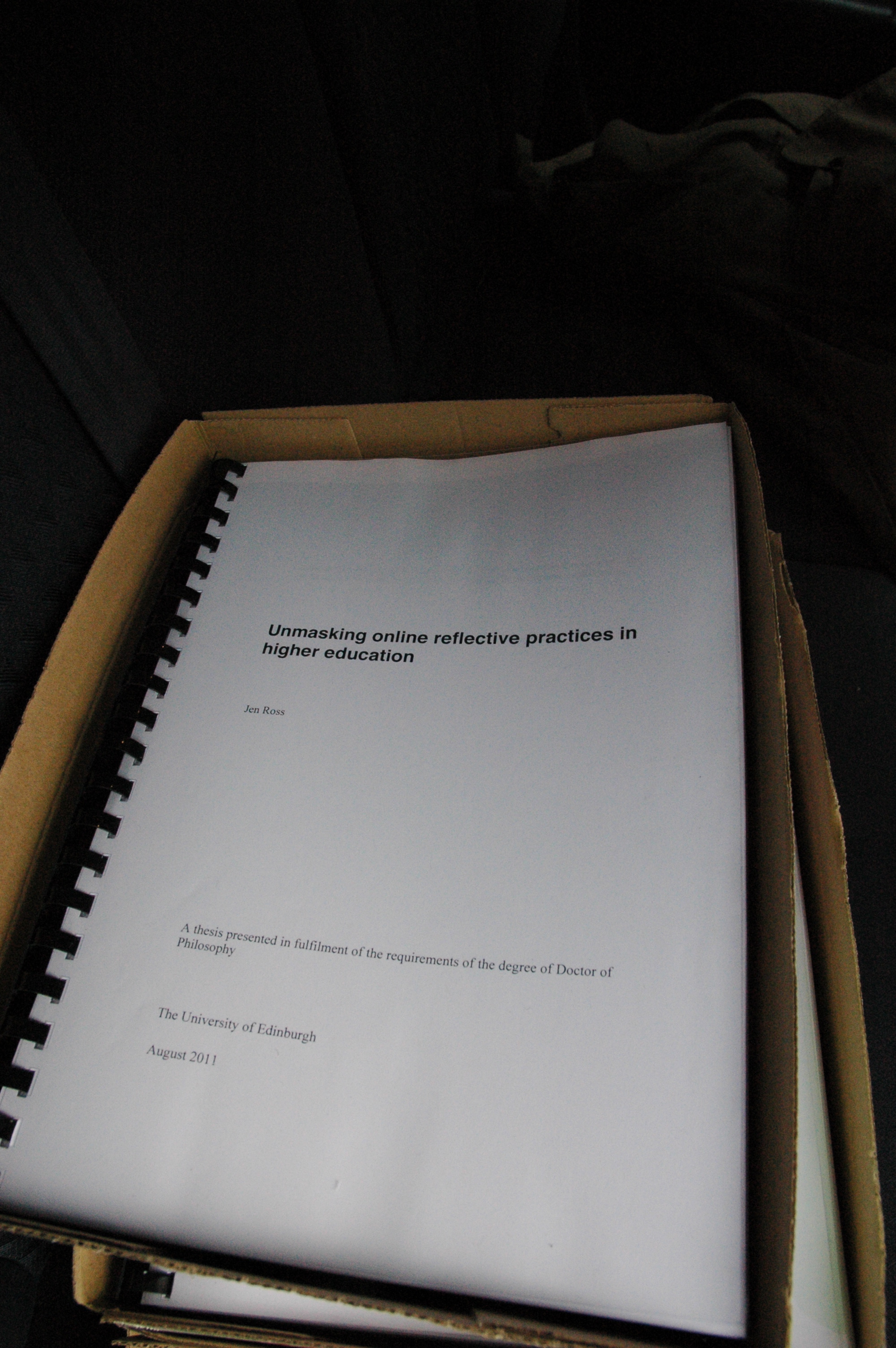 I’m really happy to say that I submitted my phd thesis this afternoon. I’m pretty much out of words, but here’s the abstract. I’ll write more soon – perhaps a small series of blog posts about the research and where it might go from here.
My viva is on 11 October, so the blog posts may have to wait til after that!
Unmasking online reflective practices in higher education
Online reflective practices that are high-stakes – summatively assessed, or used as evidence for progression or membership in a professional body – are increasingly prevalent in higher education, especially in professional and vocational programmes. A combination of factors is influencing their emergence: an e-learning agenda that promises efficiency and ubiquity; a proliferation of employability, transferable skills and personal development planning policies; a culture of surveillance which prizes visibility and transparency; and teacher preference for what are seen as empowering pedagogies.
This thesis analyses qualitative interview data to explore how students and teachers negotiate issues of audience, performance and authenticity in their high-stakes online reflective practices. Using mask metaphors, and taking a post-structuralist and specifically Foucauldian perspective, the work examines themes of performance, trace, disguise, protection, discipline and transformation. The central argument is that the effects of both compulsory reflection, and writing online, destabilise and ultimately challenge the humanist ideals on which reflective practices are based: those of a ‘true self’ which can be revealed, understood, recorded, improved or liberated through the process of writing about thoughts and experiences.
Rather than revealing and developing the ‘true self’, reflecting online and for assessment produces fragmented, performing, cautious, strategic selves. As a result, it offers an opportunity to work critically with an awareness of audience, genres of writing and shifting subjectivity. This is rarely, if ever, explicitly the goal of such practices. Instead, online reflective practices are imported wholesale from their offline counterparts without acknowledgement of the difference that being online makes, and issues of power in high-stakes reflection are disguised or ignored. Discourses of authentic self-knowledge, personal and professional development, and transformative learning are not appropriate to the nature of high-stakes online reflection. The combination creates passivity, anxiety and calculation, it normalises surveillance, and it produces rituals of confession and compliance. More critical approaches to high-stakes online reflection, which take into account addressivity, experimentation and digitality, are proposed.
via jenrossity
 It’s going to be a busy year of research! The main thing is that I am finishing writing up my PhD this year, and will be submitting at the end of August. I’ll post up some bits and pieces as I go.
My paper, Traces of self: online reflective practices and performances in higher education, has just been published in Teaching in Higher Education, 16/1. The issue’s table of contents is online.
I have a chapter appearing in the forthcoming edited collection, Exploring the Theory, Pedagogy and Practice of Networked Learning. It’s being published by Springer in 2011, edited by Lone Dirckinck-Holmfeld, Vivien Hodgson and David McConnell.
The “student writing: innovative online strategies for assessment and feedback” proejct is finishing up in May and, along with a manifesto, the team will be writing a couple of papers for publication over the next few months, drawing on the data produced by a series of student-generated virtual ethnographies of courses on the MSc in E-learning programme.
The digital futures of cultural heritage education project has two workshops this year, in March and June, and those should be a really interesting extension of the excellent open seminar held in October.
via jenrossity
I wanted to share links to the PDFs of the National Museums Online Learning Project ( http://www.vam.ac.uk/about_va/online_learning/index.html ) research reports, produced by the research team at the University of Edinburgh.
The final report coincided with the end of the project in Spring 2009. The NMOLP resources - WebQuests and Creative Spaces - continue to be developed, however, and the final report takes this into account.
Bayne, S., Ross, J., Williamson, Z. (2009) National Museums Online Learning Project final report. University of Edinburgh. http://www.malts.ed.ac.uk/staff/sian/nmolp/finalreport.pdf
Here are the earlier reports:
Bayne, S., Ross, J., Williamson, Z. (2007) National Museums Online Learning Project Stage one report. University of Edinburgh. Viewed 25 April 2009. http://www.malts.ed.ac.uk/staff/sian/nmolp/stage1.pdf
Bayne, S., Ross, J., Williamson, Z. (2008) National Museums Online Learning Project Stage two report: part 1, Creative journeying: portraits of our users. University of Edinburgh. Viewed 25 April 2009. http://www.malts.ed.ac.uk/staff/sian/nmolp/stage2creativespaces.pdf
Bayne, S., Ross, J., Williamson, Z. (2008) National Museums Online Learning Project Stage two report: part 2, Watching, gaming, learning: webquest contexts of use. University of Edinburgh. Viewed 25 April 2009. http://www.malts.ed.ac.uk/staff/sian/nmolp/stage2webquests.pdf
We would welcome any comments!
[Update 20 July] - Should have put links to the resources in the first time! There is an entry point for each resource from each of the nine partner sites, but these will get you started:
Creative Spaces: http://www.vam.ac.uk/activ_events/adult_resources/creative_spaces/index.html
Webquests: http://www.vam.ac.uk/school_stdnts/schools/pupils/webquests/index.html
This is a call for applications for a PhD studentship at the University of Edinburgh: co-supervised by Sian Bayne, the principal investigator on the National Museums Online Learning Project research strand.
School of Education, University of Edinburgh, UK
Royal Commission on the Ancient and Historical Monuments of Scotland (RCAHMS), UK
This studentship, fully funded by the UK Arts and Humanities Research Council, with additional funding from the collaborating partner, will support three years of full-time study. The student will investigate how the internet is changing the way users engage with, and learn from, the collections of cultural institutions, with supervision provided by Dr Sian Bayne (University of Edinburgh) and Ms Rebecca Bailey (RCAHMS).
Basing the study on the online education and outreach activities of RCAHMS, the broad remit of the project is to explore how new online media environments change and challenge the curatorial and outreach responsibilities of museums, galleries and archives.
The studentship covers all UK fees, and includes an allowance of £12,940 per academic year, plus an additional annual £1,500 maintenance payment provided by the AHRC and RCAHMS. Students may also be eligible for UK study visits and one overseas study visit as well as one overseas conference for the duration of the award. For eligibility criteria, see the AHRC web site at: http://www.ahrc.ac.uk/apply/postgrad/postgrad_details_d/eligibility.asp
For fuller details of the proposed project, and the application procedure, please see: http://www.education.ed.ac.uk/e-learning/ahrc.pdf.
To discuss the project informally, please contact Mrs Pam Holgate, University of Edinburgh (0131 651 6120, pam.holgate@ed.ac.uk) or Ms Rebecca Bailey, RCAHMS (0131 662 1456, rebecca.bailey@rcahms.gov.uk).
Applications should be submitted by 13 June 2008, and we anticipate that interviews will be held during the week of 7th July.
University of Edinburgh: http://www.ed.ac.uk
Royal Commission on the Ancient and Historical Monuments of Scotland: http://www.rcahms.gov.uk
I'm working on a paper for the Inclusive Museum conference in Leiden in June. The paper will focus on inclusive online museum learning, and the National Museums Online Learning Project in particular. It's structured around four key concepts: reach, relevance, relationship and recontextualisation, and touches on themes of the digital vs physical museum, the shift in museum learning from a focus on objects to a focus on users, what 'quality' means in online learning, tensions in schools between creativity and performativity, and social media and its relationship with institutional authority - all themes which have emerged so far in our research with the NMOLP.
Our experiences with this project have highlighted a number of creative tensions around openness and authority, insiders and outsiders, and control (who has it, who wants it...). It's interesting to think about how these issues might evolve as social media and user-generated content make their way from the margins to the centres of cultural institutions.
I really enjoyed Ross Parry's semantic web session at Museums and the Web in Montreal - the idea of the machine-readable web (web 3.0?) is pretty compelling and exciting. But even more interesting (to me! and sad, perhaps), is thinking about how institutions (museums, universities, schools) might use/co-opt/learn from/change/be changed by the digital environments they venture into. I often find that conversations about the digital/social/user-generated content in institutions - even those which start off innocently enough - end up being about the nature and purpose of those institutions. That's why I find e-learning such an exciting field to be involved in, I think.
I had to miss Wednesday, the last day of the conference, but had an action-packed final day myself on Tuesday.
The first presentation I saw was on museum learning and virtual worlds. I felt the presenter (Lea Kuznik, from the University of Ljubljana) could have taken time to link her theoretical framework (Gogola's experiential pedagogy and 'peak experiences') to her overview of virtual worlds. I think it could have been a fascinating paper about what a 'peak experience' might be in such a digital environment. I hope she carries on with this research - I'd like to hear about it again when it's a bit further down the road.
I was tremendously impressed by Edith Doron's paper (she is doing her doctoral research at the University of Aberdeen) on "building a Sukkah for the museum". It was about how a children's museum can engage in a responsibility to the other - a responsibility she described by quoting Edmond Jabès:
"On this side of responsibility there is solidarity. On the other, hospitality."
Her talk was largely about hospitality, and what it might mean for the museum to be a stranger among strangers, rather than a facilitator of discussion "between us about them". A Sukkah (I learned) is a booth or hut (purposefully rickety) which Jewish families build after Yom Kippur - a temporary ritualised dwelling space. The Sukkah celebrates harvest and commemorates the exodus of Hebrew slaves, and it architecturally stages the act of hospitality. It has to be an exposed space where there is an inevitability of encounter with strangers. Families have to leave the solidity of home and dwell in uncertain space. The other is not invited in by the 'potis' (master), but is invited in by an exile: the "turn toward outside is from the outside". She argued that such a metaphorical (or real, in the case of the Brooklyn Children's Museum, where Edith worked, or the Jewish Museum in Berlin) space can help museums to rethink belonging and otherness, and their place in the communities they serve.
For me the link here to the online museum is strong: the online museum itself could be a Sukkah. Rather than attempting to regulate or dominate digital space, museums could allow themselves to be in exile along with their online communities. Perhaps to treat the web as a distinctively strange and different space, rather than a bolted on, lesser version of the material museum, would be to engage with old (new) notions of hospitality in something of the way that Edith described.
I also had a number of good conversations with various interesting people on Tuesday, which is why I don't have many papers to report on! That and the repeated cancellations of things I was going to. I haven't written about everything, though, and I may find time to write more over the next few days.
Emerging into the sunshine I discovered something new had sprung up during the day.

I think today was about the personal for me. It started with a really nice chat over breakfast about people's personal attachment to museums and museum spaces - I shared a story from one of our recent NMOLP research reports with the president of ICOM - eep! - which probably got me thinking along these lines to begin with.
Then I went to Marcus Wood's keynote. He gave a moving and complex talk about museum narratives of the mass trauma of slavery, and their focus on the wounded slave body and instruments of torture, followed by the heroic story of emancipation and abolition. He contrasted this with the National Great Blacks in Wax Museum in Baltimore, Maryland, with its extremely explicit, intimate and creative depictions of mass trauma. He focussed in particular on an installation about lynching, and drew some interesting parallels between strategies the curators used in their exhibit and other artistic and cultural moves both past and present. He then linked this to Brazilian museums' approaches to the display of memory of slavery and their syncretic use of religious iconography and images of slavery, and the transformation of everyday objects (Barbie as Yemanja was particularly cool). I went afterwards to his "garden session" (held in a 2nd floor lobby...), where the conversation about the Martins, who created the NGBiWM, and their passion and commitment to telling this story and to their 'family of ancestors', got me thinking about how powerful the urge to collect, interpret and narrate is for some people. The web may make it easier for some to do this, but the impulse is not new. I already knew that, but sometimes it takes a concrete example before I Know it.
I got three more examples before long, in a talk by Donald Lawrence from UBC called "vernacular practice in the personal museum". His main examples were two personal museums in the Netherlands (both fascinating stories!), but he started off by talking about Sir John Soane's museum in London, which is one of the partners in the NMOLP and a place I really loved when I visited it. Of course Soane had buckets of money with which to indulge his passion for collecting, but the other personal museum creators I heard about today definitely didn't. This is real DIY stuff - uncomfortably chaotic, messy, and 'ugly' (as Lina Bo Bardi would have it, I learned today!).
Also today Elizabeth Mix talking about Fred Wilson's interventions in museum spaces - bringing pieces from collections together in new ways, and offering critiques of museum practice in the form of jarring juxtapositions, retitling, addition of artefacts and changes of staging. Her talk was full of great examples and interesting connections. However, a curator in the audience asked what lessons should be taken from Wilson, and Elizabeth's answer (that labels and barriers should be rethought, objects grouped differently) seemed to me to miss a point I took from what I saw of his work: that there is always an intervention, a reorganisation to be done, gaps and silences to fill in - not that there is a 'right' way to stage an exhibition, or that we should all follow Wilson's example... anyone else have a view about this?
I'm going to go out and find something nice to eat, now. Hopefully I'll fancy something besides pancakes...
At Lynda's suggestion, I thought I'd make a few notes here for those unlucky enough not to be in glorious Leiden at the first International Conference on the Inclusive Museum.


My paper about what we can learn from translation studies theory about qualitative research transcription has just been published in the open-access journal Forum: Qualitative Social Research – here is a link to it, and the reference:
Ross, J. (2010). Was that Infinity or Affinity? Applying Insights from Translation Studies to Qualitative Research Transcription. Forum: Qualitative Social Research, 11/2. http://www.qualitative-research.net/index.php/fqs/article/view/1357
This is my first sole-authored full paper, so I’m very excited!
via jenrossity
E-learning and Digital Cultures was a 12-week course taught by me and Siân Bayne as part of the MSc in E-learning programme. It was innovative for the programme because of the nature of its engagement with digital cultures: it was open-access and disaggregated (you can see for yourself by browsing the web site), and made use of blogs, lifestreaming, twitter and a range of social and user-generated tools from across the web.
We’ll be presenting a paper at the Academic Identities for the 21st Century conference at Strathclyde University in June called “Posthuman academic identities in digital environments”, drawing on Siân’s recent work on uncanny digital pedagogies to talk about some of what we’ve learned from this course: how to work productively with volatility, disorientation, and strangeness.
via jenrossity
 For this year’s Edublog Awards, I want to nominate the University of Edinburgh’s MSc in E-learning virtual graduation on 26 November 2009. Four of the students from the programme attended a graduation ceremony in Second Life, while two graduated in the University’s face to face ceremony in McEwan Hall. It was an extremely moving and amazing experience, especially when the principal asked those in McEwan Hall to give a round of applause for the virtual attendees. The whole concept and event (masterminded by my colleague Fiona Littleton) really deserves an Edublog award, I think!
Nomination for best educational use of a virtual world: Virtual Graduation at the University of Edinburgh
Update: Virtual Graduation won!! More information here: https://www.wiki.ed.ac.uk/display/VueWiki/Virtual+Graduation

via jenrossity
I wrote a review of Martin Hand’s book “Making Digital Cultures” for the Resource Centre for Cyberculture Studies, and this was published (with the author’s response) this month:
http://rccs.usfca.edu/bookinfo.asp?BookID=444&ReviewID=643
I really liked this book, and in fact Chapter 1 is now a core reading on the “E-learning and Digital Cultures” course at the University of Edinburgh.
via jenrossity
 I’ll be giving at talk at the Society for Research into Higher Education conference on Wednesday 9 December called Reflective practices as masks: a new way to think about reflection in higher education
Summary: This paper discusses ongoing research into how students and teachers negotiate issues of identity, authenticity, ownership, privacy and performativity in high-stakes online reflection in higher education. I define high-stakes reflection as reflection which is summatively assessed or has a gatekeeping function into a profession, and use a metaphor of the mask to draw out different aspects of high-stakes reflection online: performance, disguise, protection, transformation, discipline and trace. Conceiving of online reflective practices in these mutiple and overlapping ways has implications for how educators understand and support reflection, and the expectations we place on our students in terms of what high-stakes reflective writing can and should accomplish. These practices should support development of academic or professional identity and voice through explicit engagement with matters of authenticity, power, narrative, subjectivity and agency – not through a discourse which frames the recording and improvement of the “true self” as the ultimate goal of reflective practice.
I’ll be giving a longer talk on similar themes at the University of Glasgow’s Learning and Teaching Centre’s seminar series, on Wednesday 13 January 2010. I will have time at this second event to share more of the data that’s emerging from my PhD research.
I’ve been thinking about the masks for a while, and I’m now starting to draw some conclusions about what I think that thinking about reflective practices in this way might imply for teaching and learning. Both of these talks will represent the cutting edge of my ongoing doctoral research looking at online reflective practices in Higher Education!
via jenrossity
The web site for the Student writing: innovative online strategies for assessment and feedback project (which we call SWOP for short) is now online at http://www.education.ed.ac.uk/swop/
The first stage of data generation is now under way with the appointment of our first four postgraduate research associates, who are keeping ethnographic accounts of their courses and facilitating a wiki for assessment and feedback stories.
via jenrossity