

We in IT live in a complex world. While complexity is rapidly increasing, we are working hard on simplifying it. The two things occurring at the same time certainly do not make for a smooth or even linear transition, but at a minimum we are keeping complexity from overwhelming the number of man-hours available to manage the overall IT world. Our simplification efforts are across the board, which is an amazing phenomenon that I will happily lay the credit for on the DevOps world. While DevOps continues to mean different things to different people, that is the very reason we are seeing improvement in most areas of dev and operations both. And all of these efforts, while providing other benefits, generally work to make someone’s life easier by easing the burden of IT. Whether it be self-service to assist users, automated provisioning to help operations, or CI/CD to help developers, life gets easier and deployment times get faster through these efforts.
Pokemon Go has stormed onto the scene this past week and the buzz is everywhere about it! However, being so successful in such a brief period of time can have a downside. Reports of players being unable to access services started appearing in relatively short order. Amazon's CTO jumped into the fray offering their cloud services to help scale NiantecLab's (creators of Pokemon Go) server-side infrastructure. While the Pokemon Go app has been positively rated by the majority of players, there are clearly a large number of players who thought differently, as indicated in the Google play App ratings.
The big move is Amazon’s beating Exxon Mobile (used to be number 1 for many years) to the fourth spot. The switch came after Amazon posted its fifth straight quarter of profits last week as the oil giant’s profits tumbled 59 percent during the same rough period. If Exxon continues its drop, then Facebook will beat it in days.
Whether you suffer from a diagnosed anxiety disorder or not, many of us who are responsible for deployments become uneasy when deploying code to production. Did my tests catch everything? What if something happens during a migration and I can’t rollback? Will that small code change create an unstoppable reaction destroying everything in my database? Okay, maybe that’s a little aggressive, but you get my point. Deploying to production creates anxiety among developers all over the world. So how do we combat this anxiety without a prescription for Xanax? We’ve gathered a couple tricks to help ease your anxiety and optimize your release pipeline all at the same time.
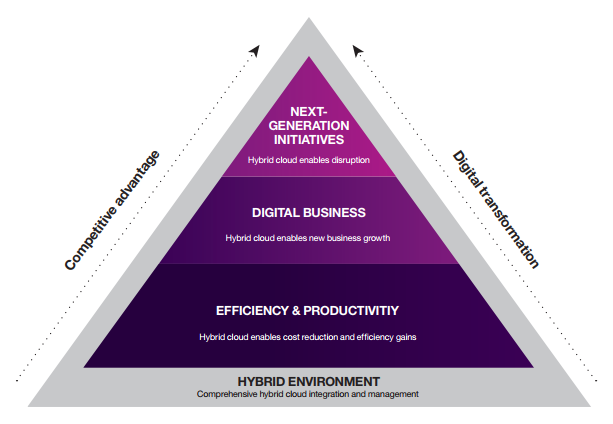
Forging a viable business technology strategy for today’s global networked economy is a high priority for most forward-thinking CEOs across the globe. Their guidance to CIOs is to create the fusion between existing IT infrastructure and modern cloud services. Moreover, the shift to a Hybrid IT model must support the organization’s key commercial expansion objectives.
The savvy leaders who have a superior approach can extract greater value from their legacy IT investments, and launch new initiatives based upon public and private cloud computing services. This is the new normal -- CIOs must create the optimal blended environment for purposeful technology-enabled innovation.
Primary Motivation
A global study of 500 hybrid cloud decision makers revealed that organizations are increasingly integrating cloud computing and storage resources with traditional IT infrastructure to accommodate dynamic needs and specific business priorities, according to a market study by the IBM Center for Applied Insights.
This thought-provoking study found that improving productivity is currently the number one goal of cloud service adoption, as the most progressive senior executives plan to offload some of their IT resources and management complexity to the cloud.
A close second goal of digital transformation is improved security and risk reduction -- using the flexibility of a hybrid solution to choose which workloads and data to move to the cloud and which to maintain on-premise.
The other two most mentioned goals by survey respondents are IT infrastructure cost reduction -- i.e. shifting costs from fixed IT to as-needed cloud services -- and scalability to handle dynamic IT workloads.
Why Maturity Matters
Following their detailed analysis, the IBM report authors grouped the survey respondents into three categories, based upon the maturity of their hybrid management capabilities and whether they’re reporting a strategic edge that’s realized from their hybrid cloud deployments:
DNS is a core component of the Internet. This rather complex system exists to perform the basic function of translating website Domain names (ex: Catchpoint.com) into an IP address. It acts as the liaison between the language that users can understand, and the address of the data center or destination in which the site is being hosted. DNS is what shapes the modern Internet. It enables users of all skill sets and technical knowledge levels to use this incredibly advanced resource on a daily basis. Businesses that exist entirely on the Internet like online banking and ecommerce companies have not only emerged into the market, but have steadily gained a global presence.
Smart Cities are here to stay, but for their promise to be delivered, the data they produce must not be put in new siloes. In his session at @ThingsExpo, Mathias Herberts, Co-founder and CTO of Cityzen Data, will deep dive into best practices that will ensure a successful smart city journey.
The Citrix Technology Professionals Program, or CTP, gives participants a larger say in essential strategy initiatives such as enabling mobile work styles. As an example, we will explore how the Citrix Technology Professionals Program, or CTPs as they are referred to, gives participants a larger say in essential strategy initiatives such as enabling mobile work styles.
During the last two years, Microsoft has upped the ante on Machine Learning and Analytics. From hiring top notch data scientists to acquiring niche startups, Redmond has made the all the right moves to transform Azure into one of the best analytics platforms. These investments have started to pay off for the company. It has been successful in articulating and demonstrating the value of data-driven insights to governments, medical institutions, and public sector organizations.
Infrastructure complexity is not unique to enterprise datacenters. Just because a business or organization is small does not mean it is exempt from the feature needs of big enterprise datacenters. Small and mid-size organizations require fault tolerance, high availability, mobility, and flexibility as much as anyone. Unfortunately, the complexity of traditional datacenter and virtualization architecture hit the SMB the hardest.
Kubernetes, Docker and containers are changing the world, and how companies are deploying their software and running their infrastructure. With the shift in how applications are built and deployed, new challenges must be solved. In his session at @DevOpsSummit at19th Cloud Expo, Sebastian Scheele, co-founder of Loodse, will discuss the implications of containerized applications/infrastructures and their impact on the enterprise. In a real world example based on Kubernetes, he will show how to migrate an existing application to Docker and Kubernetes, and what the benefits are.
So your teams want to do Agile, perhaps have even started doing so. Now your project managers run around wondering what story points are and why any number of people seem to be attributing hours to their project code. So the question is: what can you adopt easily without turning the governance of your organization upside down?
The next BriefingsDirect business innovation for procurement case study examines how UPS modernizes and streamlinines its procure-to-pay processes. Learn how UPS - across billions of dollars of supplier spend per year - automates supply-chain management and leverages new technologies to provide greater insight into procurement networks. T
Synchronoss announced the general availability of its Secure Mobility Platform (SMP) – the combination of a highly secure application container and integrated productivity suite that together improves the productivity and performances of enterprise mobile workforces. Designed and built using secure enterprise mobility technology contributed by Goldman Sachs through the venture announced last November, Synchronoss SMP consists of: Synchronoss Lagoon – a secure device container which encrypts the enterprise’s data on the device and over the air
Let's just nip the conflation of these terms in the bud, shall we?
"MIcro" is big these days. Both microservices and microsegmentation are having and will continue to have an impact on data center architecture, but not necessarily for the same reasons. There's a growing trend in which folks - particularly those with a network background - conflate the two and use them to mean the same thing.
They are not.
One is about the application. The other, the network. There is a relationship, but it's a voluntary one. They are two very different things and we need to straighten out the misconceptions that are rapidly becoming common.
Microservices are the resulting set of services (mini applications, if you will) that arise from the process of decomposing an application into smaller pieces. If you take a monolithic application and segment it into many pieces, you end up with microservices. It is an application architecture; an approach to designing applications.
 This architectural approach has a significant impact on the network architecture, as it forces broader distribution of application-affine services like load balancing, caching and acceleration to be located closer to the individual service. Microservices as an approach is a forcing factor in the bifurcation of the network as it separates application-affine services from corporate-affine services.
Microservice architectures are beneficial in that they are highly efficient; it separates functional or object domains and thus lends itself well to a more targeted and efficient scalability model. It is particularly useful when designing APIs, as in addition to the scalability benefits it also localizes capabilities and enables isolated upgrades and new features without necessarily disrupting other services (and the teams developing other services). This lends itself well to agile methodologies while enabling a greater focus on API development as it relates to other services as well as the applications that will use the service.
Microsegmentation is about the network; to be precise, at the moment it's about the security functions in the network and where they reside. It's a network architecture that, like microservices, breaks up a monolithic approach to something (in this case security) and distributes it into multiple services. You could say that microsegmentation is micro-security-services, in that it decomposes a security policy into multiple, focused security policies and distributes them in an resource-affine manner. That is, security policies peculiar to an application are physically located closer to that application, rather than at the edge of the network as part of a grandiose, corporate policy.
This approach, while initially focusing on security, can be applied to other services as well. As noted above, a result of a microservice approach to applications the network naturally bifurcates and application-affine services (like security) move closer to the application. Which is kind of what microsegmentation is all about; smaller, distributed "segments" of security (and other application-affine services like load balancing and caching) logically deployed close to the application.
Thus, if there is any relationship between the two approaches, it is that microservices tend to create an environment in which microsegmentation occurs.

There are other reasons for microsegmentation, including the reality that the scale required at the edge to support every application-specific service is simply pushing IT to the edge of its wits (pun only somewhat intended). The other driving factor (or maybe it's a benefit?) is that of service isolation, which provides for fewer disruptions in the event of changes occurring in a single service. For example, a change to the core firewall is considered potentially highly disruptive because if it goes wrong, every thing breaks. Changing the firewall rules on a localized, isolated service responsible for serving two or three applications, has a much lower rate of disruption should something go wrong.
This is highly desirable in a complex environment in which stability is as important as agility.
In a nutshell, microservices are to applications what microsegmentation is to network services. Both are about decomposing a monolithic architecture into its core components and distributing them topologically in a way that enables more scalable, secure and isolated domains of control.
The thing to remember is that just because dev has decided to leverage microservices does not in turn mean that the network somehow magically becomes microsegmented or that if microsegmentation is used to optimize the network service architecture that suddenly apps become microservices. Microsegmentation can be used to logically isolate monolithic applications as easily as it can microservices.
Either approach can be used independently of one another, although best practices in networking seem to indicate that if dev decides to go with microservices, microsegmentation is not going to be far behind. But the use of microsegmentation in the network does not mean dev is going to go all in with microservices.
If you are within a stones throw of the DevOps marketplace you have undoubtably noticed the growing trend in Microservices. Whether you have been staying up to date with the latest articles and blogs or you just read the definition for the first time, these 5 Microservices Resources You Need In Your Life will guide you through the ins and outs of Microservices in today’s world.
With over 720 million Internet users and 40–50% CAGR, the Chinese Cloud Computing market has been booming. When talking about cloud computing, what are the Chinese users of cloud thinking about? What is the most powerful force that can push them to make the buying decision? How to tap into them? In his session at 18th Cloud Expo, Yu Hao, CEO and co-founder of SpeedyCloud, answered these questions and discussed the results of SpeedyCloud’s survey.
For basic one-to-one voice or video calling solutions, WebRTC has proven to be a very powerful technology. Although WebRTC’s core functionality is to provide secure, real-time p2p media streaming, leveraging native platform features and server-side components brings up new communication capabilities for web and native mobile applications, allowing for advanced multi-user use cases such as video broadcasting, conferencing, and media recording.
With 2016 crossing the half way point, let’s take a look at some technology trends thus far. Breaches: Well, many databases are half empty due to the continued rash of intrusions while the crooks are half full with our personal information. According to the Identity Theft Resource Center (ITRC), there have been 522 breaches thus far in 2016 exposing almost 13,000,000 records. Many are health care providers as our medical information is becoming the gold mine of stolen info. Not really surprising since the health care wearable market is set to explode in the coming years. Many of those wearables will be transmitting our health data back to providers. There were also a bunch of very recognizable names getting blasted in the media: IRS, Snapchat, Wendy’s and LinkedIn. And the best advice we got? Don’t use the same password across multiple sites. Updating passwords is a huge trend in 2016.
Identity is in everything and customers are looking to their providers to ensure the security of their identities, transactions and data. With the increased reliance on cloud-based services, service providers must build security and trust into their offerings, adding value to customers and improving the user experience. Making identity, security and privacy easy for customers provides a unique advantage over the competition.
Actian Corporation has announced the latest version of the Actian Vector in Hadoop (VectorH) database, generally available at the end of July. VectorH is based on the same query engine that powers Actian Vector, which recently doubled the TPC-H benchmark record for non-clustered systems at the 3000GB scale factor (see tpc.org/3323). The ability to easily ingest information from different data sources and rapidly develop queries to make better business decisions is becoming increasingly important, particularly for those companies looking to respond to changes real-time or explore machine-learning. When paired with Actian VectorH, the industry’s fastest Enterprise SQL database that sits natively in Hadoop, Spark users have a new powerful way to help derive true business value from their data.
The Citrix Technology Professionals Program, or CTP, gives participants a larger say in essential strategy initiatives such as enabling mobile work styles. As an example, we will explore how the Citrix Technology Professionals Program, or CTPs as they are referred to, gives participants a larger say in essential strategy initiatives such as enabling mobile work styles.
There's a lot of things we do to improve the performance of web and mobile applications. We use caching. We use compression. We offload security (SSL and TLS) to a proxy with greater compute capacity. We apply image optimization and minification to content. We do all that because performance is king. Failure to perform can be, for many businesses, equivalent to an outage with increased abandonment rates and angry customers taking to the Internet to express their extreme displeasure.
Kubernetes, Docker and containers are changing the world, and how companies are deploying their software and running their infrastructure. With the shift in how applications are built and deployed, new challenges must be solved. In his session at @DevOpsSummit at19th Cloud Expo, Sebastian Scheele, co-founder of Loodse, will discuss the implications of containerized applications/infrastructures and their impact on the enterprise. In a real world example based on Kubernetes, he will show how to migrate an existing application to Docker and Kubernetes, and what the benefits are.
During the last two years, Microsoft has upped the ante on Machine Learning and Analytics. From hiring top notch data scientists to acquiring niche startups, Redmond has made the all the right moves to transform Azure into one of the best analytics platforms. These investments have started to pay off for the company. It has been successful in articulating and demonstrating the value of data-driven insights to governments, medical institutions, and public sector organizations.