

In September 2014, Apple made encryption default with the introduction of the iPhone 6. Then, in February 2016, a Los Angeles judge issued an order to Apple to help break into the encrypted iPhone belonging to a terrorist involved in a mass shooting. Apple had used some of the strongest encryption technologies and practices to protect its users and their data. The encryption technology did not discriminate between lawful and unlawful users. While there were many sides to this issue, it surfaced many important debates on security, privacy, and civil rights.
In this blog I’ll show you how to guard routes in Angular 2 Router (currently at 3.0.0-beta.2). Let’s consider some scenarios that require a certain validation to be performed to decide if the user (or a program) is allowed to navigate to or leave the route: Allowed to open the route only if the user is authenticated and authorized to do so. Implement a multi-part form that consists of several components, and the user is allowed to navigate to the next form section only if the data entered in the current one is valid.
Akana has announced the availability of version 8 of its API Management solution. The Akana Platform provides an end-to-end API Management solution for designing, implementing, securing, managing, monitoring, and publishing APIs. It is available as a SaaS platform, on-premises, and as a hybrid deployment. Version 8 introduces a lot of new functionality, all aimed at offering customers the richest API Management capabilities in a way that is easier than ever for API and app developers to use.
This is the second in a two part series of posts pertaining to using some common server storage I/O benchmark tools and workload scripts. View part I here which includes overview, background and information about the tools used and related topics.
My friend Dan sent me this press release (since he knows that I like all things “Data Analytics” related). In the press release, “Boeing Announces Data Analytics Agreements with Six Airlines,” Boeing announces that they are providing advanced analytic solutions to several airline customers including: All Nippon Airways (ANA) signed a renewal contract for Airplane Health Management (AHM) on its entire future fleet of Boeing 787 aircraft. ANA uses AHM tools to monitor their aircraft in real time and proactively manage maintenance operations more efficiently.
We’re all aware that dev/test != production environments. While the software stacks upon which applications are deployed may be (and hopefully are) the same, there still remains a whole lot of “infrastructure” (that’s everything else) that isn’t the same. Routers, switches, security devices, load balancers, caches, and other devices dedicated to ensuring the secure delivery of applications to hungry consumer and corporate users simply don’t exist in the dev/test environment. That’s particularly true as organizations continue to view “the cloud” as its ideal dev/test environment while continuing to insist that production remain firmly rooted on-premises.
The convergence of cloud, mobility, and Big Data analytics has prompted companies to innovate and produce new levels of award-winning productivity. To learn how these trend-setters create innovation value, we're joined by some finalists from the Citrix Synergy 2016 Innovation Awards Program: Olaf Romer, Head of Corporate IT and group CIO at Bâloise in Basel, Switzerland; Alan Crawford, CIO of Action for Children in London, and Craig Patterson, CEO of Patterson and Associates in San Antonio, Texas. The discussion is moderated by me, Dana Gardner, Principal Analyst at Interarbor Solutions.
Conjecture, an opinion or conclusion formed on the basis of incomplete information. All digital transformation initiatives introduce new problems, software bugs, guaranteed network vulnerabilities, new competitors; new business challenges and new stresses. The elimination of all negative consequences and vulnerabilities are impossible, so our focus should be on limiting and containing it, not eliminating it.
The enterprise is enjoying a period of rapid technological innovation driven by real-time collaboration on a grand scale. New tools have brought the ability to work from anywhere, on any device, and at any time. Centralized offices and individually assigned desks are giving way to a distributed, mobile workforce. Digital workspaces offer enormous benefits for the enterprise and for workers, but there are also challenges ahead.
Purdue University has created a strategic IT environment to support dynamic workload requirements. The next BriefingsDirect Voice of the Customer IT infrastructure thought leadership case study explores how Purdue University has created a strategic IT environment to support dynamic workload requirements. We'll now hear how Purdue extended a research and development IT support infrastructure to provide a common and "operational credibility" approach to support myriad types of compute demands by end users and departments.
You’ve submitted your favorite tools, you’ve voted on what’s Hot or Not, and finally the wait is over. Today XebiaLabs launched the second version of The Periodic Table of DevOps Tools. Since the launch of The Periodic Table of DevOps v.1 in July of 2015, the table has taken the IT world by storm. Organizing the DevOps tooling landscape had been a major pain point for anyone in the IT industry. The Periodic Table of DevOps Tools has not only alleviated this problem but has become an industry standard as a reference tool for all IT professionals. Over the past six months our team has been working diligently on updating the look and feel of the table, not to mention a cornucopia of new features.
This is a no-hype, pragmatic post about why I think you should consider architecting your next project the way SOA and/or microservices suggest. No matter if it’s a greenfield approach or if you’re in dire need of refactoring. Please note: considering still keeps open the option of not taking that approach. After reading this, you will have a better idea about whether building multiple small components instead of a single, large component makes sense for your project. This post assumes that you have experience with software architecture and services (you’ll find some words about my experience on the bottom of this post). I won’t go into the details of Wikipedia’s or Martin Fowler’s definitions per se. Much more I will talk about what microservices and/or SOA could and should do for your project.
Amazon has gradually rolled out parts of its IoT offerings in the last year, but these are just the tip of the iceberg. In addition to optimizing their back-end AWS offerings, Amazon is laying the ground work to be a major force in IoT – especially in the connected home and office. Amazon is extending its reach by building on its dominant Cloud IoT platform, its Dash Button strategy, recently announced Replenishment Services, the Echo/Alexa voice recognition control platform, the 6-7 strategic investments of its Venture group, strategic partnerships with 50+ major consumer package goods companies and the 50-70 million current Prime customers to become a dominant force in IoT.
So your teams want to do Agile, perhaps have even started doing so. Now your project managers run around wondering what story points are and why any number of people seem to be attributing hours to their project code. So the question is: what can you adopt easily without turning the governance of your organization upside down?
Conjecture, an opinion or conclusion formed on the basis of incomplete information. All digital transformation initiatives introduce new problems, software bugs, guaranteed network vulnerabilities, new competitors; new business challenges and new stresses. The elimination of all negative consequences and vulnerabilities are impossible, so our focus should be on limiting and containing it, not eliminating it.
The next BriefingsDirect business innovation for procurement case study examines how UPS modernizes and streamlinines its procure-to-pay processes. Learn how UPS - across billions of dollars of supplier spend per year - automates supply-chain management and leverages new technologies to provide greater insight into procurement networks. T
Smart Cities are here to stay, but for their promise to be delivered, the data they produce must not be put in new siloes. In his session at @ThingsExpo, Mathias Herberts, Co-founder and CTO of Cityzen Data, will deep dive into best practices that will ensure a successful smart city journey.
Synchronoss announced the general availability of its Secure Mobility Platform (SMP) – the combination of a highly secure application container and integrated productivity suite that together improves the productivity and performances of enterprise mobile workforces. Designed and built using secure enterprise mobility technology contributed by Goldman Sachs through the venture announced last November, Synchronoss SMP consists of: Synchronoss Lagoon – a secure device container which encrypts the enterprise’s data on the device and over the air
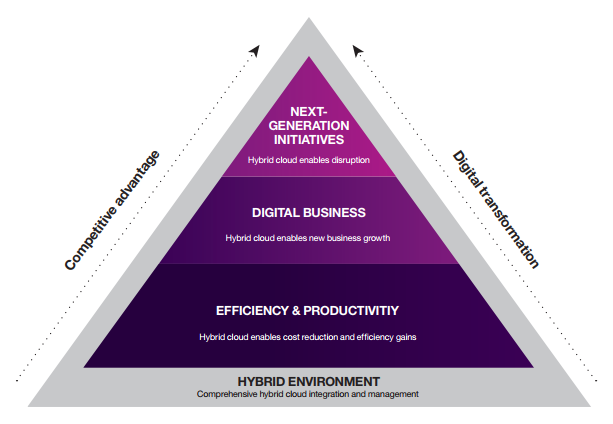
Forging a viable business technology strategy for today’s global networked economy is a high priority for most forward-thinking CEOs across the globe. Their guidance to CIOs is to create the fusion between existing IT infrastructure and modern cloud services. Moreover, the shift to a Hybrid IT model must support the organization’s key commercial expansion objectives.
The savvy leaders who have a superior approach can extract greater value from their legacy IT investments, and launch new initiatives based upon public and private cloud computing services. This is the new normal -- CIOs must create the optimal blended environment for purposeful technology-enabled innovation.
Primary Motivation
A global study of 500 hybrid cloud decision makers revealed that organizations are increasingly integrating cloud computing and storage resources with traditional IT infrastructure to accommodate dynamic needs and specific business priorities, according to a market study by the IBM Center for Applied Insights.
This thought-provoking study found that improving productivity is currently the number one goal of cloud service adoption, as the most progressive senior executives plan to offload some of their IT resources and management complexity to the cloud.
A close second goal of digital transformation is improved security and risk reduction -- using the flexibility of a hybrid solution to choose which workloads and data to move to the cloud and which to maintain on-premise.
The other two most mentioned goals by survey respondents are IT infrastructure cost reduction -- i.e. shifting costs from fixed IT to as-needed cloud services -- and scalability to handle dynamic IT workloads.
Why Maturity Matters
Following their detailed analysis, the IBM report authors grouped the survey respondents into three categories, based upon the maturity of their hybrid management capabilities and whether they’re reporting a strategic edge that’s realized from their hybrid cloud deployments:
This is the second in a two part series of posts pertaining to using some common server storage I/O benchmark tools and workload scripts. View part I here which includes overview, background and information about the tools used and related topics.
Whether you suffer from a diagnosed anxiety disorder or not, many of us who are responsible for deployments become uneasy when deploying code to production. Did my tests catch everything? What if something happens during a migration and I can’t rollback? Will that small code change create an unstoppable reaction destroying everything in my database? Okay, maybe that’s a little aggressive, but you get my point. Deploying to production creates anxiety among developers all over the world. So how do we combat this anxiety without a prescription for Xanax? We’ve gathered a couple tricks to help ease your anxiety and optimize your release pipeline all at the same time.
In September 2014, Apple made encryption default with the introduction of the iPhone 6. Then, in February 2016, a Los Angeles judge issued an order to Apple to help break into the encrypted iPhone belonging to a terrorist involved in a mass shooting. Apple had used some of the strongest encryption technologies and practices to protect its users and their data. The encryption technology did not discriminate between lawful and unlawful users. While there were many sides to this issue, it surfaced many important debates on security, privacy, and civil rights.
We’re all aware that dev/test != production environments. While the software stacks upon which applications are deployed may be (and hopefully are) the same, there still remains a whole lot of “infrastructure” (that’s everything else) that isn’t the same. Routers, switches, security devices, load balancers, caches, and other devices dedicated to ensuring the secure delivery of applications to hungry consumer and corporate users simply don’t exist in the dev/test environment. That’s particularly true as organizations continue to view “the cloud” as its ideal dev/test environment while continuing to insist that production remain firmly rooted on-premises.
Competitors can't compete, and leaders can't lead if they don't know the rules of the game. Understanding how points are scored, and what is required to win is key to any competition. In the age of digital transformation there are key rules to learn: Data is the modern commercial battlefield Information dominance is the strategic goal
As the Big Data marketplace moves closer to a point of mass-maturity, business leaders have begun to take new approaches to implementation and utilization. Advanced analytics solutions have made their way into a range of industries and regions, and companies that successfully align these investments with core goals and requirements will enjoy more progressive improvements to operational sustainability, intelligence and general performance. However, there is some housekeeping that must be addressed as organizations embark on Big Data and analytics initiatives. Data preparation, information governance and security are three fundamental elements of effective analytics strategies, yet, ironically, each has been largely ignored by many organizations in the rush to realize the promise of Big Data.