Log on:
Powered by Elgg

Rory Ewins :: Blog

March 18, 2010

Learning is defined by the free dictionary as: “The act, process, or experience of gaining knowledge or skill.” and “Behavioral modification especially through experience or conditioning”. Looking at social learning / web 2.0 tool led me to realise that while tools as delicious can be extremely useful in an academic learning and research setting it is actually the more mundane social learning tools which hold the key to realising the theory of true organisational learning.


In his book “The fifth discipline” Peter M. Senge defines the four disciplines required to build the learning organisation:

  • Personal mastery

  • Mental models

  • Shared vision

  • Team learning


While personal mastery and mental models can be achieved on an individual basis, reaching a shared vision and team learning in today's large multinational corporates is virtually impossible without the help of technology. Senge states that “There has never been a greater need for mastering team learning in organisations than there is today” this is partially a result of the rate of change in every day life – a shared vision established today might not be relevant by the tomorrow, team learning is subject to the same speed of change but is also a victim of globalisation – where teams could be spread across different countries.


According to a recent Bersin & associates factbook report, approaches to learning using social networking tools “are still in their infancy in the U.K. But training organisations are realising that most learning takes place outside of the classroom or online course.” this realisation that MOST learning occurs OUTSIDE the classroom cannot be underestimated when discussing learning in the corporate space. In fact, some organisations “noted that they are working toward a 70 / 20 / 10 learning model, wherein 70 percent of the learning takes place through on-the-job experiences and practice, 20 percent through collaboration with others (e.g., coaching, mentoring, social networking), and 10 percent through formal learning interventions. This type of blended approach uses formal learning to build fundamentals. But the bulk of learning happens through carefully crafted informal learning activities.”


When looking at the multitude of tools that fall under the category of social learning the most used one in the corporate space is communities of practice. According to the aforementioned Bersin report the most used social learning technology is currently used by 24% of US firms – Communities of Practice. These communities are supported by a number of tools such as Microsoft sharepoint (with a number of plug-ins), ELGG etc.


In their article “Communities of Practice for Professional Development” Heidi Fisk and David Holcombe define a Community of Practice (CoP): “a place where people with similar interests connect to learn from and with each other — to freely share their knowledge, insights, triumphs and tribulations.” It is easy to see how the shared vision mentioned by Senge fits into such a community when it exists within a specific organisation. Team learning is a little harder to distil from this definition but if we take into account Senge's definition of it: “Team learning is the process of aligning and developing the capacity of a team to create the results its members truly desire.” then the ability to record and retrieve “knowledge, insights, triumphs and tribulations” means that the team (and in-fact the organisation as a whole) has gained knowledge which will modify the way the team (and therefore the organisation) behaves in the future.


Technological tools to store and retrieve this knowledge are critical since they are in effect the organisation's long term memory: when an employee wants to consult, for example, how the organisation dealt with a severe recession in the past he can bring it up in the internal system etc... this makes sure that learning takes place and not just an experience.


While the idea of social learning within educational organisations can prepare young learners for life in the workplace the concept comes into its own when used in universities and corporates: these are organisations which require long term memory to build on their activities in the past.

Keywords: IDELJAN10

Posted by Asi DeGani | 2 comment(s)

March 16, 2010

Chapter 7
The Impact of Digital Games on Learning

I found this an interesting read, especially in accordance with my own reflection upon the three classes currently using or having used digital games in order to complement some aspect of learning or having “the ability to make mistakes in a safe environment and and learn from them [which] is one of the key benefits of game-based learning” (Whitton, 2010, p. 104).

CommandosCommando


On the 15th of March, the S3 pupils at Dunoon Grammar School sat their S3 exam ('mocks').  In order to foster relationships - a recurring factor in much of the material being amassed as part of my studies of the MEd in Education on The University of the West of Scotland's Chartered Teacher Pathway programme - I decided to look at the interaction within and between groups of 14 year-old boys, with each group taking part in the playing of the game projected onto a large classroom display.  Each of the 6 groups would control the mouse, direct commands and filter comments and suggestions from the other groups. The pupils are about to conduct research on a topic from which they will develop and deliver a solo talk presentation to the whole class, which will be summatively assessed in accordance with SQA Standard Grade Arrangements.  I am attempting to remove and existing barriers amongst pupils and to continue fostering the supportive and actively collaborative climate necessary in a single gender (all male) class.  These are noted as “unintended learning objectives” (Whitton, 2010, p. 108) and include: “Valuable transferable skills, such as problem solving, teamwork or negotiation” (ibid.).

I was not to be disappointed.

Initial uptake was slow: I put this down to the audience and 'public performance' factor.
  There were instances of bravado and a carefree, less-than-interested approach.  One particular academic/quiet pupil made significant progress - suggestions as to having played before (private interview afterwards). 

I then released the 'walkthrough' now that they had mastered basic navigation.
  Still, there were small isolated pockets of resistance: disengagement - post and pre-play.

However, there was plenty of humour - pupil-teacher humour and a fair amount of camaraderie/praise.

Sherlock Holmes


Whitton’s provision of examples whereby games can be justified as applicable within a learning environment lend to specific areas within which I have used this game:  

  • Narratives associated with the action in the game (e.g. characterizations, back stories, future scenarios);
  • Reflective accounts of actions taken in the game and the learning acquired from it; 

(Whitton, 2010, p. 105).

It is important to note Whitton’s view that adults require close connections to be made between game-based activities and learning outcomes and benefits.  With the S1 pupils, merely adopting the game as an adjunct to a piece of study and utilizing it for a generic lesson opening activity has been enough; whilst formative assessment of daily journals helps to deliver feedback about their writing attainment.  This is certainly a justification to anyone seeking educational merit!

Myst

After a single period of this game – used with an extremely able s2 class (aged circa 13) – I observed and detected disengagements that hadn’t been noticed before from the S1 class.  On the 16/03/2010 I passed around a Pros/Cons sheet and asked for at least one entry from each pupil. 

Myst

‘Bad graphics’ featured once, but interestingly the cons noted that it was “hard”, “no one can use it” and that it was “confusing” (no context or background is provided).  What also featured was the looseness of the lesson structure and that “we all shout out at once”.

It would be interesting to allow the pupils themselves to structure a ‘best practice’ approach…

On the plus, the idea was “fun” and that some enjoyed “puzzles” and the “mystery”, “scenes” and “setting” were positively remarked upon.  Whitton offers a more fine-grained ‘Engagement Questionnaire’ that could be used in future.

Overall, I was curious about the following:

 “higher levels of engagement with a learning activity are indicative of increased learning from it” (Jacques et al. (1995) cited in Whitton, 2010, p. 110).

But that it “is possible to be engaged while not actually in a state of flow” (Whitton, 2010, p. 110).

“Lepper and Malone (1987) provide evidence that there is a link between intrinsic motivation to learn, engagement and instructional effectiveness” (Whitton, 2010, p. 110).

I shall conclude these musings AFTER I have watched the Youtube clip on ‘flow’.

Keywords: IDGBL10

Posted by Hugh O'Donnell | 1 comment(s)

March 11, 2010

Papert confirms that most pupils find school boring - not necessarily hard.  He suggests that children must be able to practice their learning, be in control of their own learning.  He posists three suggestions for leveraging games: 
  • that they should discuss their learning with adults, which aims to develop
  • a learning vocabulary;
  • encourage children to become game designers themselves;
  • game designers should not underestimate their contribution to the learning
  • development of their young audience.
I asked 2 sets of junior pupils: 2 of the 40 claimed that school was hard.

Myst

Myst
After scouring the web for technical assistance (something that still prevents me progressing with Neverwinter Nights) I have finally managed to run 'Myst' (Masterpiece Edition on my desktop PC at work.
I plan to adopt the same strategy of play as I have been doing with my S1 class,
except that in this case the game derives from no existence canon of literature.  I have two concerns:
  • Technically/Aesthetically - is it 'up to it' and will the stage 'point and click'method of navigation not appear too staggered and not flow as contemporary digital first-person games.
  • Narratively - will the pupils feel 'at sea', too unfamiliar...
Academically very able, the chosen group collaborate very well and there is a very supportive climate.

Keywords: IDGBL10

Posted by Hugh O'Donnell | 0 comment(s)

I wanted to do my game review on a game that would be relevant to my professional work – supporting the analysis of qualitative data. Initially, I looked at what educational games existed in that area.  Most of the educational games I found were aimed at K-12 students.  The people I teach are post-graduates and professional researchers.  I explored what was available for higher education. I did not find any games about analyzing text or visual media. I did consider ‘Revolution’ which is MIT’s Education Arcade’s multi-player role-playing game set on the eve of the American revolution.   http://www.educationarcade.org/node/357 It is a conversion mod of the pc game Neverwinter Nights. It is aimed at high school students but I thought it offered interesting possibilities of exploring multiple realities and perspectives on a social phenomenon.  However, the player is not acting as an analyst, so the game was not really what I was looking for.


I then decided to look at entertainment games – to see if any of them could be adapted for my purpose.  I felt that detective games would be the closest to the analysis of unstructured data. It puts the player in the role of an analyst.  I played Sleuth. http://www.playsleuth.com/ While I enjoyed playing it, I felt it was not what I was looking for. While the detective is in the role of analyst, he/she does not analyse material. It is more of a strategy game. You choose your character and design your avatar.  Each character has different skills so you need to devise a strategy that take advantage of your given skills and allows you to build skills in other areas.  The game automatically analyses the information you are able to collect.


I also looked at And then there was none – based on an Agatha Christie novel.  http://www.gamespot.com/pc/adventure/andthentherewerenone/index (My hard drive became corrupted after I played this game – I have no idea if this was just a coincidence.)  Again, it was not quite what I was looking for.  It was more about searching and collecting clues rather than analysis.


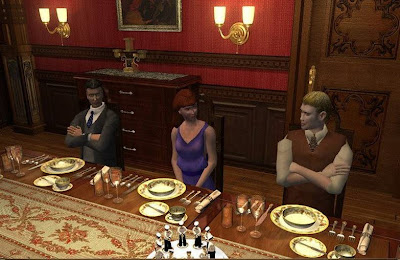
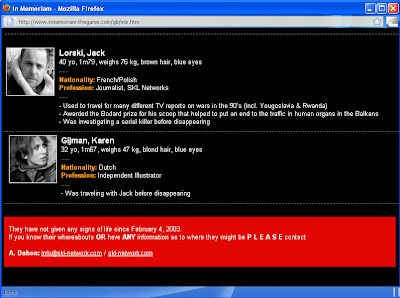
However, In Memoriam, released in the States as Missing: Since January was more of what I was looking for. http://www.inmemoriam-thegame.com/gb/gam1.htm  It is an adventure game mystery that mixes the game world with real world internet searches.  It also involves the analysis of textual (including emails) and video material.  The player is themself in this game.  I like the mixture of game world and real world and I think this game is the closest to what I think can be used to help in developing skills in analysing qualitative or unstructured data.


Keywords: And then there were none, games, IDGBL10, In Memoriam, review, Revolution, Sleuth

Posted by Silvana di Gregorio | 0 comment(s)

March 07, 2010

Bayne holds that “the discussion about the striated nature of the network is of limited relevance” I believe that this issue is of great importance, especially so in the corporate space (although the nature of such a discourse couldn't be further from that space).


It is useful to begin with definitions – when looking at the subject of the striated net I found the way in which Bayne applied the Deleuze & Gattari concept to be too polar. I believe that it is possible to define levels of striation. One simple way of defining levels can rely on continuity: the smoothest websites can be accessed using a web browser, in these the navigation toolbar is in the same place and visual appearance is more or less similar. They are followed by striations created by visual appearance (where the user needs a few seconds or minutes to reorient himself) an example of this could be the system is available to a student at the Edinburgh University:

The two levels which follow are websites which have walls between them (the need to log in) and then Internet environments which require users to use external applications to access them (for example second life). Even with the simple differences - every new environment (and with it the different visual layout) gives the user the feeling that he is in a new place which needs to be explored.


According to the the Nielsen Norman Group, a firm specializing in human-computer interaction, “intuitive equals familiar”. In other words, a space (or website) which we are familiar with is intuitive. The move between spaces on the web (and specifically between striated and smooth spaces) manifests itself as a 'difference' between the two spaces. Bayne refers to this difference: “such a difference is as likely to make the task of online learners and teachers more problematic, or problematic in unfamiliar ways”. As mentioned before, despite identifying this difference, Bayne finds the discussion behind it to be “of limited relevance”.


My personal experience, mostly in the corporate world, has taught me otherwise – This is far from being a purely academical discussion – IT managers go to great lengths to create smoothness in the striated corporate 'INTRANET': unifying the look and feel of the different components of the system and using such devices as 'single sign-on' to streamline the user experience. This is done in the corporate quest to achieve “enhanced efficiency and productivity” and to make sure that while the user is in the 'protected corporate garden' they are faced with the familiar. This ensures that new systems can be added relatively painlessly into the garden and as such, also affects learning. As such, these are the “virtual shanty-towns” that Bayne finds hard to see. It is the regulation of function and form but not of content which leads to users who operate in a smooth net where they are not bogged down by the differences and therefore do not waste time on getting to know the new place they have travelled to.


Internet users actually strive for the smoother – the number of services targeting striation is constantly growing: services such as iGoogle and Symbaloo are just two examples. These are personal portals which are dedicated to 'smoothing out' of the differences between a number of independent information sources and websites. Further examples can be found in the multitude of tools unifying instant messaging, e-mails and in boxes etc


However, even when outside the corporate space, striated spaces can have their benefits when used in an educational setting - specifically for younger children. Closed environments make sure that children are not exposed to inappropriate materials creating a “protective garden” where experiences can be had but without the inherent risk that results from the openness of the web. In fact, looking at the pedagogies that Bayne mentioned (Ulmer and LeCourt) a similar exercise to Ulmer's mystory could be very effective for younger children within the context of the striated space – preparing them to operate within the smooth one outside. In this context striated space can be a positive: enabling and empowering. These children will grow up used to using closed e-learning systems, they will not see themselves as “unfortunate... to be working within an institution in which the use of the virtual learning environment is compulsory”.


Keywords: IDELJAN10

Posted by Asi DeGani | 2 comment(s)

March 01, 2010

In an article by Donald H. Taylor in the December 2008 issue of inside learning technologies the author describes the process by which the early LMS systems were designed: “How did the vendors or the market researchers they employed, guess what functionality to include in their LMS1.0? They asked potential clients.” This process, carried out in the late 90s was applied to most other types of software (apart from those following a worse process – ask the developers to build them wherever they can). According to Taylor the result of this process was a “functionality wish-list based on solving today's issues piecemeal, not building something better for the future.” To me, this is the embodiment of: “you don't know what you don't know” – we invent things, solve problems and imagine based on what we know and experience: as a result we miss out on “the trick of doing things better or differently.”


Taylor provides the following table as an example:

PAPER-BASED APPROACH

TECHNOLOGY 'REPLICATION'

TECHNOLOGY EXTENSION

Provide manuals for instruction in the classroom.

Provide the same manuals in PDF online with no tutor support.

Divide resources into:

A. Reference manuals, cross-referenced and with great searching

B. Easily searchable instruction manuals

C. EPSS/help systems

D. Provide people for help were they can have the most effect.

Collect paper evaluation forms after every class and analyse obsessively.

Collect electronic evaluation forms after every class and analyse obsessively.

Forget evaluation forms and instead identify skill gaps prior to learning.

Collect paper-based performance / competency information once a year during an annual review and do little with it.

Do the same, but electronically.

Do the same, but use Internet technologies to make the information always in view and always linked to performance.


I believe that VLEs have suffered from a similar fate to that of the corporate LMS. However, we are now starting to see systems that use technology to extend, not fix, our paper-based everyday life. This 'extension' is critical to enabling learning in the information age where access to and contextualisation of information transforms it into knowledge.


These new 'systems' are not actually systems at all – the concept of content aggregation allows the user to 'pull' specific pieces of information and connect them together into a context relevant to him / her. Content aggregation systems have also gone from replication to extension; As explained in the mash-up wiki the two types of content aggregation systems – portals and mash-ups are different in that portals allow you to display information from different sources in the same way that this was exposed. In essence this is technology replication: by 'cutting out' the pieces of information that interests us (in the form of RSS feeds and similar) and glue them together on the same sheet we create the portal. On the other hand, the mash-up is actually technology extending an everyday task: it allows a user to take the raw data behind webpages (and other sources) and to re-contextualise it.


UKsnow mash-upAn excellent example of the more advanced content aggregation is the recent mash-up of tweets and Google maps: tweets that scored local snow out of 10, gave their postcode and used the tag uksnow were mapped on to a Google map of the UK essentially transforming raw data (tweets) into information by means of contextualisation. This can be found at: #uksnow Map 2.0 (see screenshot).


Moving forward, there is no doubt in my mind that the solution is, as mentioned by Wilson et al, standardisation. However, it is very important that we do not choose a rigid, limiting set of standards which are based on APIs and ensure that only students who have programming abilities can create a personalised environment. The answer to this could easily be products like Yahoo! Pipes or Apatar which rely on a visual model to facilitate the mashing-up. The one point on which I disagree with Wilson at al is that this is not the future: mashing up is happening every day by users who are not programming savvy. In fact, the ability to contextualise without external intervention opens up an additional option which current systems do not deal with – informal learning.


Tying the student's ability to contextualise raw data using today's e-portfolios will eventually lead to the more students centric approach that Ayala is pushing for. Personal development plans will define the path and competencies and skills rather than exam results will be the outcomes. This will of course mean that the targets system today in place will need to be abolished – that will happen eventually if not through intelligent governing than as a result of pressure from the corporate sector that needs capable employees.


At the end of the day, and probably in the same manner as they did in every century, schools and universities will have to equip students with the tools to learn and continue learning. From the introductory: enabling students to read through the basic – understanding how to access websites and how to evaluate their content and on to the intermediate: creating basic mash ups to the advanced: manipulating data in its raw form. Being the information technology the digital natives of tomorrow will move within the scope of consuming digital information and creating raw data (coming from researchers in universities and corporate). Anyone lacking the tools to process the never ending sea of data will be consigned to an underclass equivalent to today's illiterates.

Keywords: IDELJAN10

Posted by Asi DeGani | 4 comment(s)

February 26, 2010

Commandos is a real-time point and click strategy game, drawing on historical
events/missions from the Second World War.


Missions involve one or more soldier avatar each of which carries certain physical/
other characteristics and a player(s) use their combined efforts in order to solve
stealth-oriented missions.
Donald Norman's ideas - which draw on Brenda Laurel's ideas of immersion and first-person
engagement with a task - could support the use of this game with an all-boys S3 class.  I envisage:
  • engagement in critical thinking and reflection tasks before the beginning/at the end of a lesson
  • intra-/inter-group engagement
  • first-person involvement
  • cross-curricular learning (History, e.g.)
  • the provision of 'rich tasks', whereby pupils can produce non-fiction investigations, engage with World War poetry
  • group collaboration and competition (Whitton)
  • used a source for personal journal writing
This would ultimately appeal to boys (note: I wonder how girls would react and perform !?) and I would allow for 5 minutes of game engagement followed by 5 minutes of reflection/journalling, both of which could draw on a specific writing task for that period.  This type of engagement and critical thinking could 'warm the muscle' required for the remainder of the period...

Keywords: IDGBL10

Posted by Hugh O'Donnell | 0 comment(s)

February 25, 2010

Week 8


I have been thinking about Gee, Whitton in conjunction with the readings in Week 4 of my MEd (Chartered Teacher) course, which this week focuses on Cognitive Style and Formative Assessment.  Furthermore, do certain games and game genres appeal to users based on the Howard Gardner’s idea of Multiple Intelligence?


Cognitive Style

Richard Riding (Richard Riding , School Learning and Cognitive Style, 2002, David Fulton Publishers, London) defines the term cognitive style as an individual’s preferred and habitual approach to organising and representing information. He goes on to suggest that it may in fact be built into us and influence how we naturally tend to react to events and ideas.

If we recognise the way(s) in which we prefer to work, it allows us to develop strategies to work more effectively or to minimise our weaknesses. Riding proposes that there are different dimensions along which we are placed.

Firstly there is the: wholist – analytical dimension: whether a person organises information in wholes or parts. Secondly there is the: verbal – imagery dimension: whether a person represents information verbally or in mental pictures.

These two dimensions can be seen as if on two continuums, and can be represented as follows:
Within the wholist – analytical dimension wholists would see the overall picture (perhaps missing out on details);

While analytics would see a collection of different parts (perhaps sometimes concentrating on one or two parts to the exclusion of others).

Somewhere in the middle (and perhaps getting the best of both worlds) would be intermediates.

Perhaps this is what Gee is positing re subdomains, if one thinks about Vygotsky’s Zone of Proximal Development (ZPD) theory, and furthermore, I am aware of the multimodal aspect of digital games, and the second dimension is pertinent to the use of such games in adapting delivery for optimum reception by pupils. For instance, is the Nintendo Wii providing the necessary support for the kinesthetic learners as defined by Howard Gardner in his idea of Multiple Intelligences?. MI

Within the verbal – imagery dimension verbalisers would consider or represent information in words or through word associations while imagers would use mental pictures either of information or of things associated with it. Then somewhere in the middle again would be a group of bimodals.

Riding suggests that verbalisers will prefer stimulating environments with a social group helping them to develop or share meanings while imagers will prefer a more passive, static environment.  Does this have an effect on the predilection of some gamers for online collaborative gaming?  There seems to be little doubt that the pockets of digitial games-based and traditional learning is apposite within a classroom setting.   It would of course be possible to have different combinations of the dimensions, for example an analytic imager or a wholist verbaliser.  Riding goes on to state that someone’s preferred style doesn’t seem to relate to intelligence or ability and that ability would influence the level of performance while style would influence the manner of performance. He also says that it is separate from both personality and gender.

Cognitive style is the preferred manner of working but importantly learning strategies can be learned and developed to support or give alternatives to our first preference.

So, what does this all mean for learning, and in particular digital games based learning?

Well, learning performance is liable to be affected by an interaction between cognitive style and:

·  the way instructional material is structured;
·  its mode of presentation;
·  its type of content.

The structure would cover both the format structure  (appearance, headings, length of paragraphs etc) and its conceptual structure (sequence of ideas, relationship of points, logic, chronology etc).

Where a person is on the wholist – analytic dimension may cause them to prefer: large steps, large chunks of verbal information, simple diagrams, or small steps, small chunks of verbal information,  lots of pictorial or diagrammatic information.

The consequence of this is that we as teachers should be thinking about our modes of presentation – text, pictorial, text and pictorial, multimedia. 

Imagers learn better from pictorial representations than do verbalisers. Verbalisers learn better from verbal representations than do imagers. So how we present things and what we have learners do with that information should be considered.  What about the content? Is it concrete or abstract?

It’s also worth noting that we as individuals will have our own preferred styles and there might be a tendency to assume that everyone learns the same way we do, which might cause us to skew our teaching towards our own preferences.  Some possible modes of expression as preferred by the different types identified. (These are noted in a possible order of preference.)

Analytic verbaliser
Text
Speech
Diagrams
Pictures

Analytic imager
Diagrams
Pictures
Text
Speech

Wholist verbaliser
Speech
Text
Pictures
Diagrams

Wholist imager
Pictures
Diagrams
Speech
Text 

We therefore as teachers might like to consider the possible differences in our students and of our own preferences which might affect how we tend to present information.
 As we become aware of differences in our students we should begin to make them aware of their own preferences, see the positives in  their preferences but also see any possible negatives, and give them opportunities to practice other ways of working in order to broaden their repertoire of approaches by using a variety of teaching or presentation methods.

This surely suits the adoption of digital games-based learning!

Keywords: IDGBL

Posted by Hugh O'Donnell | 0 comment(s)

I woke up the morning after I posted Team Sonic’s game and suddenly wondered – but is it a game?  We were so focused on getting it done within the time constraints and our own limited time that not only did we not work out our learning objectives in advance but we did not think through what elements of a game we were using. We just assumed it was a game.

It is only now, having tried to construct a game, that the reading we did early on as to what constitutes play and what constitutes a game is starting to come together for me.  Initially, before this course, I never thought what constituted a game was problematic.  After I did the initial reading, I started to realise the multi-faceted nature of games and the different cultural, historical, and theoretical perspectives on play.  But my understanding was in the abstract.  Having now tried to construct a game, I realise how slippery the whole idea of a game as – especially when trying to use it in education.  What is the difference between a learning activity and a game? Was it a game we constructed or a learning activity?

During my chat session with Anna and Fiona, I started to rattle through Whitton’s characteristics of games, listing the characteristics that I felt was lacking in our climate change game.

·         It is not competitive (but I added that I thought competition was not necessary in a game)

·         There is no winner – linked to their being no competition above

·         There is no indicator of progress during the game (no scoring etc.)

On the positive side I said:

·         The fantasy element made it game-like

·         And collaboration was done outside of Google Earth in the reflection piece which was to consolidate the learning that was achieved during exploring climate change on Earth – the fantasy element was carried over into the reflection piece to keep the continuity with Google Earth; in fact, while the reflection piece was outside of Google Earth and in a wiki, it was part of the game – as the reflection is the goal – the ‘report’ to be given to the Mission Chief

Anna asked if there was an element of challenge – and yes, there is a challenge in working out the clues which start easy but get progressively harder (to be honest we did not deliberately design it that way – it just worked out that way) but I think the reflection at the end is the most challenging piece.

There was a goal, as mentioned above, the report to the Mission Chief on evidence of climate change on Earth.

The game allowed exploration – players could explore and read the other Met Office reports which we did not specifically direct them to – they could play with the timeline – to see how climate change will impact some parts of the Earth before other parts, etc.

There is no interaction with other players during the Google Earth part of the game. However, the reflection piece was designed so there would be interaction in that a) players could see each other’s reports and b) each team, in the end, would have to compile a final report collaboratively.

The reactions to playing the game have been very positive. Everyone said they enjoyed it. And some people have been writing reflective reports on their experience.

So it does have characteristics of a game – despite my initial doubts.  I think the cohesiveness of the fantasy is what holds it together as a game. Nicola, in her report, said the anagram, while cute, should have been more meaningfully tied to the narrative we constructed in Google Earth.  I agree but given the time we had, we had to make a quick decision on the anagram.


Posted by Silvana di Gregorio | 1 comment(s)

February 20, 2010

I have enjoyed both readings..

Whitton - Using existing commercial games 

Myst and Wolfenstein have taken my interest, especially the former re pupils and narrative creation activities. 


Gee - Chapter 5

"often stays at the edge of the player's regime of competence" (p. 121).  This is the idea whereby - as Gee states early and further on in this chapter - manage overt information but also require the presence of the teacher, or learning mediator.

Overt Telling versus Immersion in Practice.

This schism should not exist - and can be resolved,  "The learner adapts and transforms the earlier experience to be transferred to the new problem through creativity and innovation."

"The learner remains flexible, adapting performance in action." - 29. The Transfer Principle

This is key to effective learning and teaching.

Keywords: IDGBL10

Posted by Hugh O'Donnell | 0 comment(s)

<< Back Next >>