

update:
I’ve now moved my blog! The new site is almost ready – you can find it on
http://rubyonwheels.wordpress.com/
Goodbye edublogs!!!!
Oh dear – I haven’t looked at my blog for some time (a combination of being off work ill and then changing workloads …) and have just given the link to some students. I was horrified, however, when I looked myself at the recent blog posts and saw that some unwanted links had appeared in the content of the posts.
I’ve just had a trawl round the “edublogs” site to find out what is happening, and have discovered that last year (2009) there was a lot of forum discussion about this topic because others had noticed the unwanted links. My summary of the situation: yes, edublogs have allowed content links to be created; they only appear in free blog sites; if you want rid of them you have to pay. End of story. And end of my association with edublogs, I’m afraid!
I’m just working out how to save/store some of the stuff on this blog so that I can set up a blog somewhere else.
hrmph …
via Ruby (on wheels)
I’ve just noticed that the last speaker of “Bo”, a language that used to exist in the Andaman Islands, has died. What struck me particularly about the report was the sentence “Boa Sr spent the last few years of her life unable to converse with anyone in her mother tongue.” That’s a very poignant thought. Also, I wonder what it’s like to know that when you die, your language will die also?
I suppose, though, that the idea of a language dying only becomes distressing if you believe, as I do, that language, culture and a way of seeing the world are all bound together. So when we no longer have that language, we also no longer have that unique way to conceptualise the world around us. In 2002 Davie Crystal published Language Death (see a preview of the contents here). He mentions that the death of a language is “everyone’s loss”, reminding me of Donne’s “and do not ask for whom the bell tolls, it tolls for thee”.
Read the article in the Guardian here.
via Ruby (on wheels)
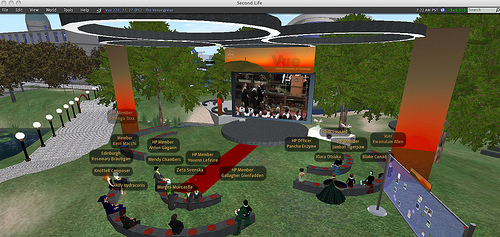
virtual graduation - photo courtesy of F Littleton
November 26th saw a new innovation for virtual worlds. Some students who are distance learners were graduating, but were unable to come to the ceremony – Fiona Littleton, working with colleagues in informatics, created the first Second Life graduation held in parallel with McEwan Hall graduation. 4 MSc graduates graduated in Second Life with 2 graduating at McEwan Hall. The live feed from McEwan Hall was streamed in to Second Life.
21 Guests in total attended the ceremony in Second Life – university staff, current students and visitors from other universities.
The event has now been nominated in the edublogs “best use of a virtual world in education” awards. To vote go to http://edublogawards.com/2009/best-educational-use-of-a-virtual-world-2009/ I must admit, it’s a difficult vote – I was also impressed by the Virtual Round Table conference, and CANVAS …
BBC Coverage:
news.bbc.co.uk/1/hi/scotland/edinburgh_and_east/8378291.stm
More details on the Virtual Graduation:
www.wiki.ed.ac.uk/display/VueWiki/Virtual+Graduation
or contact fiona.littleton@ed.ac.uk
More details on MSc in E-learning:
www.education.ed.ac.uk/e-learning
update: the virtual graduations have won the Edublogs awards for the “best educational use of a virtual world” – see all the award winners here
via Ruby (on wheels)
OK so the blog is looking a bit dismal again, but at least this time I’ve got a fairly water-tight excuse – ended up in hospital at the beginning of October, finally got diagnosed with viral labyrinthitis, and still off work (yikes!) and finding out for the first time in my life what I’m supposed to do with doctor’s lines and such-like. I thought earlier today that I would try reading some blogs, as a nice easy way to get the brain functioning again (yes – I heard you snigger). And then I came across a writing challenge in Miss Leonie’s blog and I got caught up in the general optimism of actually writing something that could approximate to a novel. It seems there’s been a challenge on for November. I’ve got this very small suspicion that before the end of November I won’t be able to complete the NaNoWriMo challenge, which is to write 50,000 words in one month. It’s still November (he he) so I guess I can still join in.
The idea is to get writing. Yes, always easier said … Miss Leonie has outlined the challenge here and the basic idea (hope you don’t mind me summarising it here – it’s so that I can remember what I’m doing!) of the first part is in one week to:
So I’ll have a go. Why not? By this time next week I’m supposed to post/photograph a blurry image of my first words just to prove that I’ve done it.
It’s a bit daunting, not just because I might find out that the wonderful best-seller is not that good after all, but also because I’ll keep reading the blogs of Miss Leonie, Loobylu and Tracylee, and they’re all just way too interesting for me to be able to keep up :’-(
via Ruby (on wheels)
I headed in to Edinburgh today, which is unusual for me on a Saturday, but there was a bike rally on and I thought I’d show some support. Although this wasn’t an SMC event, several SMC members turned up to support the general biking community (in particular, Edinburgh bikers and those who, like myself, commute into Auld Reikie every day). We met up at Hermiston park-and-ride – first time I’ve ever been there and I can’t say the experience tempts me to rush back; something to do with no coffee machine and the toilets locked …
A sizeable group gathered and at 12 noon we  headed off, following the police car and flanked by police riders. There had been a few rumours about the police wanting to get this over with ASAP, but we actually kept a fairly slow 10-15mph for most of the route. Every so often we got some waves from friendly pedestrians, who most likely had no idea what we were doing. The busiest area was the Grassmarket; plenty of people watching us and bemused tourists obviously wondering if they should look as if they expect this sort of thing every Saturday in Scotland’s capital. We reached the end of the route at Holyrood Park without any incident; the police outriders had done a fab job. There were a couple of speeches, urging us to lobby our councillors or (if we live outside Edinburgh) one of the ones marked on the sheet for general receipt of letters. The SMC contingent retired to a nearby coffee shop and sat in the sun to tell tales of biking daring-do.
Did we achieve anything? Difficult to say so yet, but hopefully some lobbying will make some waves.
Was it worthwhile? I’d say yes – seeing quite a number of people there does give the feeling that there’s enough motivation to get something done, and hearing the examples of other places in England where the idea has been successful does give a sense of purpose and hope for change.
I thought it was brilliant seeing the huge range of people – young racers, parents with kids, middle-aged sensible types (hmm … wonder who they could be …) and there were great photo opportunities  Oh – and the sun came out!
via Ruby (on wheels)
At the beginning of August I attended a really stimulating PALA conference (I have to add that I’ve never yet been to an un-stimulating PALA conference) and my ego was thoroughly boosted by people actually coming to my presentation (even though it was on the last slot of the last day …). I’m still working on the conference proceedings – when ready I’ll be putting a copy on my Mendeley profile but will let you know about that later. Oh – OK – here’s a rough outline:
My presentation was about analysis of text in Second Life (SL). I gave a quick overview of what SL is (with screen-shots mainly provided by my excellent colleague and SL-wizard, Fiona Littleton). The rest of the talk was in three parts:
So hopefully that’s whetted your appetite a bit …
Anyway, the next ego-booster at the conference was some other participants who approached me afterwards and asked if I could contribute something to a volume. Of course I said yes, and of course I’m now panicking …
So off to SL and books and theory, and exploration of literature in SL (as this is, after all, a PALA discussion). My explorations so far have not uncovered very much of interest in the literature in SL. It seems that there’s a general consensus that the idea of SL came from a novel (as with many great ideas that came from science fiction, I’m led to believe). I’ve also discovered that there are quite a few “libraries” in SL, and some publishing houses also have “stores” (one of which is an Irish pub). But the books themselves – what a let-down! Awful. What happens is: you find a book (on a shelf, or on a poster) and you click on the object. Then a window with text opens up, ready for you to read. That’s it. You read this g**-awful font in a pathetic wee window.
So I think it’s about time we created some really innovative literature in SL.
How about a narrator (the author?) who appears and invites you to listen to the story? There must be some kind of variation on an audio-book that would be interesting? And why not have you whisked off to a location where scenery unfolds around you as you “read” the story? I don’t think I’d like to have avatars acting out the story (Mr Darcy would just not work) so we could leave that out. And would it be possible to have interactive stories where you create the next part? Oh, yes, that’s right – already been done (but the people who are creating books in SL seem to have forgotten this particular literary device).
Personally, I think that even given the drawbacks of paper (it can get soggy if you read in the bath; it’s hard to hold up when you have to shield your eyes from the sun on the beach) I still like the old-fashioned books. But I’d really like to try out something new and different too … new stories in new formats.
I’ve got some ideas for the story I’ll be writing …
PS if you’d like to see an example of an innovative multi-media narrative, try Inanimate Alice
via Ruby (on wheels)
It’s not often that you meet people who just seem to be at the epitome of humankind … but David Crystal is currently my favourite person. Here are some reasons:
 I’m sure there are other reasons, but that’ll do for now. He spoke at the Canterbury “Cutting Edges” conference, and is going to be talking about his autobiography at the Edinburgh Book Festival. His abstract at the Cutting Edges conference:
New discourses in electronically mediated communication
How does electronically mediated communication alter our notion of discourse? There are some continuities with traditionally spoken and written text, but also important discontinuities. Differences with speech include new patterns of turn-taking, the use of emoticons, and new conversational rhythms. Differences with writing include issues of persistence, animateness, hypertext linkage, and framing. A pragmatic perspective brings to light new kinds of text, such as those which include features to defeat spam filters or to ensure a high search-engine ranking, or those which raise ergonomic or ethical issues. Electronically mediated communication also raises the question of how to handle texts whose boundaries are continually changing, as in forums and comment postings. Issues of responsibility arise relating to who is the author of a text, especially in contexts where there is moderation or interactivity (as in wikis).
If you haven’t already heard him speak, you should get your tickets for the Book Festival ASAP.
He’s already married *sigh*
via Ruby (on wheels)
Link: A very quick summary of events at a recent conference on “the future of education” (thanks to Mark Pegrum for the link). I was interested to note that Howard Gardner (of “multiple intelligences” fame) was speaking.
There are also some interesting videos, including a panel discussion on copyright and intellectual property.
via Ruby (on wheels)
Finally got to the Edinburgh Coffee Morning. I always pick up some interesting tips, and it’s great to find out what people are doing and looking into with software and widgets.
via Ruby (on wheels)
Should I volunteer? For some time I’ve been receiving news and reading the “Seeing Hands” blog. It’s an inspirational look at helping blind people in Nepal to gain education and a paying job – not easy in a country that assumes blind people cannot contribute to society. I’ve been wondering about volunteering to go – it would be a worthwhile use of my massage training and it would give me a chance to see Nepal, a country I’ve always wanted to visit.
Should I?
via Ruby (on wheels)
I was recently pointed to some software that is now in beta – called Mendeley – which gives you a way to store research citations and then access it from any computer. I’m still working on seeing the ways it could help with research, but so far it looks really promising!
What I like about it:
I can work online or offline, and then synchronise my references with the online version; then I can go to my office computer andsynchronise also, which means I don’t have to keep sending myself emails to rememebr to update!
via Ruby (on wheels)
