

MMOGS such as World of Warcraft and EverQuest can be viewed as communities of practice. Etienne Wenger (2006 - http://www.ewenger.com/theory/index.htm ) identifies three elements that characterise a community of practice:
· The domain – a shared domain of interest that members are committed to and have a shared competence that distinguishes them from others
· The community – members engage in joint activities and build relationships so that they can learn from each other
· The practice – members are practitioners who develop a shared resource of knowledge and expertise through sustained interaction
The community of practice is evident in the guilds of World of Warcraft . As John Seely Brown (2005) points out, guild-building is important in WoW. High level quests have to be carried out by a well-organized team with players who have diverse skills e.g. warriors, healers and spell-casters. The WoW guild has all three elements that Wenger identifies as essential to a community of practice.
David White in his case study of World of Warcraft in Whitton (2010) mentions that there are three significant techniques that WoW uses to encourage the formation of communities of players (or communities of practice):
· Their management of presence
· The formation of multi-skilled teams
· The pursuit of clear goals within an overarching narrative
White claims that the first two techniques have not been properly considered by those designing online learning environments. White makes the point that interaction in a community requires fostering both a feeling that the environment is safe and a feeling of trust that others in the community will respond to one. White claims that WoW successful does this by how they manage presence. The player is immediately aware of the presence of others in the game by being able to see their avatars. More importantly there is a general chat channel which is open to all, so the player can see the interactions going on without having to risk engaging in interaction. It is this low-risk management of presence that allows the novice player to learn the etiquette of this new world enabling them to eventually more from being an individual player to a group player. In addition, Hagel, Brown and Davison stress that there is also there is a whole “’knowledge economy’ surrounding the game –videos, blogs, wikis etc.” (http://blogs.hbr.org/bigshift/2010/01/a-better-way-to-manage-knowled.html )Any player can access these resources to learn more about the game.
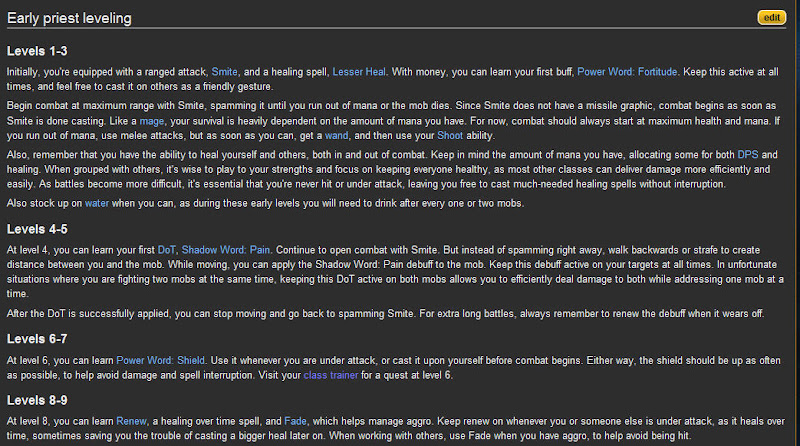
White’s discussion about presence resonates with my own experience of WoW. I am still at the early stages (having attained only level 6 at the time of writing this piece) – so I still do not feel that it is a safe environment – although I feel comfortable enough to go there on my own. However, I am aware of the open chat channel and I have observed interactions among other players – so I am getting a feel for the community. I have explored some wikis that discuss my role of the priest and the best way to maximise play at different levels.( http://www.wowwiki.com/Starting_a_priest )
I can see that if I decided to continue to play WoW that I could get to a point to start interacting with other players and maybe eventually join a guild. What I like is that I am not forced to immediately interact with others – that the game world is structured so that I can learn on my own the social norms of the world and that I am allowed to decide to interact in my own time.
Having time to explore the game world and learn about the role you have adopted leads to White’s second point about how WoW encourages the formation of multi-skilled teams. White makes the point that educators should think of designing goals that require a multi-skilled team. He feels that assigning roles is crucial to collaboration when it comes to learning. Ideally he would like learners to be able to experiment with different roles as they can in WoW.
The way WoW manages presence and has quests that require a multi-skilled team encourages the formation of guilds (a community of practice). I would like to design a game that leads to the development of a community of practice of qualitative data analysts. My goal is to design a game which is about what John Seely Brown calls ‘learning-to-be’ a qualitative analyst as opposed to ‘learning-about’ qualitative analysis. I am not sure whether a MMOG is the type of game for what I want to do, however, I can see how I can extract the ways that WoW encourages the development of communities of practice. I could see that the analysis task can be divided initially so that each analyst would be working on part of the data set (could be divided into types of data such as text, graphic, video, and audio). The initial tasks would be simple – organizing and classifying the data, moving on to commenting and reflecting on the data. This initial period would enable the analyst to familiarise themselves with their part of the data set and start to gain confidence in their ideas about the data. However, to develop the analysis, they will have to work as a team and collectively decide how to code the data and eventually they will need to collectively construct their arguments about how the data addresses their research question.
References
Brown, J.S. (2005) New Learning Environments for the 21st Century, Forum for the Future of Higher Education Symposium. Aspen.
Hagel, J., Brown, J.S., and Davison, L. (2010) A Better Way to Manage Knowledge, in Harvard Business Review blog, 19 January 2010
Wenger, E. (2006) Communities of Practice – a brief introduction, http://www.ewenger.com/theory/index.htm
White, D. (2010) Case Study 6: World of Warcraft in Whitton, N. Learning with Digital Games, Abingdon: Routledge.
Comments
Since I posted this blog post I read Sarah Payne's blog post where she interviewed some WoW players
http://holyroodpark.net/sarahpayne/weblog/4097.html
They did not enjoy the social side of the game and had some bad experiences. One had joined a guild and put in some money in it and the guild leader suddenly disappeared with everyone's money. Sarah also reported in the Discussion Board that she subsequently talked to someone she knew who had been a guild leader who resigned because of the in-fighting.
So WoW may not be such a safe environment as White suggests. Obviously an area for further research.