Ok I am rather sheepishly bring my seeping epistimological wound into my own blog where I can lick it quietly. Sorry I know that is gross but you know what I mean - we had enough fur and feathers flying in the forum, that even though everything has settled down nicely I feel a bit nervous about rubbing my hands together and saying...
"So, epistemology eh?"
It began here:
Me: But in this case, I just don't see this because, it is for the purposes of our current discussion unknowable - the nature of truth and reality. It seems like quibbling to discuss this when a certain functional acceptance of true and false is necessary to get simple tasks (like writing dissertations and cooking chickens) done. Especially as much of it seems like semantics. Truth like greek love and eskimo snow has many different forms, and one of us picks one and an other picks another and then we have a discussion - which is essentially meaningless because we are talking about different things.
Hamish: In writing your dissertation you will be planning to come to some conclusions, I assume? It is really rather expected. De rigueur, you might say. So you will be making truth claims. That is the nature of it. You need to know then, what it is you are doing. You are not doing journalism. You need to understand what you are saying and, impostantly, what you are *not* say, or able to say. That is what we are about. And it is challenging.
This is the thing, and I fear I may have exaggerated my lack of understanding along the way somehow, but I get what Epistemology is, and how it differs from Ontonology. (I have no idea why I am capitalising them, maybe I have a German ancestor, or possibly just giving them the respect of Very Important Words I Don't quite Feel I Can Relax Around.) Anyway, the thing is I am not sure why we have to bother with them in order to do research. Lol, I could hear the collective gasp of horror from everyone who has every done research ever after I typed that. Shall I explain here that I have never done research ever or leave that for another blog post. Ok, ABP. I really want to be convinced, by the way - I am very much lawful good when I play dungeons and dragons. I would love to conform, I just can't fake it.
Anyway, according to the whims of epistemology I need to get off the fence and have an opinion about knowledge.
When I make a truth claim about something either (and these are the main current contenders, not an exhaustive list, and assuming my research is good) the meaning I am offering up:
a) it is there, in stuff, and is therefore something I have discovered - and had I not discovered it, it would still be there
b) it is in my head when I 'look at' stuff and I inflict it on whatever I am assigning meaning to, but it is not inherent in the thing itself
c) it is constructed in the relationship between me and stuff
If I believe the former I am an Objectivist, if I believe the one in the middle I am a Subjectivist and if I believe the latter I am a Constructivist which is apparently the coolest position to hold at the time of writing - and you can see why, it is like the democrat of the epistemological world.
I look at those 3 choices and think "no I don't want to be any of them because I can see that all are equally possible and equally unknowable" and if I am picking one, then it is because I have to, or because it comes with good research tools and therefore I will be an agnostic when it comes to knowledge kthanx.
What makes it worse is that you have to pick one (and I get it that you don't have to be 'it' forever, you can select a stance for a particular research interest) because the rest of anything to do with research is totally dependant on this issue. If you don't have an epistemological stance you can't have a theoretical perspective, if you don't have a theoretical perspective you can't have a methodology, and yes... Crotty concedes rather magnanimously you can have methods because they are rather promiscuous critters who will hang out with anyone, but if you have a bunch of methods without the other parts then pretty much everyone is going to be tittering behind their hands when you hand in your dissertation.
I feel like I am being told that in order to read a Bible I need to be a Christian, and if I fancy taking a peak at a Qur'an I must convert to Islam (but don't worry I can go back to being Christian when I have finished). And when I wail "but I am agnostic" I feel like my inner voice says, "oh well then why not adopt a Buddhist Approach, because that is essentially agnostic, it is not like they believe in God, and then you can read the Tripitaka, which is pretty cool, it has the fire sermon in it and everything. Go on, be a Buddhist, it will make Hamish happy.
Apparently we have been recommended to keep a blog for Research Methods. I feel like I have had so many blogs my MSc in E-learning, but in fact it has been 2 main ones, this for IDEL and a Wordpress blog for Digital Cultures. I didn't know I could access either still until Damien mentioned Holyrood Park blogs and I went there hit a few links and found this old girl sitting here all neglected like Miss Havisham.
Seems appropriate that my IDEL blog gets to be my Research Methods blog. If I had my time again I would continue to keep a blog after IDEL through every course, as I think that would have been invaluable. Just thought I would mention that in case there are any IDELers wandering past, lol.
Anyway, Research Methods... yikes. A month ago I was in the blissful state of just worrying about the maths, little did I know that that worry would be utterly subsumed by my need to worry about everything else. I am currently in the zone where everything I say on the DB seems to be wrong, or off the mark somewhat - so it will be a relief to come here and mutter to myself in my inappropriately humorous, journalistic manner. I have struggled with being insufficiently academic from the beginning - I bet there is a blog about it back there somewhere - and hoped that one day something would click and I would have access to an appropriate mode of discourse (whether this would be a new way of thinking or simply a new way of presenting my ideas I don't know), but now I am going to do myself the favour of not worrying about it. Hopefully I will be able to muster enough faux gravitas for my dissertation but ultimately I accept it is not me. I am not academic. Nuff said.
That isn't to say I haven't loved it. I fully appreciate every piece of wisdom that has gone in. I just don't seem to have much control over how it comes out, lol. And before I give the impression that 'this is the end my friend' it isn't... I have one more course after Research Methods before I can consider myself a Master *snort* oh yeah, and the small thing of the dissertation.
Lolz.
Anyway, as ever this blog will be public and comments are welcome from all and sundry, especially the sundry.
I found Royle (2008 [1]) an interesting lens through which to view the last few months of thinking on digital game based learning. Royle touches on many of the themes which have persisted across game genres and approaches, such as the conflict between educationally focused games and commercial releases (particularly around verisimilitude (e.g. de freitas (2008)[11]), gaming cultures, and the tension between what makes a good educational experience and what makes a good - and entertaining - game experience. One of the factors he identifies is the time that a game should take, something that is particularly interesting at this stage of the course.
Over the last 12 weeks I have tried and played and looked at dozens of games but the engagement has largely been as part of short lived experiences. This may resemble many pedagogical experiences of games - which might occupy a single week of study or be restricted to demonstrating a particular concept - but this style of engaging with games poorly represents the experience of playing games for leisure. Puzzle games, often the very shortest in terms of narrative and challenge, might occupy a regular portion of a players time every day, week or gameplay may last over many years of regular short play. Complex games across many other genres can occupy weeks or months of committed game play: regular gamers I know will easily spend 3-5 hours a night on a game for the first few weeks they own it, in a few feverish cases gamers will simply play a game from start to finish only pausing to sleep and eat. It would be unreasonable and undesirable for learners to play for long bursts every day on a game - no matter how educational - but Royle argues that an educational game can scarecly claim to be a "game" unless it sustains a long and rich play period. He ties this style of play with notions of learning as rehersal as a sort of "virtual apprenticeship" an argument I see significant validity in:
"The original conception of Racing Academy was that through the game play and collaboration with other game players there would be an opportunity to act as a community of scientists and engineers, and use the language and practices of scientists and engineers. It was as much about developing identity as scientist or engineer as learning science or engineering."
Owen, Daimant, and Joiner (2007) quoted in Royle (2008: 3).
Such long form games present significant challenges for assessment and reflection since such assessment would require either for gameplay to be a non assessed part of learning or an enormous amount of tutor and support time. Whitton (2010 [2]) and Prensky (2001 [7]) both take pragmatic and practical approaches to integrating games into education and it is interesting to thus see how both differ, to an extent, from Royle's idealistic take on what may realistically be possible, and also from Gee's (2003 [3]) ambitioous expectations around the of 36 Learning Principles for digital game based learning that he defines. However on the whole Whitton, Gee and Royle all agree that fun and engagement are increadibly important qualities in any educational game and this is also supported by theories around the value of intrinsic motivation in learning games (e.g. Malone (1980) [8], Barab et al (2005) [9]) and notions of flow (Nakamura, J and Csikszentmihalyi (2002) [10]). "While real content is a good thing, it should not disrupt gameplay; the content presentation must be believable within the context of the game. If a believable backstory and mission have been established, real content can be inserted seamlessly into the environment. It's the crucial balance between real content and narrative that works, and the gameplay should drive this. "
Royle (2008:3)
"cheating should be both intrinsic and extrinsic to the game"
Royle claims that these are established parts of the games community and should be used in learning games also. However Some players in an educational setting will not be part of that community and cheating may be culturally problematic to them. Open structures of participation, whilst often ultimately more rewarding, can meet some resistance and, with games in particular, rules may be unsettlingly unclear compared to anticipated structured forms of learning (Jackson 2009). Whilst I agree with Royle that: "The search for cheats is itself pedagogically important; the moment a player searches for extra knowledge, an independent learning strategy is invoked."
Royle (2008:5)
I am unconvinced that simply giving a student a problem will trigger this behaviour and Gee (2003) indicates that such ingenuity may be expected only at a very advanced level of mastering gameplay and experimental hacking, unless acceptable cheating is introduced in training levels (as in Gee's discussion of Tombraider training levels). Thus some sense tutor approval needs to be conveyed to indicate acceptable cheating mechanisms to those students more used to adhering to rules. Crucially there may also be cheating bounds to be set at the other end of the spectrum - a student may be able to hack the result of a game so that they succeed without the pedagogically important steps of gameplay and this may well be an unacceptable level of cheating within the curriculum.
The idea of building a cheat site in addition to a learning game is an intriguing concept, particularly in the current educational environment which is particularly focused on clarifying and eliminating plaigurism that coincides with the growth of written-to-order assignment web services. Cheating of any sort can indicate great intelligence and independent thought from a student but there are conventions and reputation systems within academia which rely on the principle that honesty and originality is to be respected and revered (even if the reality can occasionally include inconsistancies and compromises such as inequalities in the sharing of credit for work or competition to "scoop" research colleagues). Thus an attempt to merge educational and academic cultures - a merger whose history Royle criticizes - must face a distinct moral complexity introduced by encouraging certain types of cheating but discouraging others.
The cultures of appropriate game structures, behaviour (including cheating) and player expectation are problematized by many factors, not only those of educational vs. commercial. The discussions in the comments section surrounding a particularly critical article by Adams (2010 [4]) on cultures of conduct, commerce and cheating in Chinese Free-to-Play online games are fascinating as they reveal substantially different expectations and cultural prejudice (both comments and article are tinged by prejudices around Chinese games culture) from a random cross section of digital games players. The notion of fairness is particularly in the contrast of Royle's comments about cheat sites and lively quasi-commercial communities to support pedgagical aims since such communities can be very cliquey and communication is not always made public - potentially allowing some learners greater advantage than others.
By contrast Royle's concept that narrative, social reflection spaces and personalisation should be important to educational games design seems obvious and well informed by current pedagogical thinking around personal reflection and student centred learning
The centrality of narrative to engaging gameplay is evidenced by the popularity of games that build on the success of games that build on popular film and television properties. These are familiar characters and narrative arcs and thus enable players to enter the game fully aware of characters, relationships and game goals before engaging in gameplay. For instance the successful series of Harry Potter games or the upcoming interactive Doctor Who games (Stuart 2010 [5]). Though not specifically considered over the last few months such games offer a simple model on which to build educational customisations. Royle cites "DoomEd", an attempt to include educational science content into the familiar Doom game narrative, but there is no reason why the current popularity for "brain training" and quasi-educational games cannot be combined with popular mainstream entertainment narratives and more credible pedagogy to create something genuinely educational and fun. Whitton (2010) and Royle (2008) both highlight the important role that educators can play in the process of creating and developing commercial learning games. This partnership working also resonates with current funding arrangements around educational technology (e.g. JISC (2010) [12]) and it will therefore be exciting to see if a new generation of fun learning games begins to emerge are more educators engage in the creative process of game design.
Concluding Thoughts on the last 12 weeks There is something compulsive and alluring about games and the playful visual aesthetics of digital gaming. They are engaging, visual, transliterate and frequently social. They can be directly educational, accidentally educational or be cleverly made into authentic learning moments. The challenges of actually introducing digital games into educational practice are, however, numerous and range from simple to foresee (though not always to resolve) matters of hardware, cost, fitness for purpose, accessibility and time through to more unexpected complexities such as in-game etiquette, sustained engagement and the positive and negative impact that fun game based activities may upon more traditional learning activities.
I came into this module an enthusiastic newbie to gaming with limited but positive and negative experiences. I have found this an immensely thought provoking topic but, at the end of 12 weeks of reading, discussing and, above all, playing digital games I still find myself distinctly uncertain about the best ways in which to deploy a game in a learning context though I feel well armed with theories and practical guidance (particularly from Whitton (2010)) on the subject. I find the cost and speed of commercial production an intimidating prospect for educators looking to support and entertain learners through game based learning experiences. I think I have come to the conclusion that digital game based learning can only take place when an educator is directly and personally passionate about the game(s) they use, and who is willing to be open and responsive to calls for support or criticism from learners. Games must also be fun on some sort of level in order to work as educational spaces since, to be frank, any form of education must be engaging and fun (to an extent) in order for learning to be retained, particularly when learning takes place in unconventional spaces.
In the spirit of fun I will therefore close on a video that draws on the appealing aesthetics and conventions of retro gaming and brings them to life. Such creative blurrings of fantasy and reality are, after all, one of the most beneficial aspects that gaming brings to educational experiences.
References
• [1]. Royle, K. (2008). Game-Based Learning: A different perspective. Innovate 4 (4) • [2]. Whitton, N. (2010). Learning with Digital Games: A practical guide to engaging students in higher education, London: Routledge. • [3]. Gee, J. P. (2003). What video games have to teach us about learning and literacy, New York: Palgrave Macmillan. (core textbook) • [4] Adams, Ernest (2010). The Designer's Notebook: Selling Hate and Humiliation. Gamasutra, 8th April 2010. Retrieved 8th April 2010. http://www.gamasutra.com/view/feature/4319/the_designers_noteboo • [5] Stuart, Keith (2010). Doctor Who Adventures - and the future of cross-platform entertainment. Guardian Unlimited Technology section, 8th April 2010. Retrieved 8th April 2010. http://www.guardian.co.uk/technology/gamesblog/2010/apr/08/doctor • [6] Jackson, Janna (2009). Game-based teaching: what educators can learn from videogames. Teaching Education, 20 (3). pp. 291 — 304. Retrieved 10th April 2010. http://dx.doi.org/10.1080/10476210902912533 • [7] Prensky, Marc (2001). Digital Game-based Learning. (USA: McGraw-Hill) • [8] Malone, T.W. (1982) Heuristics for designing enjoyable user interfaces: Lessons from computer games. Proceedings of the 1982 conference on Human factors in computing systems table of contents. Gaithersburg, Maryland, United States. • [9] Barab, S., Thomas, M., Dodge, T., Carteaux, R., & Tuzun, H. (2005) Making learning fun: Quest Atlantis, a game without guns, Educational Technology Research and Development, 53(1), pp.86-107 • [10] Nakamura, J and Csikszentmihalyi, M. (2002) Chapter 7, 'The Concept of Flow'. In The Handbook of Positive Psychology by C.R. Snyder and S.J. Lopez. Oxford University Press. • [11] de Freitas, S. (2008) Emerging Technologies for Learning. BECTA research report, March 2008, Volume 3 (2008). • [12] JISC (2010). Business and Community Engagement. JISC website page. Retrieved 10th April 2010. http://www.jisc.ac.uk/whatwedo/themes/bce.aspx.
At a talk on the history of Lego [1] that I attended this week I discovered that Lego are about to launch a new MMOG (Massively Multiplayer Online Game) called Lego Universe (see trailer below). When asked, only two people in the audience had heard of this type of game and yet I think there would have been a great number more hands raised if the question had been "Has anyone heard of World of Warcraft or Everquest or games that work like them?".
The popularity and business models of MMOGs, RPGs and MMORGs makes them a fascinating possibility for education. Though television shows, sports and home console games all have a significantly more visible leisure presence in current popular culture there are huge numbers of people quietly living our complex personal and social fantasies in these rich online games. Many of these games (indeed most of those I have seen) are significantly expensive to participate in and yet World of Warcraft (WoW) has over 11 million subscribers - all willing to pay an upfront fee and between $13 and $16 per month to play (around £8-10) the game[2] (see also Chan et al (2006)[10]) - indicating that there is something deeply compelling and entertaining taking place within such a game. Furthermore there are whole communities and businesses based around a game like WoW - machinima[4] and gold farming[5] (see also video below which forms part of a project from Ge Jin, a PhD student from the University of California San Diego[6]) being the most notorious though cafes that provide spaces for social (in both physical - the impact of which is discussed in Brown's account of new learning spaces (2005)[9] - and virtual senses) playing of MMORGs, quasi-official/unofficial merchandise and artwork[7], and web videos also feed off this very active community.
That social spirit and sense of investment in MMORGs is well captured by Gee (2003) [8] in his description of the intense anxiety of a player, "Adrian", facing the possibility of losing both elements of a character that he had built up (he would drop two levels if he was not ressurected - equating to about 12 hours of gameplay) and his relationship to his "clan" in EverQuest. A highly social process had to be completed to ressurect his character sparking an unusual overlap between his virtual clan and their real life identities. The most interesting part of this process is the team working and the ways in which this reflects practical real world skills. Gee describes the distributed skills structures at work in EverQuest clans and WoW guilds as "the Social Mind" and he also reflects on the ways in which highly experienced gamers can in turn become creators and hackers of these spaces - through the same social sharing processes that makes progress through the game possible. Hacking of this type can potentially generate huge technically skilled creativity (something highly transferrable not only to the games industry but many other professions) that takes the player beyond the game and into reflection on their gameplay experience and into a new form of role play where, instead of playing, say, an elvin hunter (my personal choice of character for our own experiments in WoW for this course) the player instead plays at being a games developer and/or computer programmer. In some senses it is this hacking activity - reflective, self-led, experimental, creative - that offers, in my opinion, the most exciting possibilities for learning since, if my own experience of learning programming is in any way representative, activity of this type will empower and have significant impact on the learner.
I acknowledge however that for many educational a more controlled gaming experience is preferred and the concept of team working and cooperation can certainly be safely experimented with in MMORGs in a way that is not always possible in person. We have debated the positives and negatives of role playing activities in physical situations on the discussion boards recently and it has been interesting to hear others' experiences of real life role playing contrasted with virtual experiences. Role playing should always be about a safe space for experimentation and the making of mistakes but many real world groupings include rivalvies, pre-existing relationships, and awkward social dynamics that can compromise the safety of the space. It would be nieve to assume all such compromises are eliminated in MMORGs since it may be that pre-existing rivalries and relationships exist (particularly if long term clan/guild relationships exist - a fun reflection of these strong affinity group bonds (Gee 2003) is included, below, in an episode from "The Guild" [16]) but it is fair to assume that an element of physical anonymity will allow some learners to feel more free to behave more freely.
There is, however, a concern raised by the embodiments possible in MMORGs particularly if they are to be used educationally and their use encouraged by trusted institions. At the time of Gee's account Adrian was 15 whilst a pivotal member of his community was a player from Indiana in his Thirties. Adrian comments:
"I still talk to the guy from Indiana sometimes. All of us have websites and message boards to talk on, to keep in contact with each other. Even with all like the Internet security stuff, we try not to give out our personal information, but after you get to know the person for a while, it becomes like second nature."
Although a sense of personal responsibility can, to an extent, be expected from higher and further education students it is still important that any educational use of MMORGs be well supported and that any learners exposed to these spaces be able to make well grounded judgements around their own privacy, the social ettiqueete and the potential costs of subscribing to MMORGs. Ensuring students are well supported will also mean ensuring games are available for multiple platforms (Windows, Mac OS, Linux, etc.) or are centrally available on campus (where applicable), something that proves to be no slight feat. Some console based games already offer online connections between diverse platforms (Chan et al 2006) but for games such as World of Warcraft, which are well established but also contain legacies of earlier technologies, organising in-game events may be complex for both students and tutors (something experienced this week in both WoW and EverQuest sessions). Software that may be limited in terms of compatibility, availability and cost is not a new issue (indeed software like AutoCAD and SPSS as well as costly GIS packages are commonly used by academia despite such constraints) but the element of fun, confidence, sociability and playfulness that one wants to encourage in game spaces can be hard to encourage if learners are confused, angered and frustrated (and potentially even excluded) by the process of entering the game space. In many physical courses initial encounters with software can be controlled by lab set up and increased levels of in-person support but the diversity of computers/gaming systems that students on an electronic course (such as this one) may be using makes support an extremely complex and unpredictable prospect.
Chan et al (2006)[10] examine the demographics of MMOGs and these two raise challenges to those wishing to make pegagogical use of MMOGs. Although women (indeed women over 40) represent a large proportion of those playing online games it is young adult males that make up the majority of MMOG players. The authors also note that many MMOG players, for various reasons, spend a colossal amount of time on play citing a study by Griffiths et al (2003)[15]) that found that a quarter of EverQuest players interviewed spent an average of 41 hours online (Chan et al (2006:81).
Personal MMORG Reflections
My own experiences of MMORGs this week were limited to playing World of Warcraft. After a quite spectacular amount of time trying to get the software set up and functioning (I had accidentally downloaded a full version of the software and was mystified, when I downloaded the correct trial version, to find it installed this software as a separate application) and setting up my Battle.net account I was finally able to choose a player - an Elvin Hunter I names Suchgreeneye - and begin trying ouit the game itself.
I found that gameplay was relatively intuitive though the screen layout was intensely complex and I was aware of the fact that I was not exhibiting particular skill in moving and inhabiting my character, or making selections of appropriatte tools and strategies for her. The format of the game - many sub missions make up the large MMORPG - guided me to near instant gratification as I found myself completing small manageable tasks and feeling great satisfaction at the achievement despite early tasks being clear training levels. However I did not (in part, perhaps because of my technical problems that meant I was unable to join the course sessions) find the game terribly social as a space. A few characters said hello to me and I attempted to communicate back. I am aware that the usefulness of guilds and social play does not really occur until a player reaches an advanced stage of the game but I also felt this was quite an alien space for conversation.
Just as I am naturally suspicious of chatting to random strangers in real life and in second life, I was also cautious about speaking to random characters in WoW. In part this was my own fault: I chose an avatar that had some synergies with a username (suchpretteyes) that I use widely online and, although I do not really think others would immediately google the character name and find me, I do consider my usernames to be recognisable versions of myself and thus somewhat exposed. On the whole I was, however, more concerned that I simply did not know how or what to respond. Should I respond in character or as myself? Should I be chatty or is WoW primarily about the game? Could the person I was speaking to possibly be less knowledgeable about Wow? How would I make conversation with them? I am sure some of these issues would be overcome by further gameplay. Although I enjoyed spending a full evening (many more hours than planned) in WoW I did not find myself pining for gameplay the next day. Indeed I had previously been toured around WoW by enthusiastic friends and I could not - either as viewer or player - find a compelling reason for playing the game seriously on a regular basis. I enjoyed the game greatly - though I have some reservations about the learning possible by a game that is fundamentally centred on conflict - but found it hard not to be aware of the monetary and time cost of enthusiasm. I could not say whether this subconciously affected by enjoyment or engagement but I know that conciously it was a factor in my motivation to play on beyond the first few hours. The notion that I could get engrossed enough to take up a subscription somewhat alarmed me, not because this is any more inherantly unacceptable or odd than going to the cinema once a month, going out to dinner once a month, or other regular recurring leisure costs, but more because there are many other things I would prefer to do with my time and many friends I would prefer to stay up to date with online but already find it hard to make time for (they are not WoW players so I could not, as I know some friends do, use WoW as a shared virtual social activity space).
I had hoped to try some other MMORPGs out during this course but was unable to successfully access EverQuest and ran out of time for further MMORPG experimentation though I am excited to trial Lego Universe when it comes out as I have a great existing affection for Lego as a creative experience. Farmville is, however, the game I am most interested in trying out following our work on WoW. Like WoW Farmville has a huge and growing audience, attracts substantial income from that audience and has, on the whole, existed relatively quietly as a social game within Facebook. Unlike WoW Farmville sits in a female dominated online space and is based around farming activities so potentially offers some interesting possibilities for learning even as part of conventional gameplay. The connection to existing mediated social networks has both benefits and compromises for pedagogical usage since it would be administratively simpler to set up a game between students but might force students who would not otherwise wish to open access to their profiles to uncomfortably blend studying and private personas. It is an intriguing space though so I want to play and explore it in the near future.
Tangental MMORG learning activities
At the beginning of this blog post I commented on the phenomenon of Machinima and so, to close, I wanted to return to the idea of subverting games designers' intentions in MMORG activities. Earlier this week my course colleague Sarah Payne posted a short insightful interview she had conducted with other players in World of Warcraft about the sociability of game play (Payne 2010 [17]). This is not an activity that forms part of game play, nor is it an activity that could only take place in this (or any other MMORG) space, but it is an activity that potentially benefits from the anonymity and sense of community that exists in the space. My own experience of conducting a mini digital ethnography for a previous module (Osborne 2009 [18]) brings to mind several interesting possibilities for using MMORGs for engendering trust in research participants. For particularly sensitive subjects participants may wish to remain anonymous even to researchers - although such situations would obviously raise tricky complexities around the validation and deeper analysis of participants' responses since such interviews would lack authenticatable context.
On a much lighter note I also liked the creative use of WoW as a space for comedic experimentation in the video included below (Machinima 2008). As Rich Kuras talks to various WoW players and polls their opinions of candidates for the 2008 presidential election he actually reveals opinions and ideas that are at least as insightful as many serious news programmes' focus groups into the same topics revealed. By placing the democratic process in a playful space the filmmakers elicit playful but personal responses from players.
Returning to Gee's discussions of Semiotic Domains I think this offers a fun model for increasing engagement from those who may not feel that public debate is couched in anologies or terminology that speaks to them. With a UK election currently approaching this is broadly interesting but I also see links here to many learning contexts in which the process of moving from an outsider to an insider can be slow and frustrating and where greater connection to familiar environments may increase initial levels of understanding and ownership of learning.
[8] Gee, J. P. (2003). What video games have to teach us about learning and literacy. New York, Palgrave Macmillan. Chapter 7: The Social Mind: How Do You Get Your Corspe Back After You've Died?
[12] Steinkuehler, C. A. (2004). Learning in massively multiplayer online games. Paper presented at the Proceedings of the Sixth International Conference of the Learning Sciences, Mahwah, NJ.
[13] Walker-Rettberg, J. (2008). Quests in World of Warcraft: Deferral and Repetition. In H. G. Corneliussen & J. Walker-Rettberg (Eds.), Digital Culture, Play and Identity: A World of Warcraft Reader. Cambridge, Mass.: MIT Press. Chapter 8: Quests in World of Warcraft: Deferral and Repetition
[15] Griffiths, M. D., Davies, M. N. O., & Chappell, D. (2003). Breaking the stereotype: The case of online gaming. Cyber Psychology & Behaviour, 6. pp. 81-91.
I'm blogging about this week retrospectively now that I've had a chance to mull further on the readings and ideas. In looking at the ideas of engagement, motivation and narrative we touched on some topics that really excited me but were a touch tangental to gaming.
Flow
The discussion of “Flow” from Mihaly Csikszentmihalyi (TEDtalksDirector 2008) and Nakamura and Csikszentmihalyi (2002)[4] really captured my imagination. This idea of reaching a heightened state of awareness and of filtering and focus, where one loses all track of time whilst absorbed in a task, is very recognisable and seductive as a state for learning. The further idea that even unengaging activities can become engaging if Flow is achieved (Nakamura & Csikszentmihalyi 2002 [4]: 92) is particularly pedagogically intriguing. In theory it suggests that if you can provoke efficient behaviour you can engage a student with learning though I think this would be a cynical and ineffective way to ensure your learners actually engage with the curriculum. However the related idea that a more skillful task and “skill stretching” (Massimini in [4]) is more demanding and helps promote a state of flow and engagement seems logical and it is self-evident in personal and/or many group learning activities that a lack of challenge can quickly lose attention.
How one creates and assesses a state of flow seems to be a significant challenge despite efforts to measure (e.g. Csikszentmihalyi & Csikszentmihalyi (1988), Mayers (1978) both in [4]) and create computational spaces designed for flow (e.g. Schmidt (2000), Trevino & Trevino (1992), Matocchio (1993) as discussed in Nakamura and Csikszentmihalyi (2002) [4]). But there seems to be a relationship between self-esteem and flow (perhaps in both directions) and a role for day to day success to contribute to flow (Schmidt 2000 quoted in [4]) - both aspects can certainly be supported by the pedagogic choices and mediation that takes place in digital or physical learning environments. Interestingly the fostering environments identified (Montossori schools, occupational therapy, exhibits in the Getty Museum in LA (in exhibits)) are about creating the freeing and open environments often associated with pioneering work spaces such as the Google offices in the US and Switzerland. The further example of Key School (Whalen 1999 in [4]) appears to offer facilities that enable proximal learning as well as fostering flow states and this is perhaps no accident. Indeed even if flow is not a useful theory (a question raised in our tutorial with Nicola Whitton this week) establishing creative spaces that raise learner self esteem and their sense of personal achievement can certainly have no ill benefits (whether in digital game-based learning, online or physical spaces).
From the more specific games angle Nakamura & Csikszentmihalyi (2002) talk about relaxation and flow as being two intrinsically rewarding states which would seem to raise a useful role for games in finding educationally beneficial flow. Furthermore LeFevre (1988 in [4]) talks about a desire for leisure even when workers are experiencing flow, a challenging effect but one which should further enforce the role of games in creating flow.
In reading about flow the part that rang most true for me was the idea of the “autotelic personality” - a person who enjoys life and/or does things for their own sake. Abuhamdeh (2000 in [4]) indicates that autotelics are less stressed and strained in flow than out (whilst non-autotelics experience opposite states). This resonated with my own usage of time and perhaps could be interpreted as the reasoning behind the idea that “if you want something done, ask a busy person”. However I found myself wondering about the conflict between useful and useless states of flow? You can, from what I can see, be autotelic and productive but you may also have trouble harnessing flow on the activity you want to focus or achieve progress on (vs. a fun or less important goal). Flow can also be interrupted so unrealistic or unmet goals, reminders or interruptions may trigger drops in self-esteem and breakage of flow.
I did not fine Crawford (1982) [3] as exciting. Crawford seems to suggest that exploration and fantasy must always be interlinked but I think my science and tech interests contribute to my personal sense that exploration is about imagination, trial and error and as free and creative a space as can be provided. However I don't think that fantasy is an essential to that process – even in games. Games do offer safety nets – I think we have discussed that throughout the last few months – and can offer some of recognition (I am not sure all games must have interaction at the core but a game like N0t Pr0n can be frustrating because it takes place on an individual and pretty much private space) . Crawford's suggestion that games were the earliest form of communication is problematic to me but I think if one thinks of playfulness as being a key part of survival I can see and accept that argument about the centrality to play and games.
Crawford also raises the issue of sensory qualities (“proof of games reality”) being important to motivating and enjoying game play. This harks back to de freitas (2008) [7] and her discussion of game quality as important to learning. I am not convinced by either Crawford or de freitas here but acknowledge that the prevailing direction of commercial games is towards the hyper real – whether in “realistic” visual scenarios such as war games or simulations (e.g. recent versions of The Sims) or real looking high definition fantasy games such as Final Fantasy and recent Zelda incarnations (see below - the latter video even agrees with Crawford and de freitas that better graphics make for better engagement).
As I have mentioned before on this blog I am not convinced that realistic games are automatically engaging nor that realistic high definition graphics are required to become immersed in a game but I wanted to note the similarity in those arguments from the very different perspectives of Crawford and de freitas.
ARGs (Alternate Reality Games)
The remainder of this week's readings complimented our games focus of Alternate Reality Games. Whitton (2010) [2] and (2008) [5] specifically examined the role of ARGs in learning contexts. Whitton (2010) [1] meanwhile discussed the complexities of assessing the effectiveness and learning from digital games as well as highlighting the importance of aligning engagement to desired learning outcomes, something particularly pertinent to sophisticated gaming contexts including ARGs and MMORPGs. Indeed such sophisticated games, by virtue of their complexity and the cost of development and infrastructure, will often be designed and run by commercial or external companies whose core focus is likely to be entertainment rather than education (even if their games may coincidentally be well suited to teaching and learning.
Whitton (2010) [2] is a case study of the University of Brighton's “Who is Herring Hale?” student induction ARG which consisted of 10 tasks over the course of students' first term at the university. In some senses this is a very encouraging case study as the facilities used to create and deliver the game were relatively inexpensive (with the notable exception of staff time) and take up, whilst not dramatic, was relatively good with around 15% completing at least one task in the game. Since these were involved explorations of physical student support services and resources this represents a significant amount of effort on the part of those taking part. Indeed the launch of the game was via a student quiz that offered two ipods as prizes, and the start of the game also coincided with the launch of a university wide social networking system further raising visibility of the initiative within the organisation.
What surprised me, however, was not the innovation in the induction game but how much like a professional development course the game was in terms of activities. This digital game revolved largely around reading information leaflets of rather general tone – rather than relating specifically to students own areas of study or interest. Additionally since the programme was linear in structure tasks like “find and apply for a specific job” will not be of interest/appropriate to many students and is a very involved and invasive task in comparison to later weeks' activities which involve reading leaflets. The responsiveness to real events is a nice idea but the timeline of 10 weeks seems excessive, particularly given the many other activities that students will be interested in as they begin courses and settle into the organisation. Reading through the numbers of participants it also seemed bizarre that only a tiny proportion of new students were invited to take part in the quiz and these were, by their selection process, those that were already most interested in official university information. Furthermore the “debrief” sessions only involved the 12 students that completed the ARG which seems odd since it is likely to be those students that did not, in the first place, get 70% in the new student quiz and those who dropped out of the game early – these seem likely to be students far more likely to be excluded (by their own choice or the choice of format) of existing induction processes. Although this game was measured and assessed I therefore question the measure of assessment since the audience was self-selecting, committed and interested in the game and the reasons for other students not taking part were not properly examined. I take Whitton's end of case study Tip on board – mysteries and quizzes are not for all – but I suspect that 12 people out of a possible 5000 may not represent a helpful proportion of the student body compared to traditional induction systems and the game may not financially be easily justified by this level of uptake.
Were I involved in the team behind the game I think I would have wanted to involved several students who had recently completed the first term (or year) of university and asked them to indicate the type of induction information they would want, the formats that appeal and the timing that such information would be useful. I would want them to inform the design significantly since the gap between information professionals and new students is enormous. To some extent it would be most appropriate to ask students completing secondary school to help craft the game as this would likely most match up to the expectations and needs of induction but there would be considerable complexity to doing this. However whilst looking at ARGs this week I became aware of SmokeScreen, a game built around internet safety and supported by 4iP (a funding arm of Channel 4). This game takes leverage from shows like Skins in it's alternate reality story and uses realistic looking social sites as part of the game. This seems more in tune with the expectations, aesthetic and digital savvy of young people though it will, of course, have cost far more money to initially set up. However the tasks are far more integrated to the story than those of Who is Herring Hale? and I think that is an interesting aspect of comparing different ARGs – the engagement possible in the alternate reality can vary greatly and whilst the slickness of a game may not matter I think integrity and narrative relevance of each task is crucial to building an involving scenario.
Of the ARG games I was able to test this week I found World Without Oil rather unengaging but this is probably a result of the fact that the game has finished. Video is a great medium for communication but I suspect this game was far more involving for participants than for viewers. Darfur is Dying was very effective in raising awareness of the bleakness of refugee life in the Darfur region of Sudan. However it's strength – showing how tough life is – is also the games biggest weakness as you cannot progress far enough into the game to become highly engaged. As an engagement and awareness raising tool it is excellent but I think as an ARG it has some problems. Indeed on the discussion board I have also been wondering about:
“how problematic - especially on a less learner centred course or one with a central strand of physical meet ups/tutorials - a truly emotionally engaging game is in terms of honest responses and reflections from learners. The risk factor in engaging goes up enormously in a group - especially the relatively random and relatively fleeting groupings that often characterise a single course of study - if the grounding is highly emotional and personal. I think the Darfur games this week is an interesting game from this perspective as it is instantly profoundly upsetting and game play, no matter how skilled, seems destined to always end in the death or rape (or both) of a character and there is, of course, the unsettling reminder that this game is based on real situations. I would have great trouble learning socially with a game like that as the natural tendency in a group play or discussion session is to turn to macabre humour or outrage. It is much harder to share the distress and reflect on how that reaction relates back to reality.”
Indeed I think role play – often a key component of ARGs - can be very tricky because of that issue of balance - it is risky to emotionally engage and be really part of the moment and taking a cynical attitude provides safety from exposure, particularly in social games or in public gaming settings (like a classroom or computer lab) where there is an aspect of performance. In the case of Darfur is Dying there is a great potential to feel distressed or shamed by failure if you are seen to try over and over again but still achieve no progress in the game and/or you are being seen to select children for tasks that will see them murdered, abducted or raped if unsuccessful.
Notpron was the game that most grabbed my imagination as the tasks were quite geeky and obtuse and that appealed to my explorative side. Although the game has been running for 6 years it remains fairly fresh though it's low resolution origins won't work for all and the lateral thinking required can be extremely challenging. Viola Quest was also surprisingly engaging. Although the look and feel was, compared to it's age, a little low resolution and there were uses of stock images that seemed at odds with the plot the actual puzzles and challenges were very enjoyable and appropriately challenging. As an induction process I am not sure if it would be the most efficient way to learn about Manchester Metropolitan University but I can certainly see that it would be a memorable and fun way to find out useful information in spare moments with a little competitive lure to bring me back regularly. Meanwhile Emergent Game, like World Without Oil, rather suffered for being complete but I loved the visual style of the site and the game certainly looked fun to take part in. Like Hunt The Poem there seemed to be a real sense of community around the game and that would certainly help motivate participation and retention of players. Planetarium reminded me a little of Myst (odd since I think Notpron was the most Myst like of all this week's games) and I failed to engage with the story and format of the puzzles – I think in part this was a resistance to register and login to the game (I didn't have the same response to Emergent Game partly because it was clearer who I was registering my data with and that they were trustworthy) as I found the initial puzzles difficult and not very entertaining at all.
Geocaching is a phenomenon I was already well aware of as there is a large geo community based at and around several projects and services at my work. I am actually not sure that I would previously have classified that activity as an ARG exactly. It's inclusion on the list made me wonder if communities of competitive bird watchers, mountaineers, etc. could be seen, in some way, as taking part in ARGs. This challenging use of labels resonates with an issue I raised in these week's tutorials as I wanted to explore what the difference between an ARG and a subculture might be since so many parts of being a key member of a cultural tribe or subculture relates to attaining or participating in competitive rights, learning cultural practices and vocabularies, and building networks and status in the group. It is not an issue I found closure on but it did make me reassess the gaming aspects of every day life again. The idea that one would go on a long walk uphill purely to geocache the experience seems bizarre to me, but then I rarely enjoy an experience until I have tweeted some sort of brief summary to share what I am doing and I certainly note and can (occasionally) be a little competitive about my popularity on the service. There are some really interesting examples of crowd sourcing sites that make really good use of creating a sense of competitive community so that contribution becomes a game. GalaxyZoo (http://www.galaxyzoo.org/) and the Australian National Library Newspaper digitisation project (http://newspapers.nla.gov.au/) both come to mind as they use tools like leaderboards and prizes to turn work (that could be costly and take a great deal of time to complete any other way) into fun.
Finally I also wanted to share a few links this week. First is a news item I saw after our ARG week had finished (but before I had completed this post). A child has racked up hundreds of pounds of debt in Farmville, a game which is a sort of a cross between an ARG and a MMORG that sits on Facebook. Although the story will provoke criticism of online games I think there is an aspect here that is quite intriguing. The sense of fantasy was such that this child spent all of their own real world savings to buy virtual goods and virtual points to progress through the game. This is a powerful and engaging game and, no matter to what extent the game is or could be educational, this shows the power of an absorbing sense of play (and flow?) that can be engendered in fantasy games (even those that are promoted as casual play experiences).
The other link was the Games For Change Toolkit which I thought was a great attempt to make the process of creating games as inventive and enlightening as the process of playing them. The initiative offers, as it's mission statement, that it will:
“transform urban youth into successful students and global and community leaders by engaging them in socially dynamic, content-rich learning experiences.”
And the site is rich in useful content for game creation arranged in really unusual and visual ways that fit well with the mission for making social games. The site also features huge numbers of games that have been created using the tools and ideas of Games for Change so I felt it complimented many of the games which we have been looking at this week.
References
Whitton, N. (2010) Chapter 7, 'Assessing the Impact of Digital Games on Learning'. In Learning with Digital Games: A practical guide to engaging students in higher education, London: Routledge. (core textbook)
Whitton, N. (2010) Case Study 1 in Chapter 11, 'Who is Herring Hale?'. In Learning with Digital Games: A practical guide to engaging students in higher education, London: Routledge. (core textbook)
Nakamura, J and Csikszentmihalyi, M. (2002) Chapter 7, 'The Concept of Flow'. In The Handbook of Positive Psychology by C.R. Snyder and S.J. Lopez. Oxford University Press. (p89-91 specifically, online)
I bailed very early on from attempting to configure my connectivity to WOW and Everquest. Some success was gained in accessing the latter, but even 100mbps (via an ethernet connection rather than wireless at home) my Asus EEEPC struggled.
Yes, I may have played using better equipment, but I thought that a 10mbps connection to the internet via Virgin and 2Gb of RAM would have given me *some* experience.
As for WOW, I was very disappointed: a recursive problem with registration/configuration meant that I never got to access and enter the WOW universe, just a browser redirect to a-n-other game site.
So, are these games really geared towards the Internet and the average user? Or are they still a niche genre that only harnesses the Internet for connectivity - effectively power-hungry desktop applications calling for similar high-end distributed demands?
This was a question I posed to my S2 class shortly before giving then an end-of-term creativity exercise, whereupon they were to design their own game (individually or in groups not exceeding 4) based on the 'mapping learning objectives', Concept Specification and Functional Specification templates provided by Whitton.
As may be discerned, the overwhelming response focused not on a list of the subjects that they learned but the pupils invariably produced 'answers' which focused on the social aspects of school where "perceptions of the self and others are socially determined and constrained" (Lee and Hoadley, p.2). This fortnight, Weeks 10 & 11 the Readings on Massively Multiplayer Online Games (MMOGs) explores the idea of virtual exploration of socialization as identity. This interaction and exploration is evident in the 'roles' identified by the S2 pupils, who themselves are equipped and expected to produce versions of themselves in talk and creative writing, "and learning takes place during this enactment" (ibid., p.5).
MMOs are more flexible, draw on more than two or more senses and still allow thinking "from an alternate point of view and experiencing events situated in context helps students maintain interest and facilitates learning while the student grows into the alternate identity [and when] when students have a direct investment in the learning experience, they will more readily embrace their new knowledge as a vital component of their own personal growth and development" (ibid., p.5).
References
Lee, J., and C. Hoadley. 2007. Leveraging identity to make learning fun: Possible selves and experiential learning in massively multiplayer online games (MMOGs). Innovate 3 6). http://www.innovateonline.info/index.php?view=article&id=348 (accessed April 24, 2008).
I'm blogging a little late on these weeks but I did want to record some of my thoughts of the spaces we looked at. MUVEs (Multi User Virtual Environments) were the main space looked at – with Second Life a key space – but we had some really interesting discussions about playfulness and the concept of uncanny presences that covered a broader range of games and gaming environments. Motivation and the idea of “sugaring the pill” of education also came to the fore as many of the MUVEs are actually quite tough spaces to get used to – complex in nature and requiring a steep learning curve to become a participant.
Papert (1998 [1]) interestingly argues that the entire education system is weighted to reward failure (the retaking of years, additional help requirements etc.) in stark contrast to the commercial games and “edutainment” sector where the audience must always be engaged or they will abandon a product. This is a tricky stand to take given the involvement of businesses in schools (especially via the Private Finance Initiative) but the point about the development and quality of the end product is interesting: the motivators for creating good quality teaching are provided not by the education system but by demanding learners and proactive educators.
The idea that children enjoy “hard fun” that Papert puts forward is convincing to me particularly in light of the Talking Turtle clip (cynthiaso 2007) showing a 1970s realisation of Papert's ideas around learner empowerment and difficult play. The image of young children learning programming and mathematics by trial and error is quite inspiring to me as, as noted in the clip, mathematics is a subject rarely taught in social ways (in contrast to English literature or history for instance where discussion is a crucial part of forming a good understanding). Though the video has certainly aged since original broadcast I think there is much to be said for encouraging high challenge as part of curriculum design. This is problematic though as many prevailing attitudes focus on building a learner's core sense of self-esteem and tough challenging teaching moments can be (but don't have to be) in opposition to this building of confidence. However too great a level of confidence and too unchallenging a set of learning experiences fails to take advantage of the level a student may be able to achieve. In a week looking at MUVEs, including Second Life (SL), this is a particularly interesting balance to consider since the second most frequent complaint I've heard about SL is that it is far too difficult to learn how to use and is embarrassing to get things wrong in. Personally I think demos like Hackshaven (2008 [4]), perplexitypeccable (2007 [5]) and WadaTripp (2007 [6]) offer good incentives to learning how to use the space but the balance of challenge to reward isn't quite right for everyone and can be a hard sell compared to, say, online Solitaire where the challenge is relatively low but the hurdles to getting started are very low indeed.
As we do start to look at more complex spaces – like SL – in this course I start to notice several features that trouble me about the more sophisticated digital gaming spaces. Firstly as a Mac user I am (again) facing issues of compatibility between my own machine and the games on offer. Secondly I find that the more complex the game the more inexplicable the rules, ettiquette and introductions become – it may be best to just play a game to get started but when one plays in an embodied space the fine grained details of set up matter right from the beginnning. Bayne (2008 [1]) draws on Freud in her discussions of the uncanny and the idea of duplicates and ghostly presences in virtual worlds. Whilst she does refer to the appearance of avatars created by users in SL in this paper I would add that there is something weird and uncomfortable – for me at least – of taking editorial decisions about my SL double now that she is set up. I would no more change species, gender or significant physical appearance than I would (in real life) undergo cosmetic surgery. Thus my avatar has, since I first began to feel any empathy and embodiment to her, only changed weight, hair colour and clothing. These are things I would feel comfortable with in real life so feel right in SL.
My own concern that one becomes embodied through customisation and will struggle to remain embodied if major changes occur later on also raise another issue of any customisable avatar: the presence of extremely stereotypical and problematic default avatars. This is not a new issue for me – I think I have raised it on the blog before – but it is an important one to the use of MUVEs for education. No matter which space I have entered of this type I have never been presented with a default avatar who is old, non white, unconventional looking (not unattractive), transgendered or androgenous, etc. Indeed even in the explicitly for-kids Quest Atlantis game the default avatars for teen girls were thin, maturely developed and looked improbably adult. The male avatars are often more forgivingly crafted – you will see Brad Pitt lookalikes in SL but in far less quantities than you will see female avatars that would, in real life, feature substantial breat implants and would require eating disorders to maintain their figures. Personally I think it odd that fantasies in the social online gaming worlds should revolve around extreme versions of real world fantasies (I have far more sympathy for those whose avatars are a speck of light or a flying dragon or a dalek) rather than allowing a space to express more interesting variants of existing physical forms.
But then opinion differs on the role of realism in the space. de Freitas (2008 [3]) talks very much of the importance of realism and quality in the creation of convincing and absorbing digital games for learning. Indeed it is striking (and I suspect no coincidence) that a TV ad campaign for organ donation (currently running) uses a slow visual death in a very intense short scene which is highly reminiscent of the type of TruSim demos featured in Blitz Games Studios (2010 [7]). Such trickery and uncanny scenes induce immense emotional engagement and great empathy for the virtual patient. Where I have a problem personally is in the effectiveness of the learning from this type of tool. It is indisputably useful to have visual records of what death – and crucially near death – looks like in reality as it is simply too dangerous and inappropriate to provide medics with fatal cases as part of training exercises. Seeing and playing through a patients fate seems likely, therefore, to train any viewing medic in recognising signs of deterioration.
However the response mechanism – the treatment itself – seems a million miles from a mouse and keyboard input to me and this is where I think many of the MUVEs still have a long way to go. Ideally one would want to replicate the medical emergency as much as possible – advances to see deteriorating patients on a physical form that could then be treated would be hugely beneficial but so would the more simple idea of using more physically appropriate interfaces – clicking menus for actions presents several peculiar issues:
Introduces a level of self-awareness that may take away from the uncanniness of the scenario
Does not represent or simulate a realistic environment
Provides an artificially controlled and limited number of options – unlike those that will be self-selected by a medic in an emergency situation.
Potentially trains the player in the best way to complete the game rather than the real life situation they are training for – no physical competences are measured whilst in a real situation both intellectual and physical elements will come into play.
There is some interesting work on physical interfaces currently taking place (e.g. Watson (2010 [10]) that use mainstream console technologies – most frequently WII controllers which are cheap to adapt and use – that offer interesting possibilities in terms of taking immersive educational games (including but not limited to MUVEs) into and beyond the possibilities currently offered by the WII or novel physical controllers into the realms of an even truer virtual experience where one can effectively live (and re-live as necessary) the experience one is training or learning for rather than do so at one level's distance. The idea of taking a virtual submarine [4] tour is lovely but how much more engaging would that be as a collective experience where one dresses and feels physical feedback accordingly but, crucially, does not disturb the wildlife. The human mind is a wonderful thing but many elements that can be imagined into a virtual environment are the more obvious elements that one knows about – one doesn't know to look or ask about items that are unexpected whereas many serendipitous teaching moments come out of more physical experience that force awkward and invaluable questions that the abstract experience cannot.
Having said all of the above though I must acknowledge that an engaging game can get around many issues of visual quality or cinematic or even real life accuracy. Though not a MUVE I was alerted to an incredibly clever and absorbing game this week which inhabits a rich virtual space that appears sociable but is, in reality, a single player plus incredibly clever writing and loving programming.
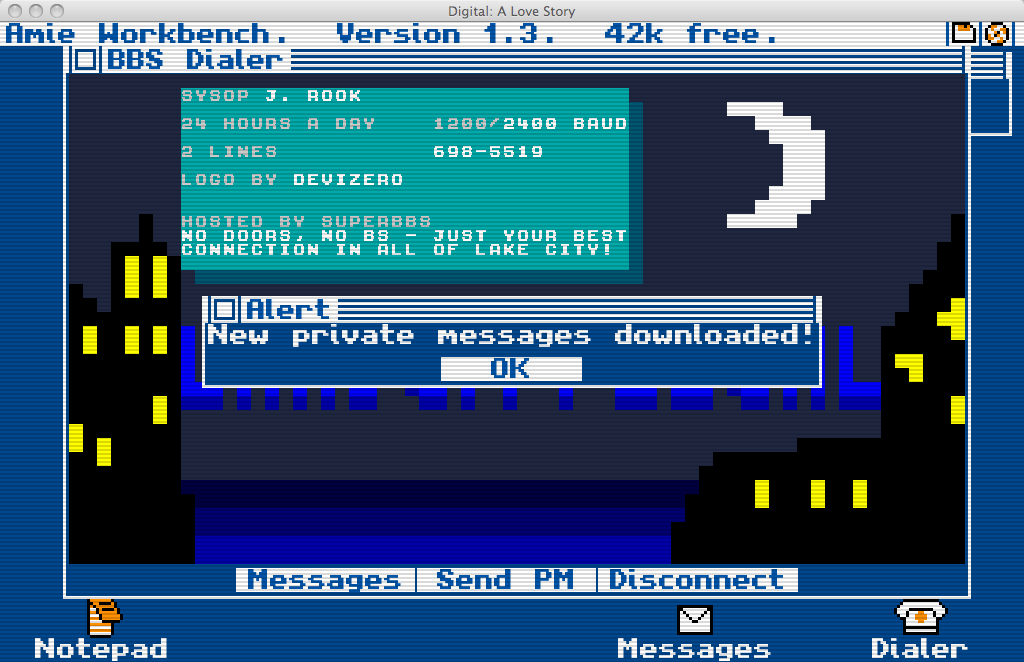
Digital: A Love Story (Love 2010) is a downloadable game which recreates beautifully the experience of the very early days of the internet. Beginning the game opens up a wonderfully rendered 1988 desktop with one or two very limited option. You are the star of the game (picking your own username, giving your real name and, as needed, adding your own passwords) and are playing the role of a teen/young student accessing local bulletin boards via long winded (and wonderfully sound effect driven) modem connections to specific machines. Relationships and plot unravel from emails and messages that you can elect to send. There are hints throughout the game but the main game play method is to click around and try everything at first to find a route through the game that can then evolve as the game swiftly becomes more complex and the storyline more urgent.
Thinking about what I liked about Digital I couldn't help but think about how it did not feel like the game – I was using a mouse and keyboard as stand in's for... a mouse and keyboard. The laptop might be lighter and infinitely better spec'ced than the type of machine I had access to in 1988 it was still remarkable how real it could feel to play with a low resolution screen, super slow internet connection and very basic text and visuals. So this is perhaps a for and against argument for my own comment about what can be learnt in uncanny spaces. On the one hand any digital environment, of any quality can be sufficiently engaging if the story behind a game is sufficiently well written, realised and learning subtly scaffolded. On the other hand Digital is a great example of how being really and truly in that virtual space is all the more powerful. For other games that replicate computer based activities the computer is likely to be the best space for learning but I do wonder how much better suited other activities would be to a hybrid space of digital and physical. To some extent the mediation of every day life makes this easier – one can simply mock up a read out for a piece of medical equipment, scientific equipment, financial monitoring systems, or emails to enact an emergency scenario or workplace simulation or emotional encounter in every day life (as Digital does). Or one could use a realistic physical surgical model with an archive feed of surgery for training keyhole techniques for instance. There may be financial and administrative gains in hosting entirely digital educational experiences for these sorts of process but there are physical sensations and reflexes which must also be trained and I think it is worth considering – particularly when we talk about the uncanny, the real, the role of simulation, and the gaining of practical skills in digital contexts - the value of digital games as sitting along different points along a real/virtual spectrum rather than always being stand alone digital-only and computer mediated (only) phenomena.
At the same time I hope that MUVEs become more radical than their current forms. One of the sad things about the beautiful scientific models shown in perplexitypeccable (2007 [5]) was the contextual limitations imposed by the space – once could go inside a cell or look at living human models or examine an atom BUT one could only do this in the “real” world of SL – sky, horizon, ground, etc. all remain. One of the toughest challenges of helping learners conceptualise abstracted educational information is that it is hard to visualize the size of an atom or the texture of a cell or the interplay between different elements of an organic system. Models in the classroom can be good but can also still seem both too abstract and too real (who for instance can fail to find a full skeleton unnerving or a medical torso model too plastic?). In theory digital environments offer the very best possibilities for suspending disbelief but, by being grounded, in normalised concepts of a “world” much of that potential is lost. 3D modelling software lacks embodiment, embodied spaces lack that useful sense of abstraction. I think there much be a way to bridge both types of system to enhance the empowered learner exploration of abstract models and ideas but I think this will be an ever more exciting area of MUVEs over the next few years.
[1] Bayne, S. (2008) Uncanny spaces for higher education: teaching and learning in virtual worlds. ALT-J, 16:3, 197.
[2] Papert, S. (1998) Does Easy Do It? Children, Games, and Learning. Game Developer Magazine, June 1998, p88.
[3] de Freitas, S. (2008) Emerging Technologies for Learning. BECTA research report, March 2008, Volume 3 (2008).
[6] WadaTripp (2007). Virtual Social Worlds and Future of Learning (Agree/Disagree?). YouTube Video. Retrieved 28th March 2010. http://www.youtube.com/watch?v=O2jY4UkPbAc
[8] cynthiaso (2007) Seymour Papert - Talking Turtle. YouTube Video from an original Open University and BBC programme. Retrieved 28th March 2010. http://www.youtube.com/watch?v=BTd3N5Oj2jk.
[10] Watson, Paul (2010). Using Real Time data to Understand and support Human Behaviour. Presentation viewed online 18th March 2010. Presentation retrieved 28th March 2010. http://www.nesc.ac.uk/action/esi/download.cfm?index=4465.
In Gee (Chapter 7: The Social Mind in What Video Games Have to Teach us About Learning and Literacy) he extends the learning through video-games from single-player to multi-player. As ever, he ends the chapter with a subset of the 36 Learning Principles (33-36) and these focus on the distributed nature of knowledge and the dispersal of this across 'affinity groups' - objects and systems as well as people - whereby he extends the notion of communities of practice and identity; all draw on traditional methods of storage and collation but importantly email, the internet, etc.
As with the classroom, players/participants work towards a common purpose, irrespective of race, class, gender, etc. This idea of common purpose and objective of all school pupils must be conveyed to pupils and allow them to acknowledge that it is their interest to work in partnership in order to support each other through their strengths and weaknesses (known as 'jigsaw method' defined by Brown & Campione (in Kate McQilly Ed. Classroom Lesson's: Integrating Cognitive Theory and Classroom Practice).
The idea of identity resurfaces, recalling the notion of 'multiple identity' whereby in such affinity groups "the norms and values of groups are contested and negotiated" (p. 184), bearing in mind that players - and us - modulate across a continuum of identity depending on context. He finishes noting that this 'identity' should not only be in control but one who can modify content and the process itself.
These ideas accord with my periphery readings of Richard Riding's School Learning and Cognitive Styles where learners are negotiated into two dimensions of 'learning style' - wholist-analytic & visual-verbal. In relation to the affinity group that Gee promotes, Riding suggests that they, the learners, can work in partnerships that take into account differences / discrepancies in different learner types. I think that this may have a significance in the successful presentation and reception of learning activities derived from digital games, and when you factor in collaborative learning I think that it is equally appropriate to look at compensatory pairing/grouping in addition.


 The popularity and business models of MMOGs, RPGs and MMORGs makes them a fascinating possibility for education. Though television shows, sports and home console games all have a significantly more visible leisure presence in current popular culture there are huge numbers of people quietly living our complex personal and social fantasies in these rich online games. Many of these games (indeed most of those I have seen) are significantly expensive to participate in and yet