

I'm blogging a little late on these weeks but I did want to record some of my thoughts of the spaces we looked at. MUVEs (Multi User Virtual Environments) were the main space looked at – with Second Life a key space – but we had some really interesting discussions about playfulness and the concept of uncanny presences that covered a broader range of games and gaming environments. Motivation and the idea of “sugaring the pill” of education also came to the fore as many of the MUVEs are actually quite tough spaces to get used to – complex in nature and requiring a steep learning curve to become a participant.
Papert (1998 [1]) interestingly argues that the entire education system is weighted to reward failure (the retaking of years, additional help requirements etc.) in stark contrast to the commercial games and “edutainment” sector where the audience must always be engaged or they will abandon a product. This is a tricky stand to take given the involvement of businesses in schools (especially via the Private Finance Initiative) but the point about the development and quality of the end product is interesting: the motivators for creating good quality teaching are provided not by the education system but by demanding learners and proactive educators.
The idea that children enjoy “hard fun” that Papert puts forward is convincing to me particularly in light of the Talking Turtle clip (cynthiaso 2007) showing a 1970s realisation of Papert's ideas around learner empowerment and difficult play. The image of young children learning programming and mathematics by trial and error is quite inspiring to me as, as noted in the clip, mathematics is a subject rarely taught in social ways (in contrast to English literature or history for instance where discussion is a crucial part of forming a good understanding). Though the video has certainly aged since original broadcast I think there is much to be said for encouraging high challenge as part of curriculum design. This is problematic though as many prevailing attitudes focus on building a learner's core sense of self-esteem and tough challenging teaching moments can be (but don't have to be) in opposition to this building of confidence. However too great a level of confidence and too unchallenging a set of learning experiences fails to take advantage of the level a student may be able to achieve. In a week looking at MUVEs, including Second Life (SL), this is a particularly interesting balance to consider since the second most frequent complaint I've heard about SL is that it is far too difficult to learn how to use and is embarrassing to get things wrong in. Personally I think demos like Hackshaven (2008 [4]), perplexitypeccable (2007 [5]) and WadaTripp (2007 [6]) offer good incentives to learning how to use the space but the balance of challenge to reward isn't quite right for everyone and can be a hard sell compared to, say, online Solitaire where the challenge is relatively low but the hurdles to getting started are very low indeed.
As we do start to look at more complex spaces – like SL – in this course I start to notice several features that trouble me about the more sophisticated digital gaming spaces. Firstly as a Mac user I am (again) facing issues of compatibility between my own machine and the games on offer. Secondly I find that the more complex the game the more inexplicable the rules, ettiquette and introductions become – it may be best to just play a game to get started but when one plays in an embodied space the fine grained details of set up matter right from the beginnning. Bayne (2008 [1]) draws on Freud in her discussions of the uncanny and the idea of duplicates and ghostly presences in virtual worlds. Whilst she does refer to the appearance of avatars created by users in SL in this paper I would add that there is something weird and uncomfortable – for me at least – of taking editorial decisions about my SL double now that she is set up. I would no more change species, gender or significant physical appearance than I would (in real life) undergo cosmetic surgery. Thus my avatar has, since I first began to feel any empathy and embodiment to her, only changed weight, hair colour and clothing. These are things I would feel comfortable with in real life so feel right in SL.
My own concern that one becomes embodied through customisation and will struggle to remain embodied if major changes occur later on also raise another issue of any customisable avatar: the presence of extremely stereotypical and problematic default avatars. This is not a new issue for me – I think I have raised it on the blog before – but it is an important one to the use of MUVEs for education. No matter which space I have entered of this type I have never been presented with a default avatar who is old, non white, unconventional looking (not unattractive), transgendered or androgenous, etc. Indeed even in the explicitly for-kids Quest Atlantis game the default avatars for teen girls were thin, maturely developed and looked improbably adult. The male avatars are often more forgivingly crafted – you will see Brad Pitt lookalikes in SL but in far less quantities than you will see female avatars that would, in real life, feature substantial breat implants and would require eating disorders to maintain their figures. Personally I think it odd that fantasies in the social online gaming worlds should revolve around extreme versions of real world fantasies (I have far more sympathy for those whose avatars are a speck of light or a flying dragon or a dalek) rather than allowing a space to express more interesting variants of existing physical forms.
But then opinion differs on the role of realism in the space. de Freitas (2008 [3]) talks very much of the importance of realism and quality in the creation of convincing and absorbing digital games for learning. Indeed it is striking (and I suspect no coincidence) that a TV ad campaign for organ donation (currently running) uses a slow visual death in a very intense short scene which is highly reminiscent of the type of TruSim demos featured in Blitz Games Studios (2010 [7]). Such trickery and uncanny scenes induce immense emotional engagement and great empathy for the virtual patient. Where I have a problem personally is in the effectiveness of the learning from this type of tool. It is indisputably useful to have visual records of what death – and crucially near death – looks like in reality as it is simply too dangerous and inappropriate to provide medics with fatal cases as part of training exercises. Seeing and playing through a patients fate seems likely, therefore, to train any viewing medic in recognising signs of deterioration.
However the response mechanism – the treatment itself – seems a million miles from a mouse and keyboard input to me and this is where I think many of the MUVEs still have a long way to go. Ideally one would want to replicate the medical emergency as much as possible – advances to see deteriorating patients on a physical form that could then be treated would be hugely beneficial but so would the more simple idea of using more physically appropriate interfaces – clicking menus for actions presents several peculiar issues:
Introduces a level of self-awareness that may take away from the uncanniness of the scenario
Does not represent or simulate a realistic environment
Provides an artificially controlled and limited number of options – unlike those that will be self-selected by a medic in an emergency situation.
Potentially trains the player in the best way to complete the game rather than the real life situation they are training for – no physical competences are measured whilst in a real situation both intellectual and physical elements will come into play.
There is some interesting work on physical interfaces currently taking place (e.g. Watson (2010 [10]) that use mainstream console technologies – most frequently WII controllers which are cheap to adapt and use – that offer interesting possibilities in terms of taking immersive educational games (including but not limited to MUVEs) into and beyond the possibilities currently offered by the WII or novel physical controllers into the realms of an even truer virtual experience where one can effectively live (and re-live as necessary) the experience one is training or learning for rather than do so at one level's distance. The idea of taking a virtual submarine [4] tour is lovely but how much more engaging would that be as a collective experience where one dresses and feels physical feedback accordingly but, crucially, does not disturb the wildlife. The human mind is a wonderful thing but many elements that can be imagined into a virtual environment are the more obvious elements that one knows about – one doesn't know to look or ask about items that are unexpected whereas many serendipitous teaching moments come out of more physical experience that force awkward and invaluable questions that the abstract experience cannot.
Having said all of the above though I must acknowledge that an engaging game can get around many issues of visual quality or cinematic or even real life accuracy. Though not a MUVE I was alerted to an incredibly clever and absorbing game this week which inhabits a rich virtual space that appears sociable but is, in reality, a single player plus incredibly clever writing and loving programming.
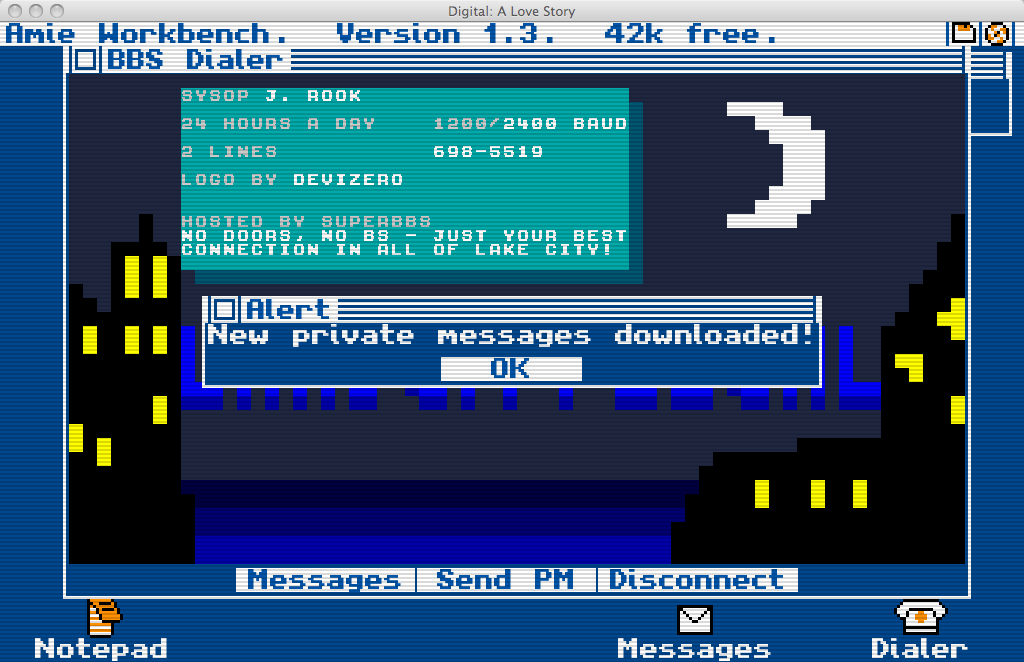
Digital: A Love Story (Love 2010) is a downloadable game which recreates beautifully the experience of the very early days of the internet. Beginning the game opens up a wonderfully rendered 1988 desktop with one or two very limited option. You are the star of the game (picking your own username, giving your real name and, as needed, adding your own passwords) and are playing the role of a teen/young student accessing local bulletin boards via long winded (and wonderfully sound effect driven) modem connections to specific machines. Relationships and plot unravel from emails and messages that you can elect to send. There are hints throughout the game but the main game play method is to click around and try everything at first to find a route through the game that can then evolve as the game swiftly becomes more complex and the storyline more urgent.
Thinking about what I liked about Digital I couldn't help but think about how it did not feel like the game – I was using a mouse and keyboard as stand in's for... a mouse and keyboard. The laptop might be lighter and infinitely better spec'ced than the type of machine I had access to in 1988 it was still remarkable how real it could feel to play with a low resolution screen, super slow internet connection and very basic text and visuals. So this is perhaps a for and against argument for my own comment about what can be learnt in uncanny spaces. On the one hand any digital environment, of any quality can be sufficiently engaging if the story behind a game is sufficiently well written, realised and learning subtly scaffolded. On the other hand Digital is a great example of how being really and truly in that virtual space is all the more powerful. For other games that replicate computer based activities the computer is likely to be the best space for learning but I do wonder how much better suited other activities would be to a hybrid space of digital and physical. To some extent the mediation of every day life makes this easier – one can simply mock up a read out for a piece of medical equipment, scientific equipment, financial monitoring systems, or emails to enact an emergency scenario or workplace simulation or emotional encounter in every day life (as Digital does). Or one could use a realistic physical surgical model with an archive feed of surgery for training keyhole techniques for instance. There may be financial and administrative gains in hosting entirely digital educational experiences for these sorts of process but there are physical sensations and reflexes which must also be trained and I think it is worth considering – particularly when we talk about the uncanny, the real, the role of simulation, and the gaining of practical skills in digital contexts - the value of digital games as sitting along different points along a real/virtual spectrum rather than always being stand alone digital-only and computer mediated (only) phenomena.
At the same time I hope that MUVEs become more radical than their current forms. One of the sad things about the beautiful scientific models shown in perplexitypeccable (2007 [5]) was the contextual limitations imposed by the space – once could go inside a cell or look at living human models or examine an atom BUT one could only do this in the “real” world of SL – sky, horizon, ground, etc. all remain. One of the toughest challenges of helping learners conceptualise abstracted educational information is that it is hard to visualize the size of an atom or the texture of a cell or the interplay between different elements of an organic system. Models in the classroom can be good but can also still seem both too abstract and too real (who for instance can fail to find a full skeleton unnerving or a medical torso model too plastic?). In theory digital environments offer the very best possibilities for suspending disbelief but, by being grounded, in normalised concepts of a “world” much of that potential is lost. 3D modelling software lacks embodiment, embodied spaces lack that useful sense of abstraction. I think there much be a way to bridge both types of system to enhance the empowered learner exploration of abstract models and ideas but I think this will be an ever more exciting area of MUVEs over the next few years.
[1] Bayne, S. (2008) Uncanny spaces for higher education: teaching and learning in virtual worlds. ALT-J, 16:3, 197.
[2] Papert, S. (1998) Does Easy Do It? Children, Games, and Learning. Game Developer Magazine, June 1998, p88.
[3] de Freitas, S. (2008) Emerging Technologies for Learning. BECTA research report, March 2008, Volume 3 (2008).
[4] hackshaven (2008) NOAA Second Life Virtual Ocean Demonstration. Retrieved 28th March 2010. http://www.youtube.com/watch?v=ut2qInl-9YU.
[5] perplexitypeccable. (2007) Science Learning in Second Life. YouTube Video. Retrieved 26th March 2010. http://www.youtube.com/watch?v=EfsSGBraUhc.
[6] WadaTripp (2007). Virtual Social Worlds and Future of Learning (Agree/Disagree?). YouTube Video. Retrieved 28th March 2010. http://www.youtube.com/watch?v=O2jY4UkPbAc
[7] Blitz Games Studios (2010). TruSim Triage Trainer/Patient rescue/Interactive Trauma Trainer. Retrieved 26th March 2010. http://www.trusim.com/?page=Demonstrations
[8] cynthiaso (2007) Seymour Papert - Talking Turtle. YouTube Video from an original Open University and BBC programme. Retrieved 28th March 2010. http://www.youtube.com/watch?v=BTd3N5Oj2jk.
[9] Love, Christine (2010). Digital: A Love Story. [Computer game]. Retrieved 28th March 2010. http://www.scoutshonour.com/digital/
[10] Watson, Paul (2010). Using Real Time data to Understand and support Human Behaviour. Presentation viewed online 18th March 2010. Presentation retrieved 28th March 2010. http://www.nesc.ac.uk/action/esi/download.cfm?index=4465.
Keywords: embodiment, idgbl10, interfaces, MUVE, uncanny