Log on:
Powered by Elgg

Tim Dalton :: Blog

October 17, 2011

I am sitting in on the distance learning MSc Introduction to AI Class at Stanford - http://www.ai-class.com/ - to observe the way they use technolgy for distance education. They seem to make very good use of short multiple choice answers and "click over the options" type quizzes after each brief video segment to make sure people are understanding.  I also see they will be using "badges" to show progress in the class and its assignments.

For those of you that have not heard of this... its believed to be the largest distance learning class ever - with 150,000 registered students.

Keywords: IDEL11

Posted by Austin Tate | 0 comment(s)

October 13, 2011

Browser incompatibility with served web pages and web content has been an issue for some time since multiple browsers and platforms have become available.  HTML itself was designed to allow for multiple possible renderings to allow for differences of display device, etc.  But as web pages have used proprietary content (e.g. Flash) and used progressively more complex scripting (e.g. JavaScript), style sheet variants (e.g. CSS) and other platform dependant content, and as specialized versions of web pages for mobile devices have appeared, the things have recently become much worse. 

We often get pages partially rendered, but see the message "Done, but with errors on page" showing in the browser status bar.  This is often due to JavaScript or other underling errors... an example, taken from the Holyrood Park Blog site itself, might look like this if you open the diagnostics window...

User Agent: Mozilla/4.0 (compatible; MSIE 8.0; Windows NT 6.0; Trident/4.0;
chromeframe; SLCC1; .NET CLR 2.0.50727; Media Center PC 5.0; InfoPath.1;
.NET CLR 1.1.4322; .NET CLR 3.5.30729; .NET CLR 3.0.30729; .NET4.0C)
Timestamp: Mon, 10 Oct 2011 19:18:06 UTC

Message: Object expected
Line: 2 Char: 1 Code: 0
URI: http://edc11.education.ed.ac.uk/.../northern-web-coders/js/dropmenu.js
A serious problem is that pages are getting richer in content, but page developers are failing to test in multiple browsers, consider different bandwidth devices, different size screen failing to provide fall back styles where they sue advanced facilities, etc. 

White Screen of Death by waiting...

Another issue is that page developers, and most content management systems and social network style web pages are laid out in ways that mean the page does not render until most of the content has been downloaded to the browser.  Where the page contains many thumbnails, images, and other large volume content this can mean the user sees a blank screen for a long time on slower links before the whole page is shown.  Progressive rendering of downloaded content is not possible if the style typical of social network web pages is adopted.  The developers of those web pages and styles often fail to set image and table/element pre-size indicators which means the content has to be loaded before the browser can decide on the layout position.

Keywords: IDEL11

Posted by Austin Tate | 0 comment(s)

October 12, 2011

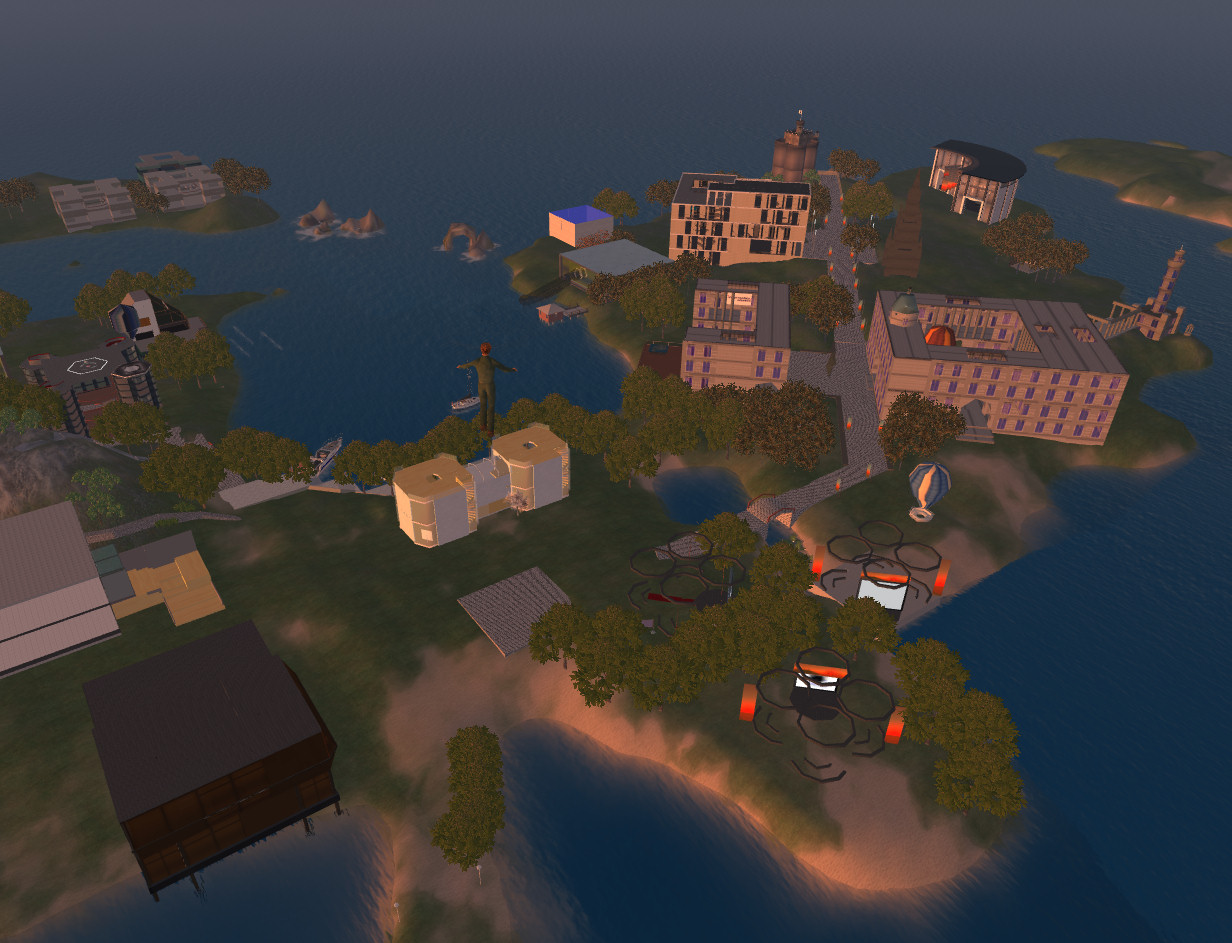
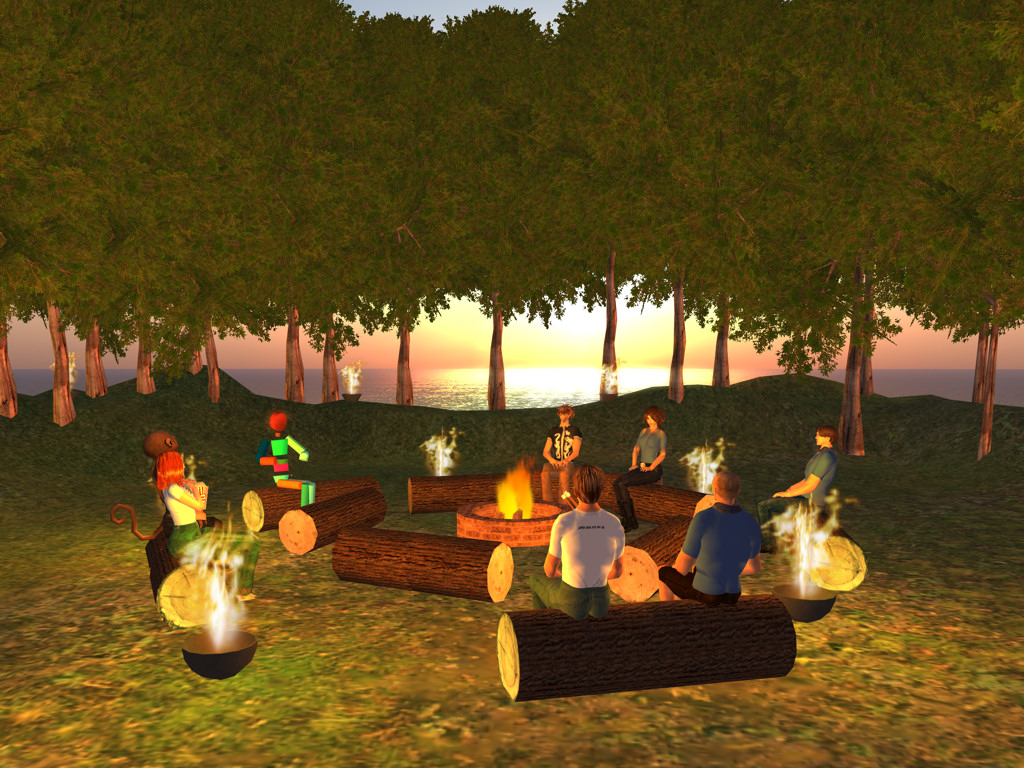
Attended tutorial on Holyrood Park in "The Grove" campfire tutorial space on Vue facilities in Second Life.  This is Ai arriving from above looking down over the Vue regions, and then in the meeting.

IDEL11 Arrival over Vue IDEL11 Tutorial

Keywords: IDEL11, Second Life

Posted by Austin Tate | 0 comment(s)

October 11, 2011

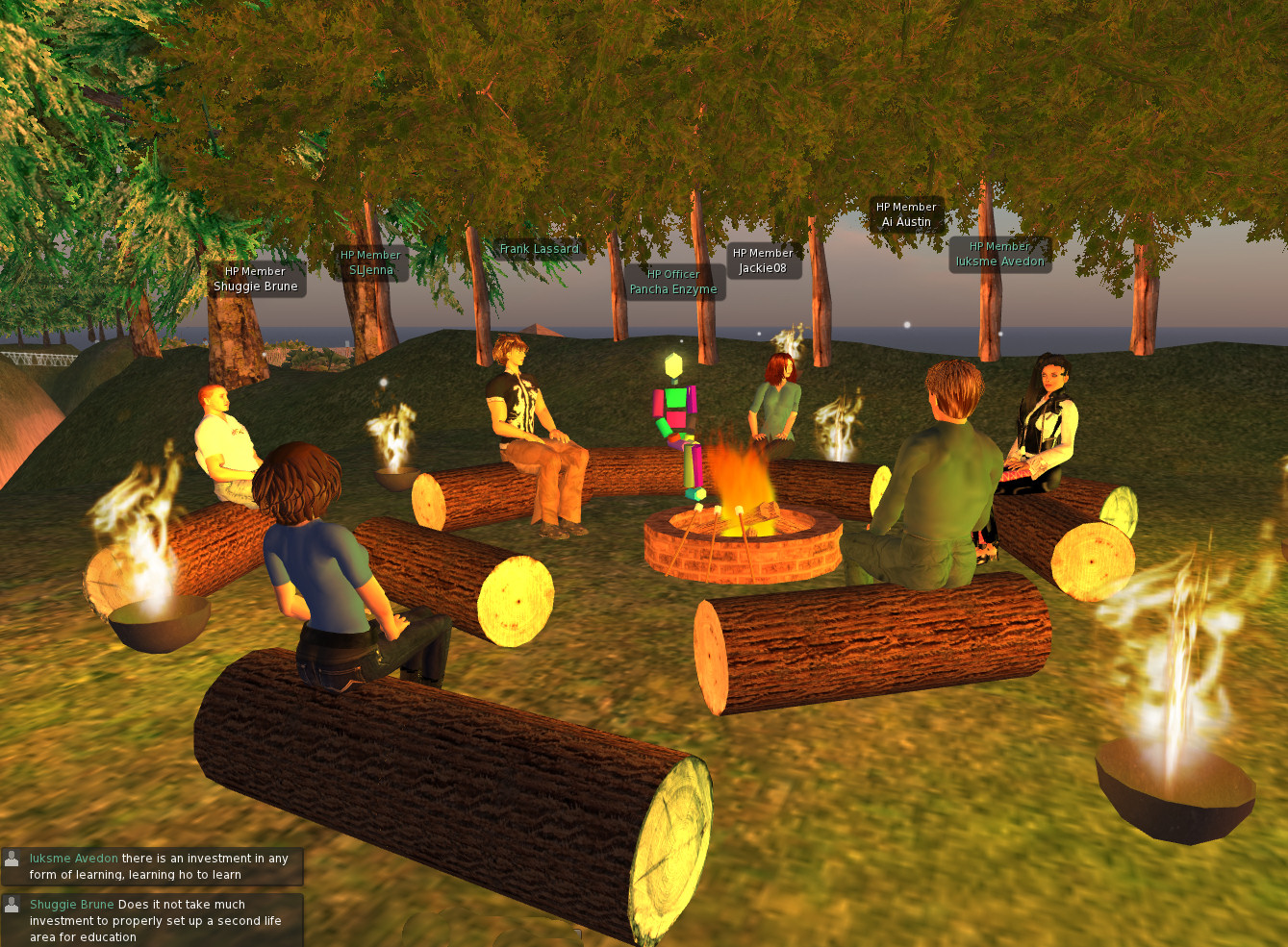
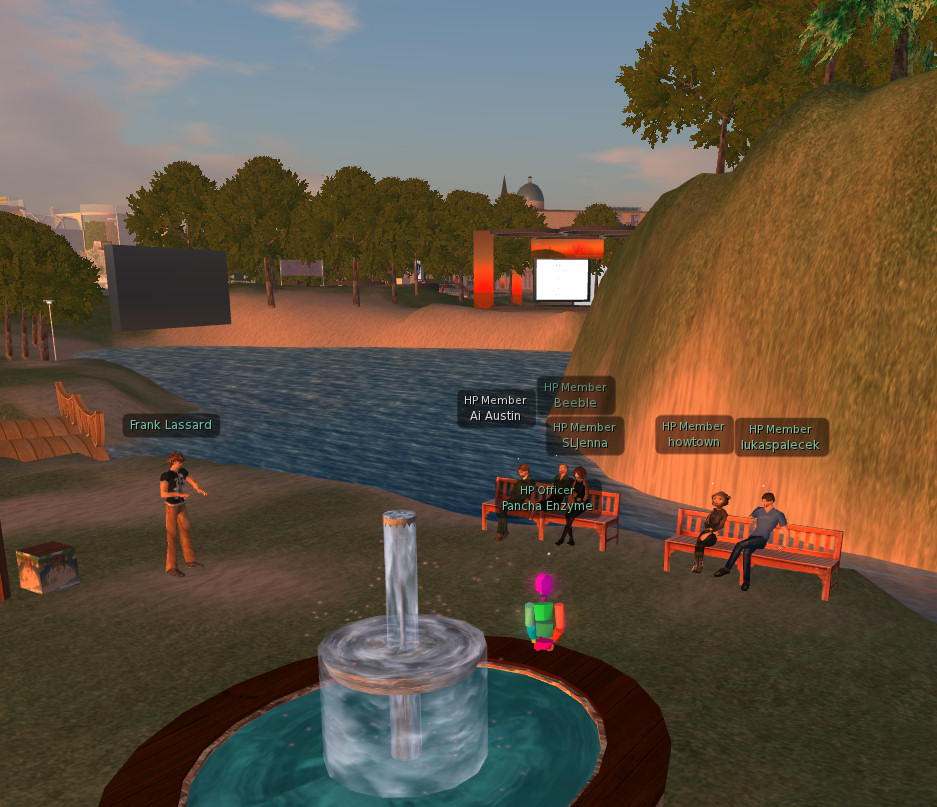
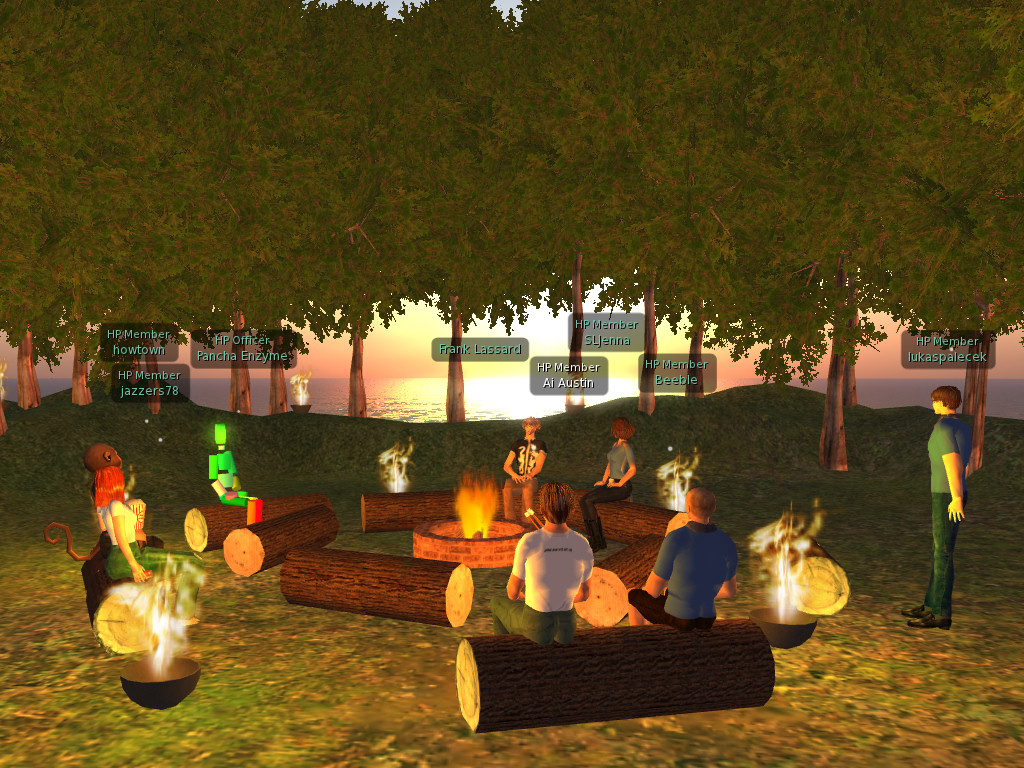
MSc in e-Learning IDEL11 Module - Virtual Worlds in Education section... tutorial for new avatars and to get used to the facilities on Virtual University of Edinburgh (Vue) given by Frank Lassard and Pancha Enzyme...

Holyrood Park IDEL11 Tutorial


Holyrood Park IDEL11 Tutorial


Holyrood Park IDEL11 Tutorial

Keywords: IDEL11, Second Life

Posted by Austin Tate | 0 comment(s)

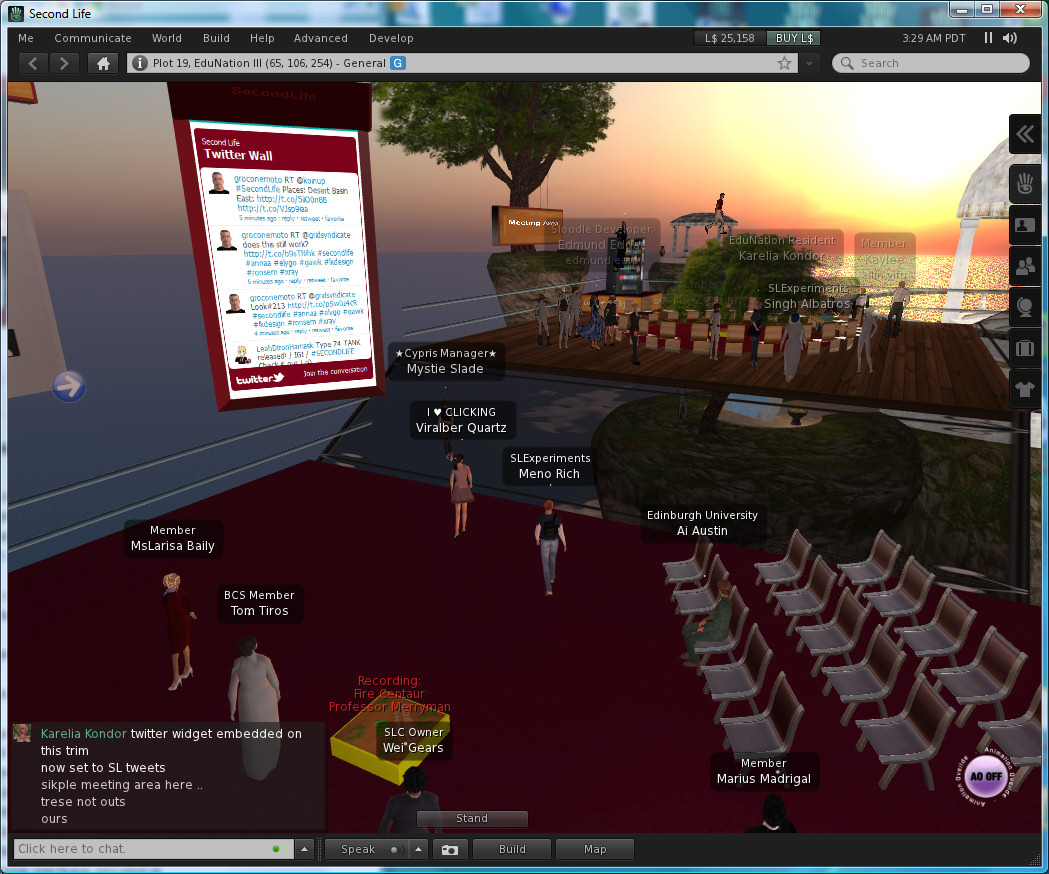
This is a mixed use and mixed institution educational area, with a number of plots used by a range of Universities, coverages and academic groups. There are a number of "classrooms in the sky" on various levels.

On arrival and initial exploration, the area is not well described or signposted.  There is no obvious entry/arrival area and no note cards are offered.  Looking round though it was clear there were specific institution and class areas set up for specific subjects.  A veterinary studies area had sculptures of horses, and posters and displays related to horse anatomy for example. It had some nice teaching and presentation aids. There was a nice interactive "Artboard 2.1" using prims for marked lines.

To find out more about the area and its uses, a Google search on "EduNation Second Life" leads to http://heyjude.wordpress.com/2007/02/05/edunation-secondlife/ which has next to no content and no one has posted comments... it's full contents are:

The Consultants-E are proud to launch the first private island simulator in Second Life dedicated to online training seminars and conferences, and the use of Second Life in Education. EduNation is a 65,000m2 island in the Second Life virtual world with seminar, powerpoint, audio and videocast facilities. Use of the seminar facilities is free. More information at EduNation (http://www.theconsultants-e.com/edunation/edunation.asp)

That URL leads only to "Server Error - 404 - File or directory not found. The resource you are looking for might have been removed, had its name changed, or is temporarily unavailable.

This is rather typical of educational regions that are not well managed or owned by specific stake-holders.  The area should be considered as one that lets people set up individual classrooms and areas and is not meant to have a cohesive design or allow for random exploration and discovery.
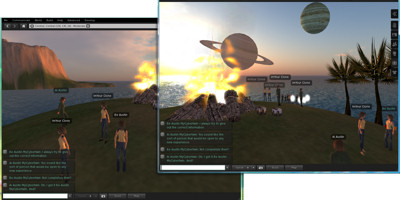
SLoodle 2.0 Demo on EduNation in Second Life

A good example of it in productive use by educators, and the reason I chose this region to explore, was a recent demonstration of a new version of the SLoodle module for the Moodle Victual Learning Environment.  The demonstration organisers set up a new area well up in the sky and rafter landing at a simple initial meeting space, they dynamically rezzed large platforms nearby to show  the facilities. and even rezzed a bridge to let the visitors walk over to that newly created facility. I attended a briefing about the new SLoodle 2 toolset on the EduNation III region of Second Life on Sunday 18-Sep-2011 by Paul Priebsch (avatar name: Fire Centaur). About 30 other educators were there. A feature of SLoodle 2 is the ability to set up "scenes" an rapidly rezz them in and around a classroom for a lesson, and then tidy them away so the ability can be re-used. This was demonstrated live on the EduNation regions. The SLoodle quiz chair can be set up to give rewards to students, or "penalise" them for failure... including dumping them in a shark filled pool with realistic screams!

A blog report of that demonstration is at http://holyroodpark.net/atate/weblog/6149.html. Full size versions of some images of the demo meeting are gathered at http://openvce.net/sloodle

Keywords: EduNation, IDEL11

Posted by Austin Tate | 0 comment(s)

October 10, 2011

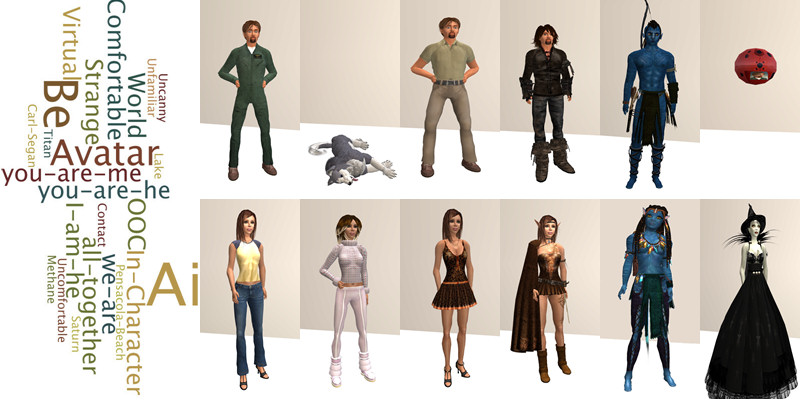
Its tricky to know which is the "real" avatar...

Ai and Be Avatars

Keywords: Avatar, IDEL11

Posted by Austin Tate | 0 comment(s)

We have been held up for a while in our experimentation with Moodle/SLoodle since the new versions (2.1.2 as at 10-Oct-2011) required a later version of PHP than our servers were set to.  Apache/PHP changes are strictly controlled in the School of Informatics to address securuity issues, so its not something we can change quickly.  Our main servers should be updated within the next month, but meantime, we updated a test server and now have a working Moodle 2.1.2 with a standing "course" for OpenVCE experimentation.

A new PhD student has started with our group, Punyanuch Borwarnginn from Thailand, having just completed the MSc in AI here.  Her work will be in the area of Intelligent Learning  Environments, and she will start with looking at aspects of Moodle, SLoodle and virtual worlds-based I-Room technology. Her blog on initial ideas is at: http://openvce.net/ile-proposal

Keywords: IDEL11, Moodle, SLoodle

Posted by Austin Tate | 0 comment(s)

October 09, 2011

My two OpenSim avatars chatting away together. Part of an exercise for the Digital Cultures EDC11 Digital Artifact exercise: http://atate.org/ai/ai/res/2011-10-09-chat-log-ai-and-be.txt

http://atate.org/ai/ai/img/2011-10-09 Avatar Identity Ai Be Chatting

At least they don't bicker like some recent chatbot to chatbot chat experiments: http://www.youtube.com/watch?v=WnzlbyTZsQY

Keywords: Avatar, Chat, IDEL11

Posted by Austin Tate | 2 comment(s)

October 07, 2011

I want to make some observations on the use this week of Twitter for the Edinburgh MSc in e-Learning IDEL11 class discussions about core readings and topics. Obviously one purpose is to test a variety of tools and modalities of interaction for distance education purposes, so I will give my experience as a student in this case. 

Twitter is a valuable "push" short messaging and trending platform.  Due to the volume of material appearing on it, lack of archiving facilities, lack of search over long periods and lack of good clustering methods in most tools it is unsuited to discussions which by their nature are threaded and need linearity in reading posts from multiple participants.  The tweeter should not assume the group members see every (or even most) tweets, and there is no confirmation of what they have and have not seen.

Shortened URLs are frequently applied by tools when tweets are posted, and this loses much valuable context for the citation or reference given.

Public accessibility and possibly permanent online availability and reposting by others of the tweets also may preclude argumentation more suited to a closed audience or group.

Seeking to use Twitter to follow 4 #tags on 3 MSc in e-Learing courses is impractical on most Twitter interfaces, including the official Twitter.com provided web site and mobile apps.  I found only TweetDeck for Desktop as recommended for the Digital Cultures course (but not the mobile versions of TweetDeck)  suitable for such uses... but that is disruptive via its new tweet arrival notification mechanism when trying to concentrate on other work.

My use of Twitter was also on low bandwidth and error prone 3G connections, and using small screen mobile devices, but I think my observations are valid even without that limitation.

I found the threaded discussion forums on WebCT much easier to follow while travelling, and the times at which they can be checked and inputs given can be managed better and more asynchronously.

Keywords: IDEL11

Posted by Austin Tate | 0 comment(s)

October 05, 2011

Where shall we to begin to unravel the drivel in the paper by Roszak.  Let’s start with his use of language... humans have minds and think... with no "quotes" on the words. Computers are "data processors" which "regurgitate" from "memory" with heavy use of quotes.  Their proponents are "data merchants" - you can almost hear him spit as he says it - and they promulgate a "cult of information" - my quotes. Human memory is the "invisible psychic adhesive" - give me a break.

Then we get pages on "ideas" which humans "think" about, and how those differ from what "computers" can "process" - and Rosak helpfully explains that these are generalization mechanisms based on experience of more or fewer instances.  Pity he seems to not know about explanation based generalization systems in computers which have worked for many years to find and refine categories in the taxonomies in many knowledge-based systems, and then used to great effect to advance scientific knowledge in astronomy, genetics and drug discovery. These systems have been around for well over three decades, so if he was speaking about generalisation, you think he could have looked it up (suggested keywords: "computer" "AI" "generalization").  But then again perhaps (neo-)luddites cannot do proper research if it involves using computers.His poor use of the Logo Poetry generator program, which included an element to ensure some randomizing phrases and vocabulary was introduced into the generated poems, was introduced as his example to illustrate the level of computer "simulation" of human "originality". This really is such a poorly related example I could not believe it got through peer review even in a philosophy paper.

He begins to go off into the void with references to the self reflection and how the mind is such a wonderful thing because it cannot fully model itself... but can (of course) completely understand its own creations. He asserts that it is "impossible to invent a machine that will be the mind's equal". Well maybe we can try to go for "mind" rather than mind and we might succeed. He does like his "quotes".

Roszak, T., (1994) "Of Ideas and Data" from Roszak, T., The cult of information : a neo-Luddite treatise on high tech, artificial intelligence, and the true art of thinking pp.87-107, University of California Press.

Keywords: IDEL11

Posted by Austin Tate | 0 comment(s)

<< Back Next >>