Log on:
Powered by Elgg

Blog :: All

You can filter this page to certain types of posts:

Filtered: Showing posts with comments (Remove filter)

November 07, 2011

My earlier blog postings have described my own preferred approach to the creation of a PLE which at its outer level is simply an easily customised web page.  I chose a freely available well constructed CSS1 stylesheet that maximised the viewable area of the central content when viewed on a wide range fo devices and browsers, using a layout that allows for flexible width.  Below this top levele entry web page a number of directories hold the locally stored content, for my own images, screenshots, and resources that it is suitable to provide locally (i.e. have no copyright issues) and these can be pulled into the web page via relative URLs to allow for the whole PLE to be easily shifted to a new hosting environment, used locally off a memory stick, or cut to CD.  The resources and images can also be used in other blogging and course discussion forums via URL reference where appropriate.

This approach works fine for me, as I am comfortable with using a simple text editor to edit HTML directly, and have a simplistic but working understanding of the CSS style sheet approach.  I also can access an area where I can store and serve the files easily.  But this custom approach is not suitable for all.  Technically a way to create such a custom web area and make changing its content and layout easier would be preferable for some. There are many drag and drop frameworks for dropping in content in "frames" and an emerging set of "widgets" that can be dropped into "containers" in such self hosted web sites using a number of script libraries.  Again, this can be quite technical to initially set up, but easy to use thereafter. I do worry about the long term stability of some of these mechanisms though, and they do mean that the contents have to be served using a web server, rather than it being possible to simply copy and use the files on a memory stick or off a CD locally on a single computer off-line Some blogging frameworks like WordPress, richer content management systems like Drupal and Joomla, and commercial platforms like iGoogle provide simple approaches for columns of content with inclusion of "blocks" made up of various types of content, widgets and frames.

The issue of security and legality must also be taken into account.  there can be legal constraints on the monitoring which an institution is obliged to perform on its own staff communications, and in some cases on the official communications of its students.  Issues of copyright infringement may also need to be investigated.  These legal requirements can be made more difficult in highly decentralised and personalised environments.

A study of the use of personal web sites as the basis for PLEs at Graz University of Technology (UT Graz) in Austria (Taraghi et al., 2010) described a set of issues to be considered before going on to describe their own framework and approach. They base their approach on work by Schaffert & Hilzensauer who describe seven crucial aspects to consider in the adoption of PLEs:

  • The role of the learner
  • Personalisation
  • Content
  • Social involvement
  • Educational & organisational

So, it is important to look at ways in which the basic approach of using a personalised web page and web area as the basis for a PLE might be made more widely accessible and accesptable within the constraints of an educational institution's role and requirements.  An educational establishment can encourage the use of PLEs alongside their institutional learning support systems.  It could seek to provide a framework or "template" approach which all students can adopt and adapt a framework or arrangement that suits them, and that they feel comfortable supports them and the degree of autonomy they seek.

Reference

Schaffert, S. and Hilzensauer, W (2008) "On the way towards Personal Learning Environments: Seven crucial aspects," in eLearning Papers, no. 9, July, 2008.

Taraghi, B.,  Ebner, M., Till, G. and Muhlburger, H. (2010) "Personal Learning Environment - A Conceptual Study", iJET - Volume 5, Special Issue 1: "ICL2009 - MashUps for Learning", January 2010.

Keywords: IDEL11, PLE

Posted by Austin Tate | 1 comment(s)

November 03, 2011

I am experimenting with a style of non-linear essay employing a customised Typographical Visual "Neo-Grammar". It involves experimentation with expressing the core message carrying semantically tagged "connectors" in a type and layout style and with interactive linking capabilities well suited to on-line communications of layers of content.

Grammar ::=  <Planet>: <Locale>: <Connector>  [ — <Annotation> ] 

<Connector> ::= <Token> ⊃—⊂ <Token>

Token gives identity elements, citations and references.

Keywords: IDEL11, Neo-grammar

Posted by Austin Tate | 2 comment(s)

October 30, 2011

Its Halloween, and the Zombies have attacked!

There has been a bit of a  struggle to get the "cron" job running on the Moodle setup.  cron.php is an admin routine that is run every few minutes to do a number of maintenance things, like pulling in information feeds, external blogs, clearing away pending messages, etc.  It need a bit of setting up and a couple of different mechanisms using the Windows Task Manager had not been working correctly.

I had settled on a way to initiate the cron.php script by calling it from a job every few minutes which launched the Firefox/Mozilla browser run the job, and then should have terminated.  I got that suggestion off blog postings by others who has similar problems getting cron to run.  It seemed to work after I set it up on testing, so I left it for a day or so...  But when I came back... spookily... there were many "Zombie" processes running.  My colleague experienced in these matters tells me that happens when you launch a browser to run a script in a web page and he had seen this issue before.

We are also still working to get the outward bound e-mail going on our Moodle 2.1.2 setup on Windows.  This is way more complicated than it should be with many layers involved.  Settings are all over the place in Apache, PHP, Moodle and beyond your machine in the SMTP server you use, as well as perhaps in multiple firewalls and out bound messaging spam filters on the way.  We have been gradually picking our way through these layers.  Our University will not allow e-mail out with a "from" address that is not validated as a legitimate University address - sensibly.  So we are having to use a "Moodle Admin" address personally tied to a staff member at the moment, which is not ideal. We have established a "noreply" address that will validate now too. More layers to work out before its working properly I am afraid.

In general, I also am finding a lot of Moodle settings are hidden away a bit or are in several places or in multiple layers whic all need to coordinate. Things like e-mail setup is under Site Administration -> Plugins -> Message Outputs -> E-mail.  The site admin/support e-mail addresses also appear there and in Site Administration -> Server -> Site Contact.  Rooting round to change the roles an individual is assigned is also convoluted, rather than just a set of check boxes off the user page you have to edit roles... and not via the edit button but by knowing to click on the role title hyperlink. And some roles are considered "System Roles" which are changed on a different web page.

Keywords: Cron, IDEL11, Moodle, Second Life, SLoodle, Zombies

Posted by Austin Tate | 1 comment(s)

October 22, 2011

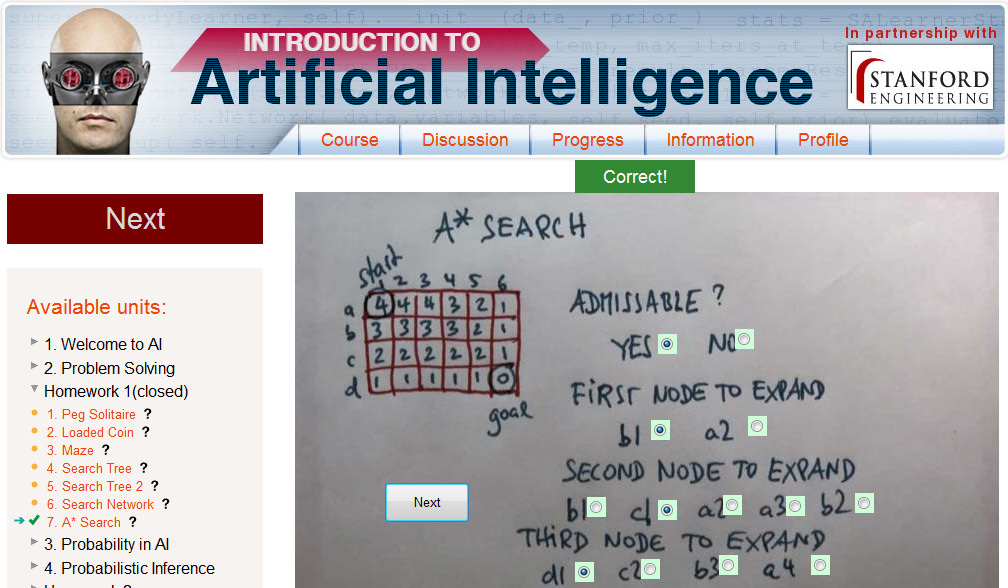
I am enrolled on the on-line Stanford AI Class... http://ai-class.com - along with 150,000 others - to watch how they present and deliver the "Introduction to AI" course, to see how the on-line assessment and quizzes work, and to see how student interaction with tutors and each other is arranged.  Its been an interesting experience so far. Everyone seems to be enjoying the course and the community.  The short video segments for each lecture are broken up with quizzes to check understanding as you go along.  Often with check boxes and type in areas overlaid with the video material itself.


Keywords: AI, IDEL11, Stanford

Posted by Austin Tate | 2 comment(s)

October 21, 2011


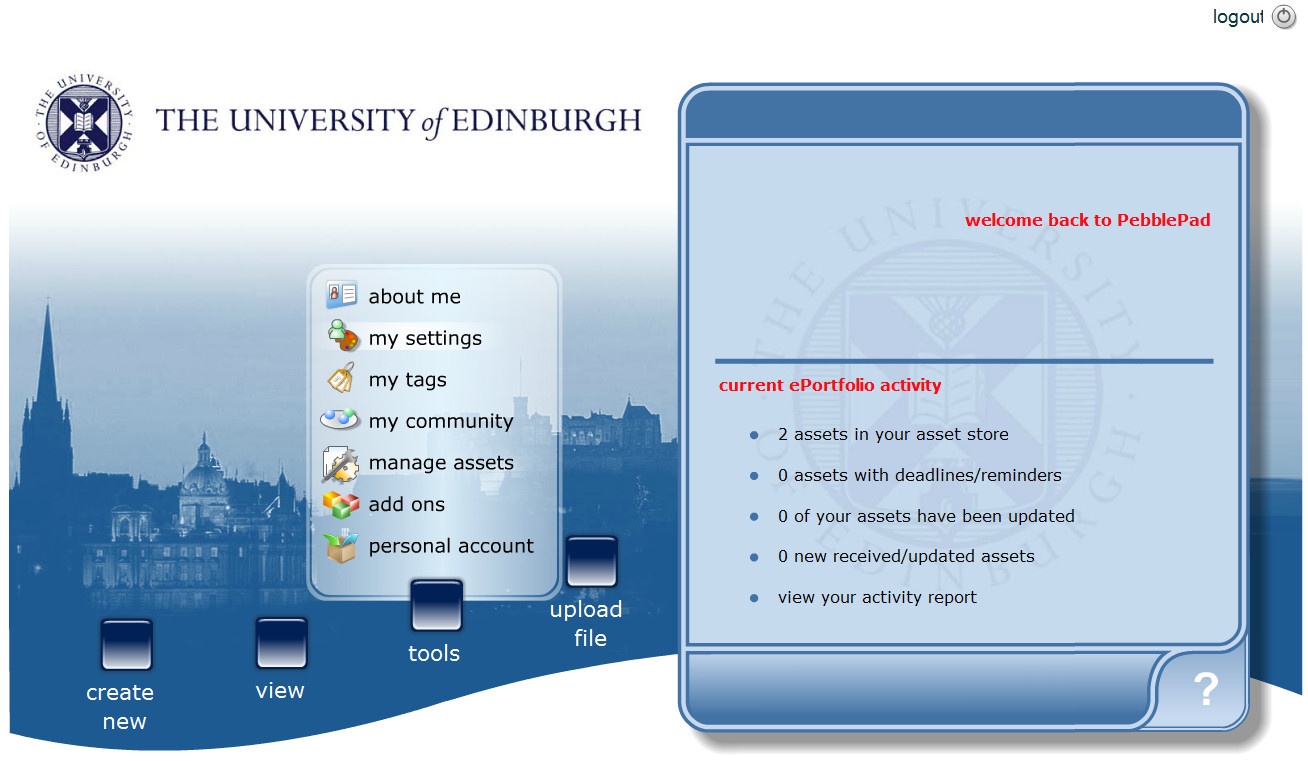
The PebblePad ePortfolio system is used to support personal learning spaces in the University of Edinburgh

If on EASE, you can log in via http://www.pebblepad.co.uk/edinburgh/pebblepad.aspx or launch from a button on MyEd with EASE login as student (MyEd - under Studies tab) or staff (MyEd - under Teaching tab).

My first experience indicated that creation of a trivial note with a few pasted web links was a very time consuming process, far beyond its value... and the resulting links note was poorly accessible with many steps to retrieve it or edit it.  The system seems designed for a very small number of assets rather than many tyhousands of assets in complex structures that would be needed in a serious personal learning environment for the future.

Keywords: IDEL11, PebblePad, PLE

Posted by Austin Tate | 1 comment(s)

October 19, 2011

Reading Boellstorff (2008) and his stories of virtual world encounters.... I have some related observations. This may get a bit deep and multi-layered.. I like layers of storytelling and meaning :-)

Some of you may (or may not) have noticed that my avatar changed appearance during the Second Life building tutorial this week. My normal bearded avatar and flight suit outfit (there is a whole history behind that too) .. changed to be a little red round ball. Why?

When "I" (Austin) am "he" (Ai) he normally shows attention and is responsive to what is happening around. I do not like "busy" and "afk" indicators and prefer to log out - or go elsewhere in world. I am not happy to leave my avatar unattended and feel it would be rude to do so... though I have no problem with others adopting that style of use of virtual worlds.

For a few years I used some text only and mobile device or low bandwidth non-graphical clients like Radegast and iPad's Pocket Metaverse. I was always unhappy that I had no idea what my avatar would look like, how it would be positioned, that it might face wrongly to those I interacted with, and it was difficult to make the avatar appear such that it was clear I was on a text chat/IM only client.

So I put some effort into designing an avatar that reflected this state of affairs. This was a Personal Satellite Assistant (PSA)... a real device NASA is working on for the Space Station that uses AI technology. It acts as an assistant to relay messages, give instructions and help, and record via camera things going on in experiments in the Space Station. It hovers near astronauts to help them, or can be sent to perform tasks. It has a screen on its front to show astronauts images, video, messages, etc. I have explicit permission from NASA Ames Research Lab to use the image of the skin of this device in my work and in virtual worlds .


I have used a sphere with this PSA skin for a number of AI driven and autonomous devices in Second Life for several years. Enter any I-Room (http://openvce.net/iroom) and there will usually be one at the entrance to act as a greeter or sensor sending back visitor and status information to our intelligent system over the web.

So I created the Ai PSA Avatar with the PSA shape, size and skin, and showed on the screen a portrait image of "Ai" to show its him that is watching as if over a video teleconference link - i.e. not immersive and "in world" fully.

Even though not on a low bandwidth or text client at the SL building tutorial, my attention was elsewhere. In fact my camera was not even in the same region as the tutorial space. I was looking at an object in a distant region that had the properties I wanted to copy to replicate a complex object I did not know how to build. But I did not feel comfortable just leaving "Ai" unattended... and did not want to fly away to get the information. I have the same issue when I am looking at web pages, or using other applications alongside the Second Life viewer. This was a case when it felt exactly right to use the Ai PSA avatar.

I see this as "Ai" looking through the "PSA" robot floating in the meeting space... "I" am behind "Ai" but its "Ai" that is disconnected from the meeting space.

Boellstorff, T. (2008). Personhood. In Coming of Age in Second Life (pp. 118-150). Oxford: Princeton University Press.

[First posted on IDEL11 Discussion Forum, 19-Oct-2011]

Keywords: IDEL11

Posted by Austin Tate | 1 comment(s)

October 09, 2011

My two OpenSim avatars chatting away together. Part of an exercise for the Digital Cultures EDC11 Digital Artifact exercise: http://atate.org/ai/ai/res/2011-10-09-chat-log-ai-and-be.txt

http://atate.org/ai/ai/img/2011-10-09 Avatar Identity Ai Be Chatting

At least they don't bicker like some recent chatbot to chatbot chat experiments: http://www.youtube.com/watch?v=WnzlbyTZsQY

Keywords: Avatar, Chat, IDEL11

Posted by Austin Tate | 2 comment(s)

September 28, 2011

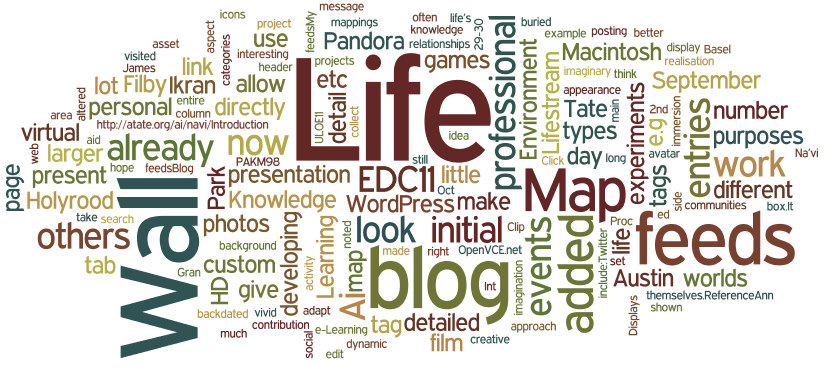
A Wordle word scatter diagram of my blogs for IDEL11 on Holyrood Park and for EDEDC11 on edc11.education show that the work I did to create a "Life Wall" at http://atate.org/ has been my top focus in the first couple of weeks of the MSC in e-Learning.  I very much like Wordle diagrams to show threads for work over a long period... and have used them for some years on my Publications sites at

Wordle on Austin Tate's MSc in e-Learning 28-Sep-2011

Keywords: EDC11, IDEL11

Posted by Austin Tate | 1 comment(s)

September 09, 2011

I have been in touch with the education system in my country for all of my life. Both of my parents have worked for over 30 years as teachers and teachnig assistants and I first taught English at an elementary school at the age of 20. Yes, I did get hired to one of downtown Prague's primaries  for about 350 EUR a month. Then, it was a good start for a student in Prague. However, some of my colleagues were not much better off and had already finished their studies and wanted to start families. I have never understood how these people survived in one of the most expensive cities in Europe. Well, they did it somehow.

And that is how the schools do it - somehow. It is no surprise to me that the schools I work with are underfinanced. To see the numbers, however, always makes one more conscious about the real state of the matter. No government in the last 20 years has been able to give education a real priority status. 

You can read the full report on the level of school funding in Czechia HERE.

 Even in the given circumstances I stay optimistic and believe in change. Would you like an LMS installation?

Keywords: Czech, education, finance, funding, government

Posted by Lukas Palecek | 1 comment(s)

April 05, 2011


Back to Goffman’s dramaturgical approach – I came across it again in Steve Wheeler’s blog post which refers to Goffman while trying to discuss the issues of personal space and place in the context of online learning/teaching experience.  According to Wheeler, there is a relationship between the self-presentation and how we perceive space and place. In order to perform well in the theatre of life/work and take the stage by storm, we need a well-defined role that suits us, our personality and skills, a script and an array of props. If any of these is missing, we might lose the sense of space which, in turn, might negatively affect our performance. For example, when I go and teach (face-to-face), I am aware of my role (and strangely enough confidence takes over my normal shyness), I’ve got my lesson plan and a stack of worksheets, sometimes an audio or a video, an internet-enabled computer and so on. Sometimes I divert from the prescribed course of action, especially if I see affordances for exploring other topics or if technology doesn’t work but with years of experience such emergencies become part of the role, sudden prop-lessness or script-lessness become part and parcel of the role and if they shake up my sense of space, it is only for a split second. Wheeler stresses the importance of continuity as a prerequisite for the sense of space and place and he claims that even nomads recreate this continuity be means of travelling with familiar objects that help them tame any new place they decide to settle down in. This resonates with me a lot – having been on the go for the last 6 years, I’ve managed to re-establish my sense of space across countries and cities with a handful of faithful objects: my fav music tunes, books, laptop and a camera.

However, how does this translate into learning online? In my previous real-time online sessions (video chat or text chat via Skype, Elluminate or WiZiQ) I was aware of the role (a teacher learning how to use technology), the props (familiar software) and the script (agenda was always provided). The same referred to the discussion forums: all the weekly tasks were clearly spelt out with questions to consider although we were always welcome to raise any other issues too. So, clearly something familiar-looking (in terms of a syllabus and objectives for the whole course and each of the weeks), safe and secure (closed moodle environment), cosy (8 people and a tutor), structured, focused on process but actually outcome oriented – a journey from A to B, from knowing little about using technology in language teaching to facilitating a fully-fledged online class on story-telling or a longer-term project on collaborative report writing. I enjoyed those course and when creating my first online course and the second I replicated those patterns as it is how things are in education, aren’t they? and everybody expects them to be like this, right? (I’m making assertions on purpose)

Now I come to do this course and most things seem to be subverted or somehow stirred or unsettled:

  • what is my role? yes, I am a student but fascinating as the content is, I’m often unsure how I am going to use it my professional context; come on, is this all applicable, replicable?
  • what are my props? WebCT looks similar to the familiar Moodle but not the same, I find it quite clunky. The blog got deserted and swapped for the wiki at some point for similar reasons.
  • what is my script? Apart from the list of readings and some guidance on what to focus on, the students are given pretty much a free hand in raising questions on the forums ... and there are so many people and so many tutors that ... I’m losing my sense of space and place and I escape. There is little structure to lean on and let’s face it I love structures and patterns and getting from A to B – my previous MA dissertation was on generative-transformational grammar and I loved drawing tree structures for sentences and tracing down movements in deep structure! And my doodling is always in form of lines forming multiple squares and rectangles ....


.... but at the same time I like organic forms too, wandering aimlessly, free improvised jazz and impressionist pictures and the dusk when the day is almost finished but not yet, sort of liminal, transitional ...

What I am trying to say is that there is dualism in me. Part of me loves the course for the challenge it presents – the readings raise interesting questions about education, learning and teaching, undermine my own perceptions and beliefs and introduce other ways of seeing, reconfiguring me as a learner and an educator – Cousin (2005:119) says after Davis (1998) and McLuhan (1964) that with technological inventions ‘we partially reconstruct the self and its world, creating new opportunities (and new traps) for thought, perception and social experience.’

Part of me dislikes it, because I feel deprived of my props and scripts and struggle to find my place and space. I also think and am puzzled as to how to implement what I am learning in my context, how to introduce activities that would encourage smooth learning when I have fixed course objectives and assessment (very much all about ticking the boxes and discrete items). The issue of assessment which is inherent in HE also poses some questions. It seems it is not only students that are led to explore the troublesome but also the tutors might experience the same – if liminal spaces are associated with intellectual uncertainty beyond the black and white of right and wrong – the foundations of the assessment have to be reconfigured too and encompass the spectrum of greys between and betwixt (something you Clara referred to in your recent presentation).


Keywords: Goffman, IDEL11, liminality, sense of space

Posted by Ania Rolinska | 2 comment(s)

<< Back Next >>