Log on:
Powered by Elgg

Blog :: All

You can filter this page to certain types of posts:

Filtered: Showing posts with no comments (Remove filter)

February 11, 2010

Pedagogy & Design

Motivation
(Whitton, 2010)

On a personal level, I value my free time – what little time is afforded to a secondary school teacher with a young family and who is undertaking two separate course of study at postgraduate level – any of which tries to contain elements of newspaper and short story/poetry reading.  I would categorise myself as one who would need to see an educational purpose or that the completion of domestic and academic activities on the peripherary were not being undermined by spending time at a console or PC playing a game.

According to Whitton (p. 37) motivation and purpose are paramount to digital games-based learning; users need to be in control, and for games in learning, users will accept them if they are the most effective way of learning – this is the most important aspect (p. 40-41).  Games have the ability to engage but must have sound educational principles in order that the play does not obfuscate the learning outcome(s).

Achieving the necessary immersion – whereby players (learners) are fascinated and increasingly challenged – relies on the authenticity of and identification with a particular context for a user.  This leads to the experience of ‘flow’ (as defined by Csikszentmihalyi) whereupon the player enters into the optimal state of learning, and is in complete control of this experience.   But motivation is seen as a complex process.  Students’ intrinsic motivations for school decline grades 3 to 9, as a result of extrinsic motivations – grades, expectations, etc. Fun, joy, meaning, challenge have been stripped out.  So what are the differences between this traditional school-based learning and digitial games-based engagement?

Malone & Lepper developed a taxonomy of four factors in intrinsic motivators when playing games: game challenge, curiosity, control and fantasy, with ten additional factors being defined by Tuzun (2004): identity presentation, social relations, playing, learning, achievement, helping, rewards, immersion, uniqueness and creativity.

Relating to the idea of the expectations place on appropriateness of a learning activity or game, the greatest potential is in developing high-level, transferable skills: autonomy, analysis, critical evaluation and team working.  Experience, discussion and application is the constructivist approach, a theory deployed by Vygotsky.  In order to support this optimized state of ‘active learning’ constructivism suggests:

- Situated cognition
- Cognitive Puzzlement
- Social Collaboration 

and I would suggest that many digitial games – specifically designed for learning or otherwise - offer such a constructivist learning environment:  "a place where learners may work together and support each other as they use a variety of tools and information resources in their guided pursuit of learning goals and problem-solving activities."

Honebein (cited in Whitton, 2010) presents 7 pedagogic goals of the design of constructivist learning environments: 

·          Responsibility for how/what they learn
·          Multiple viewpoints
·          Ownership of learning process
·          Authentic and relevant
·          Real-life activities
·          Support social learning
·          Multiple modes of learning

Additionally, game play must be offered in conjunction with periods of structured reflection, whereby the player can reflect on the activities just taken place with a view to tuning and restructuring their schematic models for use in further play or in transferable application.

At the heart is the learner or the player – the teacher acts merely as a learning facilitator, with opportunities for communities of practice (both bodied and disembodied) delivering additional critical support.  This ‘experiential learning’ (Kolb) requires feedback being given to the user in a timely and relevant format in order for the user to check their progress.


So, digital games can support the main educational theories of learning: active learning and constructivism, experiential learning, collaborative learning and problem-based learning.  

What succeeds is academic learning disguised as contextualized with important social issues, aesthetically-rich dramatic play.

Keywords: IDGBL10

Posted by Hugh O'Donnell | 0 comment(s)

February 10, 2010

Malone makes a distinction between toys and tools. He says that: A good game should be easy to learn but difficult to master.


Whereas: A good tool should be both easy to learn and easy to master. 

tool users should be able to focus most of their attention on the uncertain goal, not on the use of the tool itself p. 66


This distinction is relevant for my work – training and consulting in CAQDAS – tools that support the analysis of qualitative data (such as ATLAS.ti, NVivo, MAXqda etc.)  All these tools are difficult to learn – and many people who start to use these tools are new to analyzing qualitative data – so they are learning two new big areas at once.  But even those people who are experienced qualitative analysts need to learn what the new affordances a software package can offer qualitative analysis.  These tools are both difficult to learn AND difficult to master – which could explain why they have been slow to be adopted, even though they have been around since the 1980s. 

 Malone rightly identifies that one issue facing the designers of these packages is:conflict between desire to have the system to be easy to learn for beginners and the desire to have it be powerful and flexible for experienced users To overcome the above dilemma, Malone suggests that designers build in a logical progression of increasingly complex microworlds for users of different levels of expertise. The trouble with applying this principle to CAQDAS tools is that you need to understand most of the features as they work together in an integrated way to support an analysis.  However, I can see that in designing a game to teach qualitative analysis (as opposed to tool use), you could build in levels that correspond to the analysis process and you could use the CAQDAS software tools as an environment to play the game. And in an indirect way you would be teaching the tool use at the same time.Need to think more on this

Keywords: CAQDAS, IDGBL10, Malone, tools, toys

Posted by Silvana di Gregorio | 0 comment(s)

This weeks games forced me to confront my own ideas about what is and is not a worthwhile game to play (indeed these are the types of games that make sympathetic to the negative arguments about games discussed by Gee [1]). My reaction seeing the games listed in the Casual Games section was to roll my eyes a little and wonder whether I needed to waste my time with them. I'd played both Solitaire and Tetris before but mainly as a way to avoid homework or fill gaps between lectures when I was an undergraduate student so this week, with work and readings to more than fill my time, why would I want to fritter away minutes on such trivial games?


Solitaire more than lived up to my memories. It has some appeal as a procrastination tool but I quickly grew bored of the game play. The challenge of the game comes from the speed and strategy of completion but otherwise the game is fairly easy to complete. The cards are randomly dealt but once you have completed a game the challenge is significantly diminished for later rounds (unless you start altering difficulty levels or attempting to beat your time). Once I had played a few abortive rounds of Solitaire I completed a game and that was my interest peaked. In game play it reminds me of something I used to do for a job: sorting library books into their Shelfmark. There is strategy and speed at play but ultimately you are simply mechanically obeying the rules and the novelty is quickly lost.


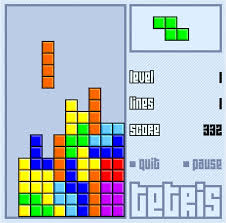
Tetris on the other hand (and less so the derivative Columns) held my attention for far longer than I was expecting. Tetris is a very simple game with just 6 shapes all dropping at increasingly fast speeds which can be rotated and slotted together. However the random order in which blocks drop and combine, the ability to rotate blocks, and the altering speeds make a huge difference to how absorbing the game becomes. It feels much more like a game of skills although, like Solitaire, there is a basic element of recognition and pattern matching (albeit quite a different game in Tetris – rotating blocks offers new possibilities for strategy and alternative approaches) but, unlike Solitaire it actually gets the pulse racing a bit. Every failure feels like you've just missed success by a tiny error and that encourages you to go back and try again and again.


Although the educational content of Tetris is clearly rather dubious (hand eye coordination and pattern matching but little else) I think there is something very educationally useful about what makes the game so captivating. Clearly any game that attempts to engage learners needs to be compelling and involving in order for any of the learning bound up with the game to be successful. So I think what I find really useful from this week's games is the idea of the great game mechanic:


I always think that the ideal game is the game where the winner thinks he's won because he's played it skillfully, and the losers feel that they've lost because they've had bad luck”

Steve Jackson, Games Designer (BBC 2009 [2])


So although this weeks games did not seem directly to the teaching and earning process I do feel that my dislike for Solitaire and my compulsion to continue with Tetris are both useful experiences for understanding learning games. I have previously sat in on web demonstrations from e-learning software companies and the stock learning games demo-ed by these sorts of software companies relate to matching images with phrases or pop quiz formats and, whilst some situations will suit these types of ideas I think the quick boredom that can occur in playing games that just make you go through the motions is important to note. I also have high hopes that some of the more sophisticated games coming up in the next few weeks will also start to include games that more educationally engage that simple but clever game mechanic that encourages you to go back again and again to perfect and prove your skill because you were just a few moves from getting it right... !


References

  • [1] Gee, J. P. (2003). Chapter 2, 'Semiotic Domains: Is playing video games a "waste of time"?'. In What video games have to teach us about learning and literacy, New York: Palgrave Macmillan. (core textbook)

  • [2] BBC (2009). Episode 2: Monopolies and Mergers. In Games Britannia. Accessed and viewed (via iPlayer) on 5th February 2010. http://www.bbc.co.uk/programmes/b00pf0rr.

Keywords: columns, gamemechanic, IDGBL10, solitaire, tetris

Posted by Nicola Osborne | 0 comment(s)

February 07, 2010

Week 3 – Update on game experience

While I did not enjoy the arcade games, I have enjoyed Solitaire, Tetris and Columns and this week Mahjong and Bookworm. I haven’t had a chance to play Scrabble yet but that is a game I have played since I was a child.  I also have always played Solitaire as well as puzzle games such as crosswords and sudoku.  I like to look for patterns and also having some time to reflect, although all the games had a timed element but I didn’t find them as frantic as the arcade games.

I didn’t realise how complex Mahjong was – I was concentrating on clearing all the tiles. I did notice the scoring but didn’t understand it. It wasn’t until Anna directed us to the link explaining the rules and the different suits you could make that I realised the complexity. But I am quite happy to play it on a simple level. I think I could get into it, and slowly learn the different suits you could make and think more strategically.

I never gave much thought before this course about defining what is ‘play’.  I think I just thought of it as a negative – the opposite of work. But I enjoyed the Kane and Sutton-Smith readings. I liked the focus on the different rhetorics of ‘play’ and situating them within their historical and/or scholarly context.  In particular, I find interesting the tension Kane points out between ancient (fate, chance and community) and modern rhetorics (freedom, progress and imagination).  As Kane says, there is a paradox:

To be a player is to try to live and thrive between freedom and determinism, chance and necessity. P. 40

vs.

I am not sure, though, how much the modern rhetorics are free of fate and determinism.  Progress can be seen as deterministic – particularly following Piaget - that there are stages of development that a child must go through.  Intertwining this developmental approach with play, turns play as something inherent in our genetic makeup, something we do not have control over.  Rather than being the ‘playthings’ of the gods, the child is a ‘plaything’ of his/her genetic make-up. Kane does touch upon this in saying that there is a tension between the modern rhetoric of play as progress –something that is hard-wired in our make-up and the modern rhetoric of play as imagination.  But Kane talks about our biological urge fusing with our creative imagination.  But where does our creative imagination come from? It comes back to the age old debate of nature vs. nurture.  But instead of posing fate and freedom or nature and nurture as oppositions, shouldn’t they be seem as a kind of continuum – in some areas we have more control than others. Or should they be visualized as concentric circles with freedom within fate/ or nature.  That we have certain ‘room for manoeuvre’ within a certain context.  Hence, our genetic composition or social circumstances at birth are fate or beyond our control.  But within that context, we have some freedom in the ‘raw material’ we have to start with.  And isn’t that what happens within game?  There are rules that are given but within the context of rules, we have some control over how we play the game.

Kane brings an interesting dimension into the discussion of play – considering what is ethical play. 

by dignifying our play with an ethical force, we can begin to create and act, rather than simply consume and spectate p. 62 

I think his choice of the term dignifying is revealing.  It seems he is countering the interpretation of play as being frivolous.  But there is also a moral dimension in his argument which is a critique of what he sees as the dominance of Western consumer-oriented society.

References

Kane, P. (2005) Chapter 2, 'A General Theory of Play'. In The Play Ethic : a Manifesto for a Different Way of Living. London, Pan. p35-6

Sutton-Smith, B. (1997) Chapter 1, 'Play and Ambiguity'. In The Ambiguity of Play. Cambridge, Mass: Harvard University Press.


Posted by Silvana di Gregorio | 0 comment(s)

February 04, 2010

My University is involved in phase two of JISC's Institutional Innovation Programme:

"This programme represents a £13.08m investment aimed at supporting existing institutional strategies by providing solutions to institution-wide problems, based upon proven practices, technologies, standards and services. The solutions will act as exemplars to other institutions by demonstrating innovation and good practice, and building knowledge and experience, which can be shared across institutions."

One of those projects is the Academic Social Networking project which is being developed by the Centre for Applied Research in Educational Technologies (CARET) at the University of Cambridge. The project itself "aims to bring some of the affordances of consumer social networks to teaching and learning".

What is interesting to me, and possibly to other students on the research methods module is that CARET collaborated with Flow Interactive, an external company, to investigate whether commercial user-centric design (UCD) techniques could be transferable and be used within a Higher Education context.

As the research team suggest, user-centric design is different because:

"...it explicitly, constructively and actively includes users in the design process from a very early stage."

One of the key features of their particular methodology is the notion of "design personas" and how it enabled them to:

"...identified trends or patterns in user behaviours, expectations and motivations, through conducting a combination of diary studies and interviews, and how this formed the basis of our personas. Having these personas enabled us to focus the design effort on supporting user goals. Also, where traditionally a designer might have lists and lists of requirements, personas allow one to prioritize these requirements to the degree these personas would find them important, offering more clarity."

Moreover, the research team at CARET have published their UCD methodology into a rather useful and compelling handbook for us lucky reseachers to peruse and may even offer a new approach to conducting research with our key stakeholders.

Keywords: academic social networking, caret, design persona, flow interactive, institutional innovation programme, jisc, project, research methods, rmel2010, ucd, user-centric design

Posted by Wayne Barry | 0 comment(s)

February 02, 2010

I have been thinking more about my intended research project as well as bouncing ideas and talking to colleagues about it as well. One of the recurring themes was a person or a groups relationship to and between space (physical, virtual or both?). These relationships could occur between:

  • Student to Student
  • Student to Peer Group
  • Student to Tutor
  • Peer Group to Peer Group
  • Peer Group to Tutor

It reminded me of some journal articles that I read as part of my "Space, Place and Technology" wiki articles for the "Psychological and Social Contexts of e-Learning" module. Specifically, this regards Nova (2005, p. 119) who proposes that when "dealing with the concept of space in collective situations", it should be considered through the lens of a number of dimensions:

  • Person to Person
  • Person to Artefact
  • Person to Place
  • Space, Place and Activity
  • Space and Artefacts
  • Space and Time

The "Space, Place and Technology" wiki articles are now converted into an "as is" electronic paper version on Issuu, if you wish to find out more about these dimensions. We can represent these dimension using the following illustration.

Relationship between space, place, people and artefacts across time

What we are looking at are fixed physical spaces are depicted as solid circles whereas transient physical spaces are denoted with dashed circles. Each circle is inhabited by people with some form of information and communication device like a desktop computer, laptop, mobile phone or PDA; also present are a number of "artefacts" represented by the orange star and the green diamond - these "artefacts" could be a chair, table, books, or Interactive White Boards. As depicted in the diagram, some "spaces" can overlap and be shared. Each information and communication device is connected to one or more virtual spaces as depicted by the computer servers inside a blue dashed cloud formation. These virtual spaces could be blogs, wikis, virtual environments, web pages and such like.

In terms of thinking about methodology, some ethnographic approach could be considered, but as Cousin (2009, p. 109) warns us:

"At first sight, it might seem that anyone can do ethnography but doing it well requires familiarity with a theoretical field, a set of research skills and perhaps, above all, ... an 'enlightened eye'"

Cousin (ibid) goes to say that "ethnography is not so much about studying people as learning from them". In their joint Centre of Excellence in Teaching and Learning (CETL) in Creativity project called inQbate, the Universities of Sussex and Brighton have created "two creativity zones" which offers "exciting opportunities for students to work in spaces that foster collaborative, self-directed and experiential learning".

The methodology for capturing how students reacted to and interacted within the space and with eachother was to use Interpretative Phenomenological Analysis (IPA). This is a relatively recent qualitative approach developed specifically within psychology by Jonathan A. Smith, a Professor of Psychology at Birkbeck, University of London. IPA concerns itself by:

"...trying to understand lived experience and with how participants themselves make sense of their experiences. Therefore it is centrally concerned with the meanings which those experiences hold for the participants."

I am not really considering IPA but it does demonstrate some of the deep and rich approaches to data collection and analysis. What has caught my eye, however, is something called Theory of Planned Behaviour (TPB) which is a theory about the link between attitudes and behaviour. TPB is a quantitative approach developed by Icek Ajzen, a Professor of Psychology at Amherst, University of Massachusetts. It was Siragusa & Dixon (2009) paper for the Ascilite 2009 conference where they were using questionnaire items related to components of the TPB to determine students’ attitudes and planned use of ICT-based instruction. Like any methodology, TPB has its' advocates and detractors.

It has been suggested to me that I could develop a case study. But in the meantime, I think I will look into TPB to see if it has any real value.

References

Cohen, L., Manion, L. & Morrison, K. (2007). Research Methods in Education (6th Edition). New York, London: Routledge.

Cousin, G. (2009). Researching Learning in Higher Education. New York, London: Routledge.

Norton, L.S. (2009). Action Research in Teaching & Learning. New York, London: Routledge.

Nova, N. (2005). "A Review of How Space Affords Socio-Cognitive Processes during Collaboration". PsychNology Journal, 3(2): 118-148.

Robson, C. (2002). Real World Research (2nd Edition). Malden, MA; Oxford; Carlton, Victoria: Blackwell Publishing.

Siragusa, L. & Dixon, K.C. (2009). "Theory of planned behaviour: Higher education students'
attitudes towards ICT-based learning interactions". In Same places, different spaces. Proceedings ascilite Auckland 2009. Available at: http://www.ascilite.org.au/conferences/auckland09/procs/siragusa.pdf [Accessed 02.02.2010].

Keywords: case study, ethnography, interpretative phenomenological analysis, learning spaces, physical spaces, research methods, rmel2010, theory of planned behaviour, virtual spaces

Posted by Wayne Barry | 0 comment(s)

February 01, 2010

It was lovely to start this week with Dara O'Briain's [4] great overview on the problem of content from the point of view of a gamer forced through uninteresting but difficult entry levels before the main advertised action of a computer game commences.


Gee [1], almost as a second introduction to What Video Games Have to Teach Us About Learning and Literacy, starts addressing the core criticism of gaming in general – what is the point of playing them? I was quite taken by how Gee compared the cynicism over gaming to the attitude taken to visual content in academic contexts and the lack of acceptance of more transliterate approaches to scholarly practice communication – formal text is still king and any sort of game will therefore thus appear particularly alien.


Although I am not from a linguistic background I found Gee's concept of the semiotic domain of gaming to be quite helpful as, as a very occasional gamer, any interaction with gaming websites, magazines etc. feels like dipping into a wholly new domain. I recognise some of the symbols and their meaning but there others that entirely pass me by because I am not sufficiently versed into this domain to be able to decode even some quite basic features. In particular my unfamiliarity with the social as well as game play practices of current gaming platforms is a key gap in my understanding of current gaming culture and practices.


I was thus pleased that Gee had focused on Pikmin, a GameCube game from 2001 which I spent many weeks playing not long after release, to further explore the ways in which games could provide learning opportunities far more sophisticated than their basic narrative at first suggests. Pikmin amply illustrates the level of concentration, time and commitment needed to complete many apparently cute but daft games – every action in any vaguely creative, complex or involving game will involve some elements of problem solving, of sustained imagination, of efforts that far outweigh the actual reward of the game. Framed in this helpful context it becomes easy to see Gee's view that:


“The problem with the content view is that an academic discipline (or any other semiotic domain, for that matter) is not primarily content, in the sense of facts and principles. It is primarily a lived and historically changing set of distinctive social practices”

Gee (2003[1] p. 22)


Indeed during the same week that I was reading Gee a senior colleague was telling me the very same thing about my own studying process – reminding me to do well but also warning me that it was not the content per se, nor the grades, that makes the MSc but the communication and research skills and the understanding of the work process at the expected level that really counts.


If that disconnect between what is often assessed (the content) and what the actual focus of learning should be (skills, process, social practice) is accepted then there some interesting questions to ask about gaming. What, for instance, are the skills of first person shooter games and, if content is immaterial, is there any moral restriction on what might be reasonably played for learning? In some regards content can, in fact, be a driver for interest in learning a new skill but at the same time there are few literacy courses teaching adults to read English with violent thrillers or erotica and I think there would be some concern if learning games were to fully adopt some of the morally grey areas in which many of the most popular computer games sit.


However there is, as was briefly addressed on the boards this week, a gender element as well. Some content and playing styles will instantly be more appealing to female players, others to male players. In the commercial sector the choice of focus for games designers may be rather skewed but in the educational sector gender must be handled in a more balanced way and that may offer challenges in finding both game formats and content (as a driver rather than the focus of learning) that will motivate both learners sufficiently to progress and learn from a game.


But I digress...


Gee's concept of Semiotic Domains and the processes of active learning seem to have synergies with the ideas of Threshold Concepts (Meyer & Land 2006 [5]) and the transformation of a learners identity from distanced outsider to increasingly skilled novice to equipped insider to qualified practitioner. It is at this latter stage of working through threshold concepts that Gee's Affinity Groups also ring true. Once one can prove one's literacy in a semiotic domain then one becomes eligible for memberships of affinity groups. At the time of writing I find the World of Warcraft (WoW) conversations on the course discussion boards quite obscure and, if not excluding, then certainly detached from meaning for me as I am not versed in this quite specific semiotic domain and cannot thus be part of the course's own affinity group of WoW players. I do however know some of the external grammars of WoW as I have friends who are players so I am, at least, able to recognise and understand the broad tone of messages about the game.. I could not bluff more specific internal grammars but neither am I a total outsider. If I wanted to enter that domain more fully then I could call upon my own knowledge and that of my friends' and gradually blend these interrelated internal and external grammars to reflect my changing experience of the game.


Gee sees Critical learning as a natural add on to active learning. But whilst most games offer some sort of space for critical reflection I think the use of the word here is quite loaded. Analysis, critique and reflection are, of course, possible in computer games but I am not compelled that formulating a multitude of strategies for completing/succeeding at a game are born of entirely conscious intellectual reflection. Greenfield (1984 [2]) too examines in detail the clinical detail of a game (Pac Man in this case) establishing a very rational outline of the discoveries made by gamers. But Greenfield takes not the players of PacMan but a cheat guide as her source whilst Gee attributes complex thought processes to a six year old's game strategy – in neither case do the players articulately relate their experience of the game in a way that shows a particular understanding of the process of game design. In critical thinking around cinema there is one level at which one recognises and can articulate a cinematic trick, convention or feature but there is also a much more critical level at which one can stand back and analyse the way in which such a feature has been used, or subverted, or referenced, etc. and I am not convinced either Gee or Greenfield entirely convince me that the players they describe are equipped to properly critically evaluate the games they play from the perspective purely of insiders within those games.


Playing of related and/or competing games and the social aspects around gaming certainly provide greater possibility for critical learning and comparison but these forms of criticism and analysis are, perhaps, equivalent to affinity groups around genre novels: a group of murder mystery fans may be extremely well placed to compare genre novels, their use of references and conventions, the most successful and inventive plotting etc. but that same group may not be equipped to compare their book to a broader palate of literature sources and compare conventions and ideas from wider contexts.


For gaming to be taken seriously as a semiotic domain I think it is essential to ensure that gamers and learners are equipped with extended critical skills that inform not only their own learning but also allows for reflection on the selection and use of a given gaming-learning spaces as well as how these relate to other semiotic domains – both gaming and non gaming domains. This in turn brings us back to Gee's fifth learning principle of Metalevel Thinking About Semiotic Domains [1].


One of the more interesting aspects of Wood [3] is the fact that it seems to be a lack of public (and medical) acceptance of gaming as a legitimate leisure pursuit that drives the move to radicalise and classify heavy usage of games as a problem. Greenfield [2] raises the peculiar disparity between the acceptance of television versus video games. It seems that the wider the experience, the more acceptable the pursuit although some of both Greenfield and Wood's observations hint at some of the most subjective problems in dealing with the arguments over digital game addition. Greenfield was writing at a time where use of video games was more visibly centred around specific gaming venues – although much more gaming took place at home – and these spaces carry their own baggage. Wood points to the difficulty in measuring time spend on games and how this relates to other activities.


However both Wood and Greenfield do not address other cultural aspirations challenged by computer gaming. As far back as gladiatorial combat the idea that competition is based on physical prowess and achievement and one of the most complex aspects of attitudes to computer gaming is the idea that there is something unusual, perhaps even perverse, in a virtualised or screen based form of play and competition. Television competitions are all conducted via some sense of real physical achievement – whether quiz contestants or Olympic athletes we see a human embodiment rather than a pixellated or stylised avatar – and it may be that that feels inherantly less unsettling than the bigger imaginative leap required in most computer games (no matter how good the graphics). Perhaps this is the reason that puzzle games are never raised as the cause of addictive game playing whilst highly animated virtual worlds are most often highlighted by the media as potential causes for concern. Puzzles can relate to an offline play paradigm and this is reassuring no matter how peculiar or potentially disruptive to normal life 3 hours of Scrabble per night (say) may be. More alien spaces such as Virtual worlds, first person shooters, MMOPGS, etc. all look and feel more like the niche pursuit of battle re-enactment and are seen with similar disdain perhaps, in part, because of the confidence and imagination inherant in choosing to be an active part of a community in preference to fully inhabiting one's own (real) world space. Perhaps it is merely a sense of rejection or abandonment that fuels concerns about addiction – it is not the actual number of hours spent in a game space but, as Wood indicates, the potential flaws in real life a high level of usage may highlight. Personally I think it is interesting that most of the media and academic debate on games addiction revolves around the use of games by teenagers. This is an age group who are biologically programmed to exhibit boundary testing, provocative, experimental and independent behaviours no matter what form such activity may take. Their parents, as their long term carers, protectors, etc. are therefore equally naturally likely to be concerned about whatever form teenage distancing takes and to blame the form, not the function - from Rock and Roll in the 50s to games “addiction” at present. Teenage years also coincide, in most countries, with the taking of genuinely important academic milestones – exams, transitions to college, university, work etc. - thus heightening the anxious tone of any debate on the consequences of gaming. I have many friends who spend substantial time playing computer games but this (aside from virtual world shock pieces) is not an age whose possible gaming addition is scrutinised nearly as closely. I do not think this is a reflection of the fact that older individuals spend less time on games but that at the age of 30 most people have proved that, alongside whatever their leisure pursuits might be, they manage to hold down a job, and/or attract and retain a mate, and to conduct a socially recognised pattern in their life. Teenagers however must face a world of possibility and parental and societal fears that goals will not be achieved, distractions will prove damaging etc. I think that disparity in studied communities is as important to Wood's argument as are his own interviews with functioning games “addicts” whose problems reflect other issues.


References

  • [1] Gee, J. P. (2003). Chapter 2, 'Semiotic Domains: Is playing video games a "waste of time"?'In What video games have to teach us about learning and literacy, New York: Palgrave Macmillan.

  • [2] Greenfield, P. M. (1984). Chapter 7, 'Video Games'. In Mind and media : the effects of television, video games, and computers. Cambridge, Mass: Harvard University Press.

  • [3] Wood, R. T. A. (2008). Problems with the Concept of Video Game “Addiction”: Some Case Study Examples. International Journal of Mental Health Addiction, 6, 169-178.

  • [4] "Dara O Briain - Charlie Brooker's Gameswipe". YouTube clip retrieved from eightySeventh's channel 1st February 2010. http://www.youtube.com/watch?v=eG3aHvPG6H8

  • [5] Meyer, J. and Land, R. (2006). Threshold concepts and troublesome knowledge. Overcoming barriers to student understanding: threshold concepts and troublesome knowledge. J. Meyer and R. Land (Eds.). (London, Routledge): pp. 3-18.


Keywords: addiction, content, Gee2003, IDGBL10, pikmin, skills, Solitaire, Tetris, thresholdconcepts

Posted by Nicola Osborne | 0 comment(s)

January 29, 2010

Topic:
Which are the beliefs for assessment among ICT teachers of secondary-high schools, what assessment methods they employ (i.e. traditional paper-based/online) and how their assessment beliefs and methods are affected by their implicit beliefs about knowledge and learning.
 
 
As Robson notes, the research questions help in determining the strategy. Therefore, taking into account that I am seeking to:
  • Answer “which” questions (i.e. “which are the assessment beliefs of ICT teachers?”, “which are their epistemological beliefs?”), I should consider to deploy a non-epxerimental fixed strategy such as a survey
  • Answer “how” and “what” questions (i.e. “what assessment methods ICT teachers prefer?”, “how their assessment beliefs and methods correlate with their implicit beliefs about knowledge and learning?”), I should also consider to deploy a flexible strategy.

However, there seem to be some problems in my topic concerning the implicit beliefs and their relation to assessment beliefs. How can I be so sure that there is indeed a mechanism, which is in operation? May be implicit beliefs does not affect assessment beliefs or methods, or that their relation is trivial while other mechanisms are more dominant. Therefore, it is clear the need to search the literature more thoroughly before proceeding to that question.
 
 
References:

Real World Research: A Resource for Social Scientists and Practitioner-Researchers, 2nd Edition. Colin Robson. (p.80, 91)

Keywords: strategy, thoughts, topic

Posted by Angelos Konstantinidis | 0 comment(s)

January 26, 2010

Things had started to get pretty sophisticated in the home console market pretty quickly as I got near to finishing primary school and although my mum certainly wasn't enthused by computer games we started to hear about them through friends and, I suppose, the media. The Sega Mega Drive came out and we started occasionally renting consoles and games when we went to the village shop to rent video cassettes. Sonic the Hedgehog became the first game my sister and I both got pretty good at playing and I remember spending hours and hours of the weekend with my sister and I lounging on my mum's big squishy bed playing Sonic on the second telly. We never plugged it into the big TV downstairs as it wasn't seen as appropriate to play games in the lounge as it would be visible, would interfere with visiting adults and, in our wee house, would have meant us getting under my mum's feet. Gaming was to be done in relative privacy.

There was all of one Sega console in the village shop so we'd also rent and play Super Mario Brothers on the NES. In fact I can't recall which we started out with but Sonic felt rather more energised and entertaining to play and certainly had the showier graphics of the two. However all of the visual shorthand and game play tactics learned in Super Mario would turn out to be handy in later Nintendo titles from Mario Party to Super Mario Sunshine and Luigi's Mansion. And no matter which console was available for hire, these occasional weekends of gaming felt like a pretty special and unusual activity.


All of the games played to date were fun but were marked by extreme frustration. Not just over understanding controls and goals of the game but mainly over getting a chance to play at all. Access to just about all the machines or gaming devices was rationed in the extreme because they weren't owned hugely widely and were expensive to buy.


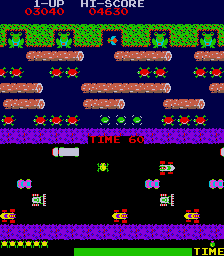
For instance Frogger had been used as a (learning free) reward at school – a carrot for finishing work on time or doing well but even then maybe 5 people would be crammed into the (open) cupboard awaiting their turn the moment you killed your frog.


Having just replayed the game this week I can see why it was so frustrating – a very unsuccessful player can burn through froggy lives in about 2 minutes, controls are fiddly and reaction speed is a part of the challenge all of which, in a room full of enthusiastic 9 year olds, means it's very easy to kill your frog(s) with the smallest delay in reaction. Then one was left sitting there waiting the next turn exasperatedly for maybe half an hour.


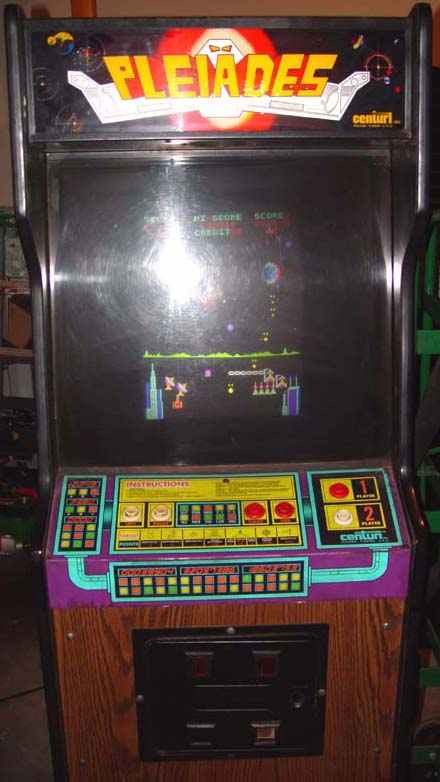
I knew that arcade games existed out there in a sort of parallel urban universe but programme like Blue Peter, Press Gang and Grange Hill ran stories about how addictive and dangerous they were with little differentiation between One Armed Bandits and other types of arcade games. News Round highlighted people thieving money and bunking off school to support arcade playing habits. All of the above are surely the precursor to the current array of gaming scare stories though I'm sure there was a small kernel of truth there also. But, in any case, this was all very academic as we were living in a small village so an arcade seemed like a bizarre scary place. I think anything from sky diving clubs to film sets to strip bars probably all seem less bizarre and much more accessible to the average 10 year old growing up in the same place today. At the time though such establishments seemed very “There be dragons!” to us. Watching Ferris Bueller's Day Off I remember thinking how very mature and bad-ass the girl who is mistaken for Ferris in – gasp! - an arcade must have been. To this day I see arcade gaming machines as pricey, for other people, and pretty much equivalent to gambling thanks to all those media warnings about their addictiveness.


Some diversionary arcade-ish gaming was, however, permitted in the palace of tackiness that was the Laser-quest venue that opened up in Cardiff in the early 90s. Amongst my favourites here were the games that were hybrids of electronic and physical games – I particularly remember a basketball game where you threw real balls and the points were electronically totted up. It wasn't that clever but – like Laser-quest itself - it felt very high tech and gave you a very physical sense of feedback and sense of accomplishment – oddly the natural successors to these types of games are probably the WII and Project Natal (for Xbox). Indeed very few of the video/computer/digital games I encountered till the late '90s had anything to do with beating other people, most were about beating your own high score or a previously set high score. This was very different to the other types of games I was playing – from catch to bowling (bowling being the highlight of an 11 year olds life) or laser-quest (all very performed forms of play) to the many varieties of board games played with friends.
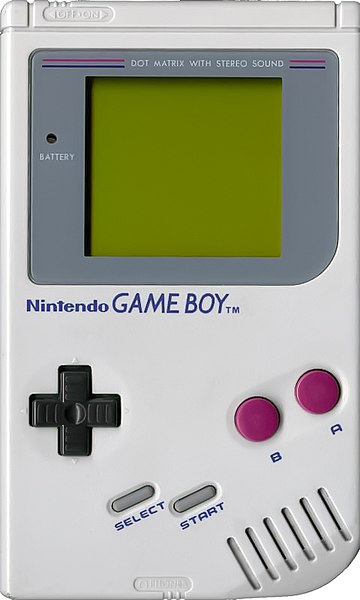
 

Next into my gaming life wandered the Nintendo Game Boy. It seemed like an excessively expensive treat and it was thus not me (busy with crafts) but my sister who asked for/part paid for a shiny new Game Boy to entertain her into her teens. Tetris was almost the only thing anyone in the house ever played on her Game Boy, in part because it had been bundled free but, in larger part, because it was a very simple and very addictive game to play. Although my sister also acquired such classics as Bill & Ted's Excellent Game Boy Adventure the gameplay rarely contended with Tetris. Indeed not only did I start poaching the Game Boy to play a few levels but so did my mum who became sufficiently addicted to get, if I recall correctly, the highest score in the house (when I mentioned this course the other week she commented on how addicted she had been to Tetris in fond but baffled terms).


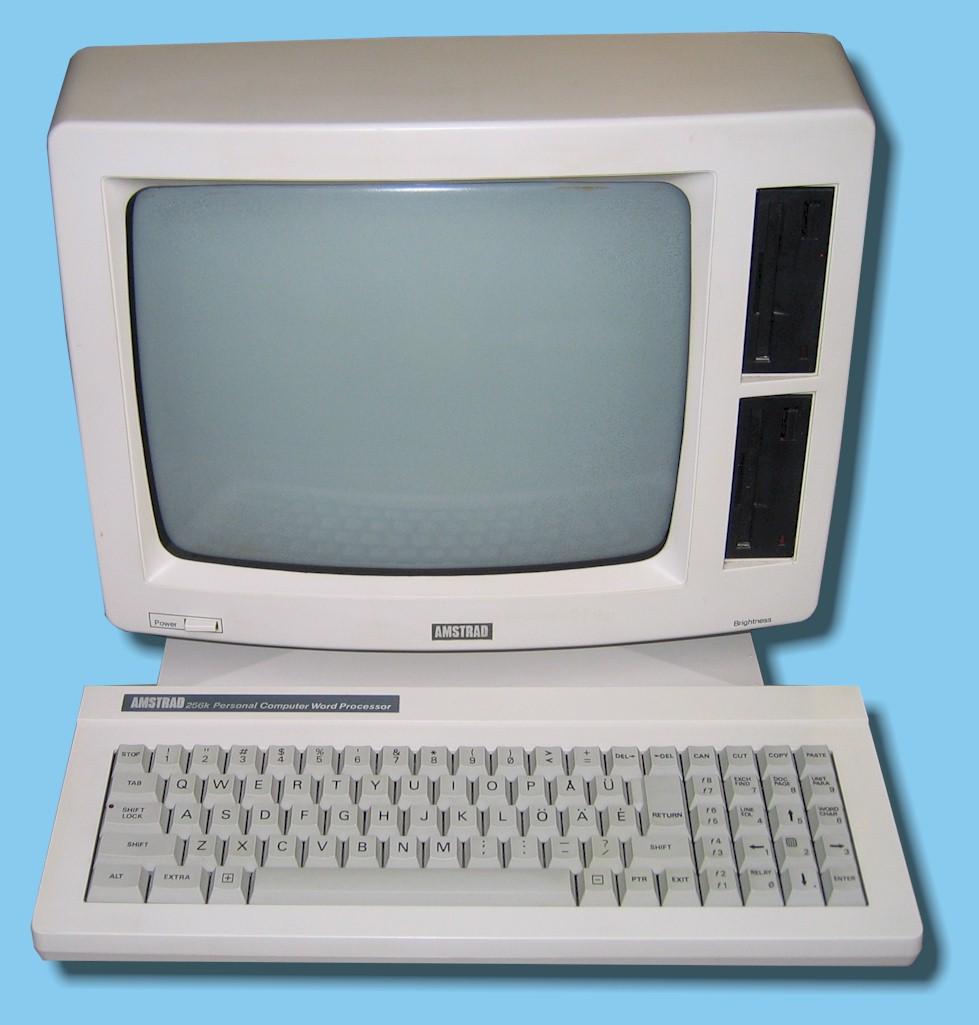
I never got interested enough for my own GameBoy but I did become fascinated with making pretty shapes on screen and, having just gotten access to my dad's very old Amstrad, I was largely entertaining myself trying to find ways to draw random pictures with text (also fun, of course, on typewriters) and experimenting with watching his vast archive of old films. Other digital games and entertainment largely passed me by as I really wanted more freedom and creativity in my gaming and platform games and puzzle games of the time were fairly dictatorial about how you could play the game. It was great to get absorbed in beating the clock but wasn't terribly satisfying.

Having said this a few games offered some short term distractions. A leisure centre near us offered a very underused and cheap Tekken arcade game and that, on a pleasing visceral level, became a good way for my sister and I to beat each other up in an acceptable and entertaining manner.

 At school the one room of PCs also had but one exciting game available. Snake, in all it's basic glory, looked vaguely like it could be a bit mathematical and somehow slipped through the academic net. Thus the room was oft packed with school peers playing for extended periods. I enjoyed it but found the opportunity to write up and format actual pieces of work more exciting in terms of the hours I would spend on the computers. Snake was fun but writing let me express myself rather than fill time. This, as you may notice, is a bit of a theme with my enjoyment of computer games and some of my attitude about what makes good games and thus good learning games. Reflecting on my previous gaming experience feels like a useful part of a process of understanding what would and could have truly engaged me as a learning gaming process. Graphics and interactivity has moved on substantially but conceptual elements of what makes a good game seem important even in the lowest tech computer games experiences.


As PCs were getting more sophisticated they started to be the main space I encountered games (leaving consoles to others at this point) including Solitaire, MineSweeper, Hearts (which I never did or have understood), and the curious Mavis Beacon touch typing game. It's only in recent years that I realise what a handy primer the latter game was. It didn't teach me to touch type but it did focus me, after years of watching my mother type like lightening when working from home, on thinking about which keys should do which keys when I actually learned speedy touch typing some years later through enthusiastic use of chat rooms on AOL when we finally got a (modern) PC at home.


PCs also brought gaming to an older friend in my neighbourhood which also meant I started to see games that much more closely resemble what the term “computer game” means to most people these days. These were games like Doom, Civilisation, and Tomb Raider and, noticeably, these were adult games with gore or ridiculously proportioned stars or complex goals and game play. They were a world away from Mario or Tetris but, at the time, they looked both more life like and more disappointing – the bright garish animation of kids games suited the screens better and the power of the computers meant that Solitaire or minesweeper could move fast but games like Doom could move quite choppily with parts of the screen barely rendering in time for you to play them.

However by the time we had that first Windows machine at home the internet existed. Indeed we'd gotten the PC, in part, to allow my mum access to email for work. So my first experiments with the PC were about the enormous package of bundled CDs roms (including creative but random titles like an Alan Titchmarsh Gardening program), those included Windows 95 games and, most excitingly of all, very slow dial up internet explorations which would take me away from games for several years as I met new people across the world and read and wrote and chatted – all activities that seemed terribly exciting compared to gaming for hours to a teenager who was more than ready to move out of a small village and wanted to explore lots of things that school and friends weren't offering me about films, about my identity. It was a revelation and just couldn't compare with any other leisure pursuit for most of my late teens. But when I reached university the internet was plentiful, the real life opportunities greater and the call of games was thus a little stronger...


Keywords: gaming, IDGBL10, Mario

Posted by Nicola Osborne | 0 comment(s)

January 25, 2010


Last week, getting myself set for looking at computer games for this module, I started to think about what games I'd played before and was staggered by the variety and number of games I had, at some point, come into contact with.

Because both of my parents had computers purely for work at a time when Apricots and early Amstrads just didgn't come with any sort of game I probably started with Frogger on the BBC computer at school. There was one other game too but early Frogger is what I properly recall playing badly in the broom cupboard (where all the primary school computers used to be kept/used).


Around the same time as Frogger appeared I took possession of a little purple portable Snoopy Tennis game which, despite being effectively Pong with even less potential for game variance, kept me entertained for hours. This was the same portable gaming device (with only one pre-loaded game and fixes labelled buttons) that other people had Donkey Kong on but that was never my bag (playing it again this week it still isn't). I also vividly recall having, in parallel with Snoopy Tennis, small (but not as small) water games – you pressed a button to push balls around a water maze. They were fun too but they got broken or accidentally drained far faster than Snoopy Tennis' batteries died.


In the next few years several friends started getting various games. One friend had what, in retrospect, must have been one of the early (and expensive) Sinclair machines. I remember tapes, I remember baffling minutes of loading and finally blotchy graphics on a small colour telly. I have absolutely no recollection of the game or gameplay. Friends of my sister had Paperboy (an Atari game) involving a paper boy cycling his route – although I remember watching at least 4 rounds of people playing before realising that this was the plot as the graphics were very basic. As these friends got consoles (because that was pretty much what you played games on at the time) they became experts at the games they had available. But they pretty much all had different games. This meant visits to these friend's houses might involve watching them play but inevitably, if you had a turn, you would be dead in seconds and have to watch your friend gloat as they showed off their skills. There was a little peer learning and support but many of these kids assumed you would know all about the game too and some revelled in their status as an expert player. That said not many friends had games at all partly because of the cost (my home village is now well funded and very middle class but in the 80s incomes were modest and computer games prohibitively pricey) and partly because most of my sister and my friends were little girls. Memory of play at that age involved toys, various hours spent styling hair, making up dance steps to the Reynolds Sisters and doing little craft projects and Brownie badges. Computer games were just not a mainstream activity for anyone under 10 and most of the girls I knew just weren't that excited by them. Those that were tended to have brothers or lots of cousins that they were keen to keep ahead of.


My dad had been the sort to buy small robots and VCR machines (we always had two, the better for making amateur records of classic movies to remove Channel 4 ads) when he saw them but he was always more into things like Scalelextric, things with a physical note, but it probably wouldn't have been long until we would have had computer games or a console of our own in the house had his death not intervened when I was about 9. This pretty much ensured we wouldn't be in the mood, nor in any way able to afford much in the way of new technology for a while. My dad would go out and spend money in occasional overenthusiastic bursts on things that looked new and shiny, my mother however had always been less impressed with expensive gadgets and with cash short she certainly wasn't about to focus on games as a spending priority. She was working from home pretty much full time though and using a computer and laser printer to do so. Her boss occasionally came round with early laptops and, once, a very early modem so as friends started to get used to computers as gaming devices we were learning that computers were hugely powerful publishing tools. I think in the long term this probably fared both myself and my sister fairly well – when we first got access to PCs at secondary school we both found it easy to use them for work and research whilst peers seemed unable to tear themselves away from basic games like Snake. But that was later...


Keywords: 80s, games, IDGBL10, ItWasAcceptableInThe80s, Mario, SnoopyTennis, Sonic

Posted by Nicola Osborne | 0 comment(s)

<< Back Next >>