

This weeks games forced me to confront my own ideas about what is and is not a worthwhile game to play (indeed these are the types of games that make sympathetic to the negative arguments about games discussed by Gee [1]). My reaction seeing the games listed in the Casual Games section was to roll my eyes a little and wonder whether I needed to waste my time with them. I'd played both Solitaire and Tetris before but mainly as a way to avoid homework or fill gaps between lectures when I was an undergraduate student so this week, with work and readings to more than fill my time, why would I want to fritter away minutes on such trivial games?

Solitaire more than lived up to my memories. It has some appeal as a procrastination tool but I quickly grew bored of the game play. The challenge of the game comes from the speed and strategy of completion but otherwise the game is fairly easy to complete. The cards are randomly dealt but once you have completed a game the challenge is significantly diminished for later rounds (unless you start altering difficulty levels or attempting to beat your time). Once I had played a few abortive rounds of Solitaire I completed a game and that was my interest peaked. In game play it reminds me of something I used to do for a job: sorting library books into their Shelfmark. There is strategy and speed at play but ultimately you are simply mechanically obeying the rules and the novelty is quickly lost.
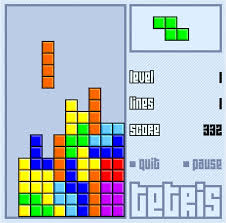 Tetris on the other hand (and less so the derivative Columns) held my attention for far longer than I was expecting. Tetris is a very simple game with just 6 shapes all dropping at increasingly fast speeds which can be rotated and slotted together. However the random order in which blocks drop and combine, the ability to rotate blocks, and the altering speeds make a huge difference to how absorbing the game becomes. It feels much more like a game of skills although, like Solitaire, there is a basic element of recognition and pattern matching (albeit quite a different game in Tetris – rotating blocks offers new possibilities for strategy and alternative approaches) but, unlike Solitaire it actually gets the pulse racing a bit. Every failure feels like you've just missed success by a tiny error and that encourages you to go back and try again and again.
Although the educational content of Tetris is clearly rather dubious (hand eye coordination and pattern matching but little else) I think there is something very educationally useful about what makes the game so captivating. Clearly any game that attempts to engage learners needs to be compelling and involving in order for any of the learning bound up with the game to be successful. So I think what I find really useful from this week's games is the idea of the great game mechanic:
“I always think that the ideal game is the game where the winner thinks he's won because he's played it skillfully, and the losers feel that they've lost because they've had bad luck”
Steve Jackson, Games Designer (BBC 2009 [2])
So although this weeks games did not seem directly to the teaching and earning process I do feel that my dislike for Solitaire and my compulsion to continue with Tetris are both useful experiences for understanding learning games. I have previously sat in on web demonstrations from e-learning software companies and the stock learning games demo-ed by these sorts of software companies relate to matching images with phrases or pop quiz formats and, whilst some situations will suit these types of ideas I think the quick boredom that can occur in playing games that just make you go through the motions is important to note. I also have high hopes that some of the more sophisticated games coming up in the next few weeks will also start to include games that more educationally engage that simple but clever game mechanic that encourages you to go back again and again to perfect and prove your skill because you were just a few moves from getting it right... !
References
[1] Gee, J. P. (2003). Chapter 2, 'Semiotic Domains: Is playing video games a "waste of time"?'. In What video games have to teach us about learning and literacy, New York: Palgrave Macmillan. (core textbook)
[2] BBC (2009). Episode 2: Monopolies and Mergers. In Games Britannia. Accessed and viewed (via iPlayer) on 5th February 2010. http://www.bbc.co.uk/programmes/b00pf0rr.