

Things had started to get pretty sophisticated in the home console market pretty quickly as I got near to finishing primary school and although my mum certainly wasn't enthused by computer games we started to hear about them through friends and, I suppose, the media. The Sega Mega Drive came out and we started occasionally renting consoles and games when we went to the village shop to rent video cassettes. Sonic the Hedgehog became the first game my sister and I both got pretty good at playing and I remember spending hours and hours of the weekend with my sister and I lounging on my mum's big squishy bed playing Sonic on the second telly. We never plugged it into the big TV downstairs as it wasn't seen as appropriate to play games in the lounge as it would be visible, would interfere with visiting adults and, in our wee house, would have meant us getting under my mum's feet. Gaming was to be done in relative privacy.

There was all of one Sega console in the village shop so we'd also rent and play Super Mario Brothers on the NES. In fact I can't recall which we started out with but Sonic felt rather more energised and entertaining to play and certainly had the showier graphics of the two. However all of the visual shorthand and game play tactics learned in Super Mario would turn out to be handy in later Nintendo titles from Mario Party to Super Mario Sunshine and Luigi's Mansion. And no matter which console was available for hire, these occasional weekends of gaming felt like a pretty special and unusual activity.


All of the games played to date were fun but were marked by extreme frustration. Not just over understanding controls and goals of the game but mainly over getting a chance to play at all. Access to just about all the machines or gaming devices was rationed in the extreme because they weren't owned hugely widely and were expensive to buy.

For instance Frogger had been used as a (learning free) reward at school – a carrot for finishing work on time or doing well but even then maybe 5 people would be crammed into the (open) cupboard awaiting their turn the moment you killed your frog.
Having just replayed the game this week I can see why it was so frustrating – a very unsuccessful player can burn through froggy lives in about 2 minutes, controls are fiddly and reaction speed is a part of the challenge all of which, in a room full of enthusiastic 9 year olds, means it's very easy to kill your frog(s) with the smallest delay in reaction. Then one was left sitting there waiting the next turn exasperatedly for maybe half an hour.
I knew that arcade games existed out there in a sort of parallel urban universe but programme like Blue Peter, Press Gang and Grange Hill ran stories about how addictive and dangerous they were with little differentiation between One Armed Bandits and other types of arcade games. News Round highlighted people thieving money and bunking off school to support arcade playing habits. All of the above are surely the precursor to the current array of gaming scare stories though I'm sure there was a small kernel of truth there also. But, in any case, this was all very academic as we were living in a small village so an arcade seemed like a bizarre scary place. I think anything from sky diving clubs to film sets to strip bars probably all seem less bizarre and much more accessible to the average 10 year old growing up in the same place today. At the time though such establishments seemed very “There be dragons!” to us. Watching Ferris Bueller's Day Off I remember thinking how very mature and bad-ass the girl who is mistaken for Ferris in – gasp! - an arcade must have been. To this day I see arcade gaming machines as pricey, for other people, and pretty much equivalent to gambling thanks to all those media warnings about their addictiveness.

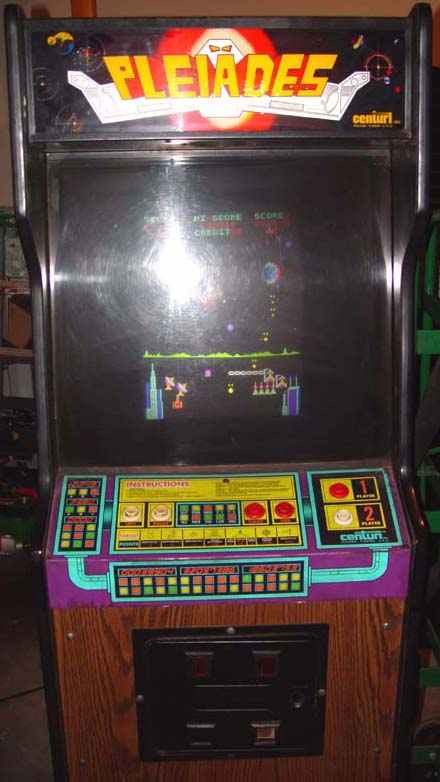
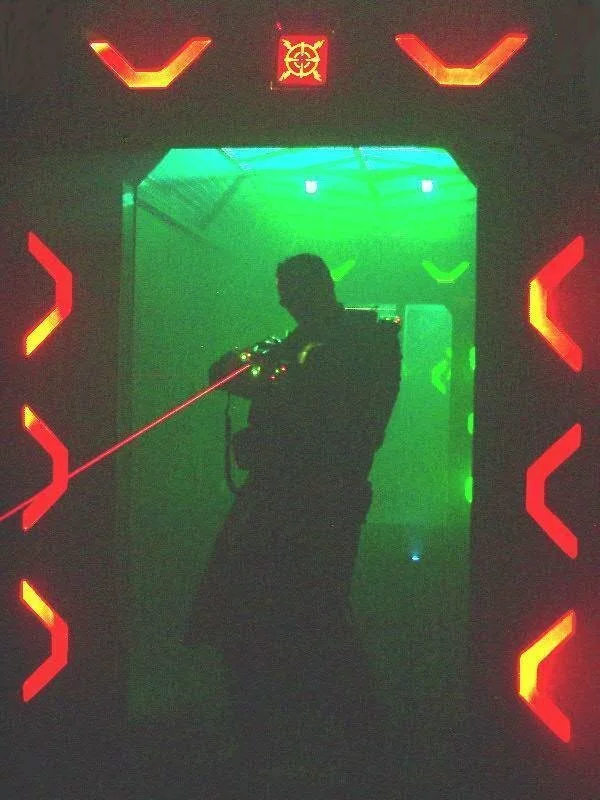 Some diversionary arcade-ish gaming was, however, permitted in the palace of tackiness that was the Laser-quest venue that opened up in Cardiff in the early 90s. Amongst my favourites here were the games that were hybrids of electronic and physical games – I particularly remember a basketball game where you threw real balls and the points were electronically totted up. It wasn't that clever but – like Laser-quest itself - it felt very high tech and gave you a very physical sense of feedback and sense of accomplishment – oddly the natural successors to these types of games are probably the WII and Project Natal (for Xbox). Indeed very few of the video/computer/digital games I encountered till the late '90s had anything to do with beating other people, most were about beating your own high score or a previously set high score. This was very different to the other types of games I was playing – from catch to bowling (bowling being the highlight of an 11 year olds life) or laser-quest (all very performed forms of play) to the many varieties of board games played with friends.
Next into my gaming life wandered the Nintendo Game Boy. It seemed like an excessively expensive treat and it was thus not me (busy with crafts) but my sister who asked for/part paid for a shiny new Game Boy to entertain her into her teens. Tetris was almost the only thing anyone in the house ever played on her Game Boy, in part because it had been bundled free but, in larger part, because it was a very simple and very addictive game to play. Although my sister also acquired such classics as Bill & Ted's Excellent Game Boy Adventure the gameplay rarely contended with Tetris. Indeed not only did I start poaching the Game Boy to play a few levels but so did my mum who became sufficiently addicted to get, if I recall correctly, the highest score in the house (when I mentioned this course the other week she commented on how addicted she had been to Tetris in fond but baffled terms).
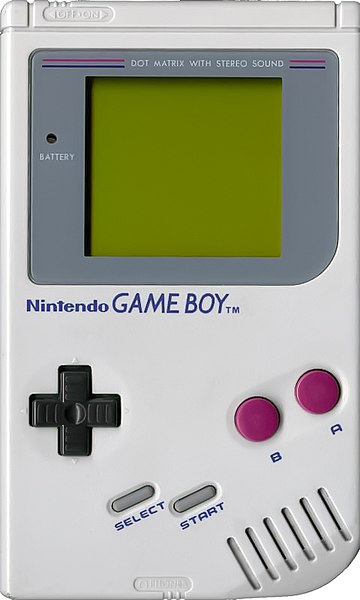

I never got interested enough for my own GameBoy but I did become fascinated with making pretty shapes on screen and, having just gotten access to my dad's very old Amstrad, I was largely entertaining myself trying to find ways to draw random pictures with text (also fun, of course, on typewriters) and experimenting with watching his vast archive of old films. Other digital games and entertainment largely passed me by as I really wanted more freedom and creativity in my gaming and platform games and puzzle games of the time were fairly dictatorial about how you could play the game. It was great to get absorbed in beating the clock but wasn't terribly satisfying.
 Having said this a few games offered some short term distractions. A leisure centre near us offered a very underused and cheap Tekken arcade game and that, on a pleasing visceral level, became a good way for my sister and I to beat each other up in an acceptable and entertaining manner.
At school the one room of PCs also had but one exciting game available. Snake, in all it's basic glory, looked vaguely like it could be a bit mathematical and somehow slipped through the academic net. Thus the room was oft packed with school peers playing for extended periods. I enjoyed it but found the opportunity to write up and format actual pieces of work more exciting in terms of the hours I would spend on the computers. Snake was fun but writing let me express myself rather than fill time. This, as you may notice, is a bit of a theme with my enjoyment of computer games and some of my attitude about what makes good games and thus good learning games. Reflecting on my previous gaming experience feels like a useful part of a process of understanding what would and could have truly engaged me as a learning gaming process. Graphics and interactivity has moved on substantially but conceptual elements of what makes a good game seem important even in the lowest tech computer games experiences. 
As PCs were getting more sophisticated they started to be the main space I encountered games (leaving consoles to others at this point) including Solitaire, MineSweeper, Hearts (which I never did or have understood), and the curious Mavis Beacon touch typing game. It's only in recent years that I realise what a handy primer the latter game was. It didn't teach me to touch type but it did focus me, after years of watching my mother type like lightening when working from home, on thinking about which keys should do which keys when I actually learned speedy touch typing some years later through enthusiastic use of chat rooms on AOL when we finally got a (modern) PC at home.
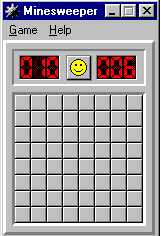
PCs also brought gaming to an older friend in my neighbourhood which also meant I started to see games that much more closely resemble what the term “computer game” means to most people these days. These were games like Doom, Civilisation, and Tomb Raider and, noticeably, these were adult games with gore or ridiculously proportioned stars or complex goals and game play. They were a world away from Mario or Tetris but, at the time, they looked both more life like and more disappointing – the bright garish animation of kids games suited the screens better and the power of the computers meant that Solitaire or minesweeper could move fast but games like Doom could move quite choppily with parts of the screen barely rendering in time for you to play them.


However by the time we had that first Windows machine at home the internet existed. Indeed we'd gotten the PC, in part, to allow my mum access to email for work. So my first experiments with the PC were about the enormous package of bundled CDs roms (including creative but random titles like an Alan Titchmarsh Gardening program), those included Windows 95 games and, most excitingly of all, very slow dial up internet explorations which would take me away from games for several years as I met new people across the world and read and wrote and chatted – all activities that seemed terribly exciting compared to gaming for hours to a teenager who was more than ready to move out of a small village and wanted to explore lots of things that school and friends weren't offering me about films, about my identity. It was a revelation and just couldn't compare with any other leisure pursuit for most of my late teens. But when I reached university the internet was plentiful, the real life opportunities greater and the call of games was thus a little stronger...