Log on:
Powered by Elgg

Blog :: All

You can filter this page to certain types of posts:

Filtered: Showing personal blog posts (Remove filter)

March 31, 2010

What do we learn at school?

This was a question I posed to my S2 class shortly before giving then an end-of-term creativity exercise, whereupon they were to design their own game (individually or in groups not exceeding 4) based on the 'mapping learning objectives', Concept Specification and Functional Specification templates provided by Whitton.  

Feedback

As may be discerned, the overwhelming response focused not on a list of the subjects that they learned but the pupils invariably produced 'answers' which focused on the social aspects of school where "perceptions of the self and others are socially determined and constrained" (Lee and Hoadley, p.2).  This fortnight, Weeks 10 & 11 the Readings on Massively Multiplayer Online Games (MMOGs) explores the idea of virtual exploration of socialization as identity.  This interaction and exploration is evident in the 'roles' identified by the S2 pupils, who themselves are equipped and expected to produce versions of themselves in talk and creative writing, "and learning takes place during this enactment" (ibid., p.5).

MMOs are more flexible, draw on more than two or more senses and still allow thinking "from an alternate point of view and experiencing events situated in context helps students maintain interest and facilitates learning while the student grows into the alternate identity [and when] when students have a direct investment in the learning experience, they will more readily embrace their new knowledge as a vital component of their own personal growth and development" (ibid., p.5).


References 

Lee, J., and C. Hoadley. 2007. Leveraging identity to make learning fun: Possible selves and experiential learning in massively multiplayer online games (MMOGs). Innovate 3 6).
http://www.innovateonline.info/index.php?view=article&id=348 (accessed April 24, 2008).


Keywords: IDGBL10

Posted by Hugh O'Donnell | 0 comment(s)

March 29, 2010

I'm blogging a little late on these weeks but I did want to record some of my thoughts of the spaces we looked at. MUVEs (Multi User Virtual Environments) were the main space looked at – with Second Life a key space – but we had some really interesting discussions about playfulness and the concept of uncanny presences that covered a broader range of games and gaming environments. Motivation and the idea of “sugaring the pill” of education also came to the fore as many of the MUVEs are actually quite tough spaces to get used to – complex in nature and requiring a steep learning curve to become a participant.

Papert (1998 [1]) interestingly argues that the entire education system is weighted to reward failure (the retaking of years, additional help requirements etc.) in stark contrast to the commercial games and “edutainment” sector where the audience must always be engaged or they will abandon a product. This is a tricky stand to take given the involvement of businesses in schools (especially via the Private Finance Initiative) but the point about the development and quality of the end product is interesting: the motivators for creating good quality teaching are provided not by the education system but by demanding learners and proactive educators.

The idea that children enjoy “hard fun” that Papert puts forward is convincing to me particularly in light of the Talking Turtle clip (cynthiaso 2007) showing a 1970s realisation of Papert's ideas around learner empowerment and difficult play. The image of young children learning programming and mathematics by trial and error is quite inspiring to me as, as noted in the clip, mathematics is a subject rarely taught in social ways (in contrast to English literature or history for instance where discussion is a crucial part of forming a good understanding). Though the video has certainly aged since original broadcast I think there is much to be said for encouraging high challenge as part of curriculum design. This is problematic though as many prevailing attitudes focus on building a learner's core sense of self-esteem and tough challenging teaching moments can be (but don't have to be) in opposition to this building of confidence. However too great a level of confidence and too unchallenging a set of learning experiences fails to take advantage of the level a student may be able to achieve. In a week looking at MUVEs, including Second Life (SL), this is a particularly interesting balance to consider since the second most frequent complaint I've heard about SL is that it is far too difficult to learn how to use and is embarrassing to get things wrong in. Personally I think demos like Hackshaven (2008 [4]), perplexitypeccable (2007 [5]) and WadaTripp (2007 [6]) offer good incentives to learning how to use the space but the balance of challenge to reward isn't quite right for everyone and can be a hard sell compared to, say, online Solitaire where the challenge is relatively low but the hurdles to getting started are very low indeed.

As we do start to look at more complex spaces – like SL – in this course I start to notice several features that trouble me about the more sophisticated digital gaming spaces. Firstly as a Mac user I am (again) facing issues of compatibility between my own machine and the games on offer. Secondly I find that the more complex the game the more inexplicable the rules, ettiquette and introductions become – it may be best to just play a game to get started but when one plays in an embodied space the fine grained details of set up matter right from the beginnning. Bayne (2008 [1]) draws on Freud in her discussions of the uncanny and the idea of duplicates and ghostly presences in virtual worlds. Whilst she does refer to the appearance of avatars created by users in SL in this paper I would add that there is something weird and uncomfortable – for me at least – of taking editorial decisions about my SL double now that she is set up. I would no more change species, gender or significant physical appearance than I would (in real life) undergo cosmetic surgery. Thus my avatar has, since I first began to feel any empathy and embodiment to her, only changed weight, hair colour and clothing. These are things I would feel comfortable with in real life so feel right in SL.

My own concern that one becomes embodied through customisation and will struggle to remain embodied if major changes occur later on also raise another issue of any customisable avatar: the presence of extremely stereotypical and problematic default avatars. This is not a new issue for me – I think I have raised it on the blog before – but it is an important one to the use of MUVEs for education. No matter which space I have entered of this type I have never been presented with a default avatar who is old, non white, unconventional looking (not unattractive), transgendered or androgenous, etc. Indeed even in the explicitly for-kids Quest Atlantis game the default avatars for teen girls were thin, maturely developed and looked improbably adult. The male avatars are often more forgivingly crafted – you will see Brad Pitt lookalikes in SL but in far less quantities than you will see female avatars that would, in real life, feature substantial breat implants and would require eating disorders to maintain their figures. Personally I think it odd that fantasies in the social online gaming worlds should revolve around extreme versions of real world fantasies (I have far more sympathy for those whose avatars are a speck of light or a flying dragon or a dalek) rather than allowing a space to express more interesting variants of existing physical forms.

But then opinion differs on the role of realism in the space. de Freitas (2008 [3]) talks very much of the importance of realism and quality in the creation of convincing and absorbing digital games for learning. Indeed it is striking (and I suspect no coincidence) that a TV ad campaign for organ donation (currently running) uses a slow visual death in a very intense short scene which is highly reminiscent of the type of TruSim demos featured in Blitz Games Studios (2010 [7]). Such trickery and uncanny scenes induce immense emotional engagement and great empathy for the virtual patient. Where I have a problem personally is in the effectiveness of the learning from this type of tool. It is indisputably useful to have visual records of what death – and crucially near death – looks like in reality as it is simply too dangerous and inappropriate to provide medics with fatal cases as part of training exercises. Seeing and playing through a patients fate seems likely, therefore, to train any viewing medic in recognising signs of deterioration.

However the response mechanism – the treatment itself – seems a million miles from a mouse and keyboard input to me and this is where I think many of the MUVEs still have a long way to go. Ideally one would want to replicate the medical emergency as much as possible – advances to see deteriorating patients on a physical form that could then be treated would be hugely beneficial but so would the more simple idea of using more physically appropriate interfaces – clicking menus for actions presents several peculiar issues:

  • Introduces a level of self-awareness that may take away from the uncanniness of the scenario

  • Does not represent or simulate a realistic environment

  • Provides an artificially controlled and limited number of options – unlike those that will be self-selected by a medic in an emergency situation.

  • Potentially trains the player in the best way to complete the game rather than the real life situation they are training for – no physical competences are measured whilst in a real situation both intellectual and physical elements will come into play.

There is some interesting work on physical interfaces currently taking place (e.g. Watson (2010 [10]) that use mainstream console technologies – most frequently WII controllers which are cheap to adapt and use – that offer interesting possibilities in terms of taking immersive educational games (including but not limited to MUVEs) into and beyond the possibilities currently offered by the WII or novel physical controllers into the realms of an even truer virtual experience where one can effectively live (and re-live as necessary) the experience one is training or learning for rather than do so at one level's distance. The idea of taking a virtual submarine [4] tour is lovely but how much more engaging would that be as a collective experience where one dresses and feels physical feedback accordingly but, crucially, does not disturb the wildlife. The human mind is a wonderful thing but many elements that can be imagined into a virtual environment are the more obvious elements that one knows about – one doesn't know to look or ask about items that are unexpected whereas many serendipitous teaching moments come out of more physical experience that force awkward and invaluable questions that the abstract experience cannot.

Having said all of the above though I must acknowledge that an engaging game can get around many issues of visual quality or cinematic or even real life accuracy. Though not a MUVE I was alerted to an incredibly clever and absorbing game this week which inhabits a rich virtual space that appears sociable but is, in reality, a single player plus incredibly clever writing and loving programming.


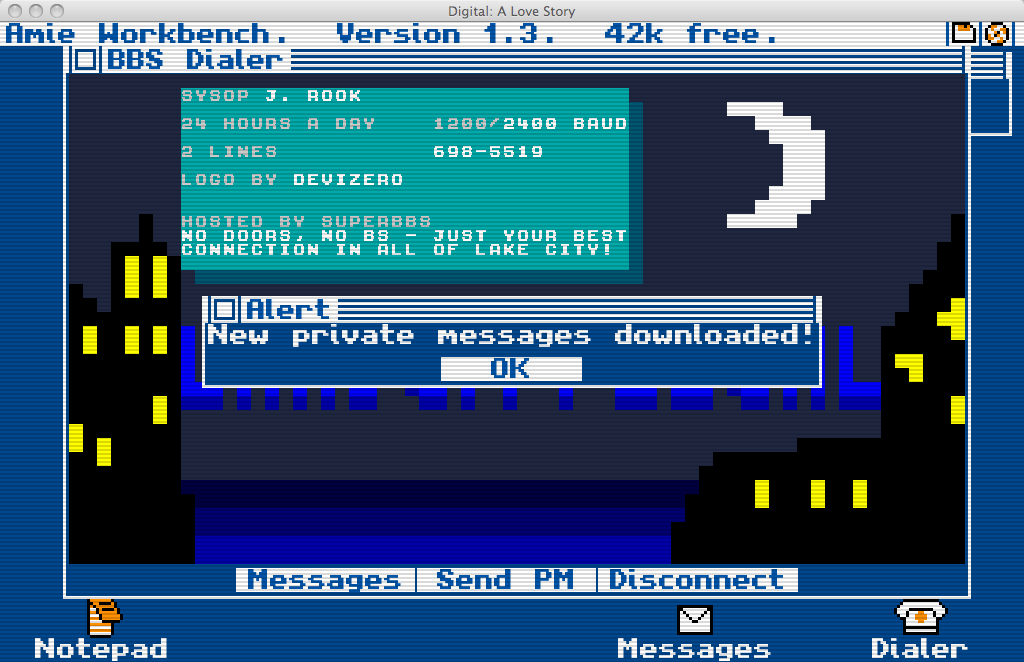
Digital: A Love Story (Love 2010) is a downloadable game which recreates beautifully the experience of the very early days of the internet. Beginning the game opens up a wonderfully rendered 1988 desktop with one or two very limited option. You are the star of the game (picking your own username, giving your real name and, as needed, adding your own passwords) and are playing the role of a teen/young student accessing local bulletin boards via long winded (and wonderfully sound effect driven) modem connections to specific machines. Relationships and plot unravel from emails and messages that you can elect to send. There are hints throughout the game but the main game play method is to click around and try everything at first to find a route through the game that can then evolve as the game swiftly becomes more complex and the storyline more urgent.

Thinking about what I liked about Digital I couldn't help but think about how it did not feel like the game – I was using a mouse and keyboard as stand in's for... a mouse and keyboard. The laptop might be lighter and infinitely better spec'ced than the type of machine I had access to in 1988 it was still remarkable how real it could feel to play with a low resolution screen, super slow internet connection and very basic text and visuals. So this is perhaps a for and against argument for my own comment about what can be learnt in uncanny spaces. On the one hand any digital environment, of any quality can be sufficiently engaging if the story behind a game is sufficiently well written, realised and learning subtly scaffolded. On the other hand Digital is a great example of how being really and truly in that virtual space is all the more powerful. For other games that replicate computer based activities the computer is likely to be the best space for learning but I do wonder how much better suited other activities would be to a hybrid space of digital and physical. To some extent the mediation of every day life makes this easier – one can simply mock up a read out for a piece of medical equipment, scientific equipment, financial monitoring systems, or emails to enact an emergency scenario or workplace simulation or emotional encounter in every day life (as Digital does). Or one could use a realistic physical surgical model with an archive feed of surgery for training keyhole techniques for instance. There may be financial and administrative gains in hosting entirely digital educational experiences for these sorts of process but there are physical sensations and reflexes which must also be trained and I think it is worth considering – particularly when we talk about the uncanny, the real, the role of simulation, and the gaining of practical skills in digital contexts - the value of digital games as sitting along different points along a real/virtual spectrum rather than always being stand alone digital-only and computer mediated (only) phenomena.

At the same time I hope that MUVEs become more radical than their current forms. One of the sad things about the beautiful scientific models shown in perplexitypeccable (2007 [5]) was the contextual limitations imposed by the space – once could go inside a cell or look at living human models or examine an atom BUT one could only do this in the “real” world of SL – sky, horizon, ground, etc. all remain. One of the toughest challenges of helping learners conceptualise abstracted educational information is that it is hard to visualize the size of an atom or the texture of a cell or the interplay between different elements of an organic system. Models in the classroom can be good but can also still seem both too abstract and too real (who for instance can fail to find a full skeleton unnerving or a medical torso model too plastic?). In theory digital environments offer the very best possibilities for suspending disbelief but, by being grounded, in normalised concepts of a “world” much of that potential is lost. 3D modelling software lacks embodiment, embodied spaces lack that useful sense of abstraction. I think there much be a way to bridge both types of system to enhance the empowered learner exploration of abstract models and ideas but I think this will be an ever more exciting area of MUVEs over the next few years.


Keywords: embodiment, idgbl10, interfaces, MUVE, uncanny

Posted by Nicola Osborne | 0 comment(s)

March 28, 2010

In Gee (Chapter 7: The Social Mind in What Video Games Have to Teach us About Learning and Literacy) he extends the learning through video-games from single-player to multi-player.  As ever, he ends the chapter with a subset of the 36 Learning Principles (33-36) and these focus on the distributed nature of knowledge and the dispersal of this across 'affinity groups' - objects and systems as well as people - whereby he extends the notion of communities of practice and identity; all draw on traditional methods of storage and collation but importantly email, the internet, etc.

As with the classroom, players/participants work towards a common purpose, irrespective of race, class, gender, etc. This idea of common purpose and objective of all school pupils must be conveyed to pupils and allow them to acknowledge that it is their interest to work in partnership in order to support each other through their strengths and weaknesses (known as 'jigsaw method' defined by Brown & Campione (in Kate McQilly Ed. Classroom Lesson's: Integrating Cognitive Theory and Classroom Practice).

The idea of identity resurfaces, recalling the notion of 'multiple identity' whereby in such affinity groups "the norms and values of groups are contested and negotiated" (p. 184), bearing in mind that players - and us - modulate across a continuum of identity depending on context.  He finishes noting that this 'identity' should not only be in control but one who can modify content and the process itself.

These ideas accord with my periphery readings of Richard Riding's School Learning and Cognitive Styles where learners are negotiated into two dimensions of 'learning style' - wholist-analytic & visual-verbal.  In relation to the  affinity group that Gee promotes, Riding suggests that they, the learners, can work in partnerships that take into account differences / discrepancies in different learner types.  I think that this may have a significance in the successful presentation and reception of learning activities derived from digital games, and when you factor in collaborative learning I think that it is equally appropriate to look at compensatory pairing/grouping in addition.  

http://www.encorewiki.org/display/~hnajafi/Communities+of+Learners

Keywords: IDGBL10

Posted by Hugh O'Donnell | 0 comment(s)

March 27, 2010

Having recently started sending my daughter (now aged 4½) to school I was very worried when I saw Ken Robinson's talk on schools and creativity. One of the opening statements relates to the purpose and origins of the public schooling system - unfortunately, Robinson is right – schools still operate as if their purpose is to “produce” standardised employees for an industrial era. The main problem with this is that this era is long gone (in the majority of the Western world at least). It is my experience that this intention to “produce” labourers is also present within the corporate training world. However, with today's information economy this ancient type of labourer is no longer needed – most work places need a multi-disciplined individuals capable of solving problems especially valuable in a 'cost cutting' environment where less employees are required to complete more and more diverse tasks.


Commercial organisations both in the UK and the US have, over the last few years, complained about young workers (coming out of schools and universities) not having the necessary skills for today's workplace. If we accept the purpose of the public school systems as stated in the opening paragraph than I would argue that those educational systems need to reconsider the way they teach if they are to continue fulfilling their own objectives of 'producing' a capable workforce. An example of this lack of skills can be found in the following – “A study commissioned by Hewlett Packard and conducted by Glenn Wilson, a psychologist at the University of London, confirmed that endless typing at a phone or computer keypad – along with the clearly obsessional checking for text messages – temporarily removes ten points of a user's IQ. … The hypothesized cause for this drop in IQ is that the constant distraction of messaging and emails prevents concentration on important tasks. Rapid reaction replaces thoughtful reflection.” (“the univesity of google”, Barbazon, p 76). The inability of employees to deal with today's information overload is creating what Barbazon (and the research she mentions) describes as “infomaniacs”. It is my opinion that the skills required to deal with this overload – effective time management, dealing with sensory overload, prioritising information are but a few of the skills (all within the digital context) which schools should be teaching.


However, schools, and other educational establishments are still stuck in the 19th century mode of operating – in their article “Beyond Web 2.0: Mapping the technology landscapes of young learners” Clark et al discuss the ways in which youngsters use current technologies such as social websites and mobile phones. One of the questions raised by their work is “the potential transferability of skills between informal and formal settings.” In other words it is assumed that the skills acquired while using the web are informal and therefore not directly useful to the classroom or education. Schools are so troubled by this 'irrelevant' use of technology that “young People's 'everyday' use of digital technologies is encountering a process of de-legitimization as evidenced by the banning of mobile phone use in schools”.


In today's capitalist environment one would expect this skills gap to be bridged by an overactive training department in most organisations, surprisingly this is not the case - more and more companies understand that the majority of learning occurs outside the classroom. There can be a number of explanations for this situation (not enough research has been done on this) but to me it looks as if the speed of development of the new tools and required skills and the fact that we are a social learners translates into a failure on the part of traditional formal training.


This failure has translated well into e-learning: the majority of today's content is in the form of electronic flip books (where the “next” button is the king) which employees detest. The advent of standards like SCORM as meant that content producers can create mediocre and boring materials because of the standard. The truth is somewhere in between – while the existing standards do not dictate a boring online training product they make creativity almost impossible: in an attempt to be as efficient as possible (meaning: to be able to resell the same content to as many clients as possible) such concepts as reusability, (learning) content syndication, content repositories, training efficiency etc etc have taken the place of ideas such as knowledge retention, understanding, contextual applicability.


During the Internet bubble of the 1990s various researchers found out that one of the key elements to employee retention is the ability to offer such employees opportunity for personal growth this has also been the case with staff motivation. Staff retention and development is more important during tough economic times – a survey of 700 CIPD members held in February 2009 indicated that developing more talented in-house is the key approach (over 55%) to talent management during the recession. If e-learning is to take its proper place as an effective tool in the trainers (and managers) toolbox then 'efficiency' needs to be redefined; There is nothing wrong with an efficient learning program when efficiency means that students retain information after seeing it once. It is this efficiency that we need to strive to attain.

Keywords: IDELJAN10

Posted by Asi DeGani | 0 comment(s)

March 25, 2010

World of Warcraft 
 
I spoke to one of my 14 year-old pupils about World of Warcraft...

He was quite excited to see me looking at the pdf instruction file
for World of Warcraft ("loads better than Everquest") and he talked
to me about the stand-alone campaigns, how it felt real when you played
it...
 
But the main thing for me was when I asked him about "being good"
as an alternative to killing and pillaging.  He responded that the goal
was to achieve money - gold, he informed me, was also of value and could 
also be stolen and traded - in order to buy swords and other forms of 
weaponry.

You can trade animals and 'fall in love with some girls', but the biggest 
draw is that it is fun and every level offers a greater challenge, and
that your character becomes stronger.

'Oblivion' was a game suggested by other pupils, who had picked up on our
little informal conversation during a reading period.
 
He seemed just so au fait with the game, its narrative and objectives - much
shared by the games mentioned by the other pupils.
 
I pressed him on some of the ideas from Gee and Brown - the distribution of
knowledge within community (this is something that I have picked up from my
S4 all boys class, discussing previous and future online missions, despite their
close physical proximity when at home) - and he remembers undertaking "six,
probably" missions or campaigns organised by a leader and how this led to achieving
an overall objective.  

He agreed - after thinking about it - that he was in some way learning - about 
friendships, tactics - and that when people overstepped the mark they would suffer 
a consequence for repeated offences.  "Learning to Be" as Brown would suggest, 
'construction' via a digital medium that facilitated the accretion of knowledge
and understanding across a community of practice existing in disparate times and space.

The Grand Transition - 'learning to be' - that is the 'demand-pull' model of learning.

And, this pupil is one of many who invest considerable amounts of time and 
credence to the tasks entailed in successful participation of games like WOW.

Keywords: IDGBL10

Posted by Hugh O'Donnell | 0 comment(s)

March 20, 2010

I wanted to post a very short posting on playful spaces.

In this month's Wired there was a short piece on public games that combine public spaces
and communities in real time. 

The first game, Noticings, turns a private reflective sub domain of photography - taking pictures of obscure ephemera of every day life, street scenes, abandoned items etc - and turns it into a community games through creating league tables of participation and points for specific features (see screen caps below). It is a fun game but one could see more practical community uses (for instance the same structure of game but specifically being used to flag up graffiti, littering, etc.) or for learning games in the field - this is, after all, a sophisticated community treasure hunt that could be extended to feature more specific goals or reflective learning opportunities (as in, say, some uses of geocaching.

[You do not have permission to access this file]  [You do not have permission to access this file]

The second game, created by KMA, was a really interesting way to engage people in a safe and interesting space. I don't think there is learning per se here but it is a great and fun use of playfulness in unexpected places:

What triggered me to make this post was however was attending Maker Faire in Newcastle a week or so back and wanted to record some of the really interesting learning environments that formed part of that event. The Faire was essentially around 100 stalls by people who make geeky things varying from high complexity robots right down to hand sewn merit badges. It was not a trade show, now a sales event but a space for sharing experience, knowledge and trying things out. There were contact cards and some small items for sale but on the whole it was a space for relaxed peer learning for fun. 

One of the more elaborate items on display was the Maker Bot (pictured above) a low cost open source self-assembly 3d printer. I think this is a really interesting example of a playful learning experience as the Bot's arrive in kit form and require mixed construction skills and a large number of hours - most owners quote between one and three days to built the kit completely. Once constructed the bot must be given complex 3D images and the owner must therefore be familiar or learn how to use those tools. They can then print an item of their own design enabling a relatively instant ongoing relationship between creative idea and manufactured prototype/limited run product. 

What cannot be seen in the video above is the wealth of resources - learning objects, advice, template items etc. - that the community around the Maker Bot have and continue to create. This is a peer supported and enhanced machine with small modifications, reuse of designs and communities of creativity around it. The hours required to build and use the machine are extensive but the number and usage of YouTube and Vimeo clips (see above) of owners proudly building and sharing there build of their machine turns this into a type of community game where the rules are that everyone builds the same things from the same kit, the community is a mixture of experts, new comers, and observers of how the game should be played, there are right ways to construct the kit but additional knowledge or experience can enable shortcuts, reflection is part of the process and the success is a complex mix of completing a working machine, doing so swiftly and/or stylishly AND participating in the ongoing community comparison of cool and interesting things. 

Maker Bot is quite typical of the types of work and creativity shared at Maker Faire - my partner and I spent 2 hours making a circuit and sewing it into a plush toy in one workshop, a further 2 hours learning a new programming language to create digitial art in which we exchanged designs in a game to adapt and change each other's work, and we spend half a day soldering items just so that we could plug them in and see if they worked and could be programmed (see above). It was all intensely playful activity and often structured to be lightly competitiv. Learning was scaffolded in a safe and mixed environment with peers and experts on hand to help. It was a really interesting experience to compare with the style of learning in other spaces (and it bore positive resemblence to much of the peer support and accessibility I associatte with this MSc) and gave me some ideas about what might or might not work in my final game design assignment which I am currently thinking about.

The weekend also reminded me how important the haptic dimension of play and games can be. Doing most of this course on a laptop or desktop machine isolates me from the devices many normally experience digital games on - handheld gaming devices, consoles, add ons (controllers disguised as skateboards, drums, guitars, aerobics steps, steering wheels and (very old fashioned) joy sticks even), and phones. The physical element is not something we have been considering in this module and I think it often overlooked in educational games designed for academic or workplace environments - where PCs or laptops are expected. I do wonder, especially for specialised and/or training games, how much that physical aspect is crucial to engagement, a real sense of embodiment and participation and a sense of emotional involvement in a scenario. 

Keywords: controllers, engagement, haptic, idgbl10, makerfaire, physicalgames, playfulness, publicgames

Posted by Nicola Osborne | 0 comment(s)

March 19, 2010

uLearning (ubiquitous and context-specific) and Alternative Reality Games (ARGs)

The binding medium is generally the Internet, drawing on other forms of media. 

My understanding is that it is an inversion of the classic computer gaming paradigm, whereby the real-world characters are controlled or undertake a computer-generated narrative.

Where I think uLearning is interesting within this particular genre of gaming is that a context-aware environment can play along/maintain this invention of reality in supporting the narrative, therefore removing itself from the players’ physical domain and merely adopting symbols or metaphorical representations from of this narrative.

uLearning “enables users to interact and learn with sensors and radio frequency identification (RFID) embedded objects in their surroundings… As a student moves around the learning area, the system can detect their location by reading and analysing the data from the nearest RFID tag. Consequently, assessment can be conducted to evaluate the learning performance of the student in the realworld” (Liu et Hwang, 2009b, p. 1 & 4)


References

Liu and Hwang. (2009).  A key step to understanding paradigm shifts in e-learning: towards context-aware ubiquitous learning.  British Journal of Educational Technology (2009) doi:10.1111/j.1467-8535.2009.00976.x

Liu and Hwang. (2009).  Learning spaces, learning environments and the dis‘placement’ of learning.  British Journal of Educational Technology (2009) doi:10.1111/j.1467-8535.2009.00974.x

http://edutechwiki.unige.ch/en/Ubiquitous_learning
http://en.wikipedia.org/wiki/Ubiquitous_learning 

Keywords: IDGBL10

Posted by Hugh O'Donnell | 0 comment(s)

March 18, 2010

Learning is defined by the free dictionary as: “The act, process, or experience of gaining knowledge or skill.” and “Behavioral modification especially through experience or conditioning”. Looking at social learning / web 2.0 tool led me to realise that while tools as delicious can be extremely useful in an academic learning and research setting it is actually the more mundane social learning tools which hold the key to realising the theory of true organisational learning.


In his book “The fifth discipline” Peter M. Senge defines the four disciplines required to build the learning organisation:

  • Personal mastery

  • Mental models

  • Shared vision

  • Team learning


While personal mastery and mental models can be achieved on an individual basis, reaching a shared vision and team learning in today's large multinational corporates is virtually impossible without the help of technology. Senge states that “There has never been a greater need for mastering team learning in organisations than there is today” this is partially a result of the rate of change in every day life – a shared vision established today might not be relevant by the tomorrow, team learning is subject to the same speed of change but is also a victim of globalisation – where teams could be spread across different countries.


According to a recent Bersin & associates factbook report, approaches to learning using social networking tools “are still in their infancy in the U.K. But training organisations are realising that most learning takes place outside of the classroom or online course.” this realisation that MOST learning occurs OUTSIDE the classroom cannot be underestimated when discussing learning in the corporate space. In fact, some organisations “noted that they are working toward a 70 / 20 / 10 learning model, wherein 70 percent of the learning takes place through on-the-job experiences and practice, 20 percent through collaboration with others (e.g., coaching, mentoring, social networking), and 10 percent through formal learning interventions. This type of blended approach uses formal learning to build fundamentals. But the bulk of learning happens through carefully crafted informal learning activities.”


When looking at the multitude of tools that fall under the category of social learning the most used one in the corporate space is communities of practice. According to the aforementioned Bersin report the most used social learning technology is currently used by 24% of US firms – Communities of Practice. These communities are supported by a number of tools such as Microsoft sharepoint (with a number of plug-ins), ELGG etc.


In their article “Communities of Practice for Professional Development” Heidi Fisk and David Holcombe define a Community of Practice (CoP): “a place where people with similar interests connect to learn from and with each other — to freely share their knowledge, insights, triumphs and tribulations.” It is easy to see how the shared vision mentioned by Senge fits into such a community when it exists within a specific organisation. Team learning is a little harder to distil from this definition but if we take into account Senge's definition of it: “Team learning is the process of aligning and developing the capacity of a team to create the results its members truly desire.” then the ability to record and retrieve “knowledge, insights, triumphs and tribulations” means that the team (and in-fact the organisation as a whole) has gained knowledge which will modify the way the team (and therefore the organisation) behaves in the future.


Technological tools to store and retrieve this knowledge are critical since they are in effect the organisation's long term memory: when an employee wants to consult, for example, how the organisation dealt with a severe recession in the past he can bring it up in the internal system etc... this makes sure that learning takes place and not just an experience.


While the idea of social learning within educational organisations can prepare young learners for life in the workplace the concept comes into its own when used in universities and corporates: these are organisations which require long term memory to build on their activities in the past.

Keywords: IDELJAN10

Posted by Asi DeGani | 2 comment(s)

March 16, 2010

Chapter 7
The Impact of Digital Games on Learning

I found this an interesting read, especially in accordance with my own reflection upon the three classes currently using or having used digital games in order to complement some aspect of learning or having “the ability to make mistakes in a safe environment and and learn from them [which] is one of the key benefits of game-based learning” (Whitton, 2010, p. 104).

CommandosCommando


On the 15th of March, the S3 pupils at Dunoon Grammar School sat their S3 exam ('mocks').  In order to foster relationships - a recurring factor in much of the material being amassed as part of my studies of the MEd in Education on The University of the West of Scotland's Chartered Teacher Pathway programme - I decided to look at the interaction within and between groups of 14 year-old boys, with each group taking part in the playing of the game projected onto a large classroom display.  Each of the 6 groups would control the mouse, direct commands and filter comments and suggestions from the other groups. The pupils are about to conduct research on a topic from which they will develop and deliver a solo talk presentation to the whole class, which will be summatively assessed in accordance with SQA Standard Grade Arrangements.  I am attempting to remove and existing barriers amongst pupils and to continue fostering the supportive and actively collaborative climate necessary in a single gender (all male) class.  These are noted as “unintended learning objectives” (Whitton, 2010, p. 108) and include: “Valuable transferable skills, such as problem solving, teamwork or negotiation” (ibid.).

I was not to be disappointed.

Initial uptake was slow: I put this down to the audience and 'public performance' factor.
  There were instances of bravado and a carefree, less-than-interested approach.  One particular academic/quiet pupil made significant progress - suggestions as to having played before (private interview afterwards). 

I then released the 'walkthrough' now that they had mastered basic navigation.
  Still, there were small isolated pockets of resistance: disengagement - post and pre-play.

However, there was plenty of humour - pupil-teacher humour and a fair amount of camaraderie/praise.

Sherlock Holmes


Whitton’s provision of examples whereby games can be justified as applicable within a learning environment lend to specific areas within which I have used this game:  

  • Narratives associated with the action in the game (e.g. characterizations, back stories, future scenarios);
  • Reflective accounts of actions taken in the game and the learning acquired from it; 

(Whitton, 2010, p. 105).

It is important to note Whitton’s view that adults require close connections to be made between game-based activities and learning outcomes and benefits.  With the S1 pupils, merely adopting the game as an adjunct to a piece of study and utilizing it for a generic lesson opening activity has been enough; whilst formative assessment of daily journals helps to deliver feedback about their writing attainment.  This is certainly a justification to anyone seeking educational merit!

Myst

After a single period of this game – used with an extremely able s2 class (aged circa 13) – I observed and detected disengagements that hadn’t been noticed before from the S1 class.  On the 16/03/2010 I passed around a Pros/Cons sheet and asked for at least one entry from each pupil. 

Myst

‘Bad graphics’ featured once, but interestingly the cons noted that it was “hard”, “no one can use it” and that it was “confusing” (no context or background is provided).  What also featured was the looseness of the lesson structure and that “we all shout out at once”.

It would be interesting to allow the pupils themselves to structure a ‘best practice’ approach…

On the plus, the idea was “fun” and that some enjoyed “puzzles” and the “mystery”, “scenes” and “setting” were positively remarked upon.  Whitton offers a more fine-grained ‘Engagement Questionnaire’ that could be used in future.

Overall, I was curious about the following:

 “higher levels of engagement with a learning activity are indicative of increased learning from it” (Jacques et al. (1995) cited in Whitton, 2010, p. 110).

But that it “is possible to be engaged while not actually in a state of flow” (Whitton, 2010, p. 110).

“Lepper and Malone (1987) provide evidence that there is a link between intrinsic motivation to learn, engagement and instructional effectiveness” (Whitton, 2010, p. 110).

I shall conclude these musings AFTER I have watched the Youtube clip on ‘flow’.

Keywords: IDGBL10

Posted by Hugh O'Donnell | 1 comment(s)

March 11, 2010

Papert confirms that most pupils find school boring - not necessarily hard.  He suggests that children must be able to practice their learning, be in control of their own learning.  He posists three suggestions for leveraging games: 
  • that they should discuss their learning with adults, which aims to develop
  • a learning vocabulary;
  • encourage children to become game designers themselves;
  • game designers should not underestimate their contribution to the learning
  • development of their young audience.
I asked 2 sets of junior pupils: 2 of the 40 claimed that school was hard.

Myst

Myst
After scouring the web for technical assistance (something that still prevents me progressing with Neverwinter Nights) I have finally managed to run 'Myst' (Masterpiece Edition on my desktop PC at work.
I plan to adopt the same strategy of play as I have been doing with my S1 class,
except that in this case the game derives from no existence canon of literature.  I have two concerns:
  • Technically/Aesthetically - is it 'up to it' and will the stage 'point and click'method of navigation not appear too staggered and not flow as contemporary digital first-person games.
  • Narratively - will the pupils feel 'at sea', too unfamiliar...
Academically very able, the chosen group collaborate very well and there is a very supportive climate.

Keywords: IDGBL10

Posted by Hugh O'Donnell | 0 comment(s)

<< Back Next >>