Log on:
Powered by Elgg

Blog :: All

You can filter this page to certain types of posts:

February 12, 2010

This weeks games felt more educational than last week's <Casual Games> although I think in part this may be leisure snobbery. Scrabble is a game I'm very familiar with as a boardgame but also online in it's unlicensed form (on Facebook) of “Scrabulous”. I like a word game and see it as a more worthwhile waste of time than Tetris or Solitaire because it is about words and patterns and, for right or wrong, I feel that words are somehow more worthwhile than visual patterns (which is an odd sort of bias now that I think about it). What I was not prepared for was the social aspect of Scrabble in the Hasbro version of the Facebook app. What was immediately disconcerting was the fact that I was presented with a huge wall of possible players who I don't know at all. It looked most like one of those late night “There are girls in your area!” type ads which I found immediately off-putting – I've never thought of boardgames as the online equivalent of a dubious Wednesday night in a particularly low rent pub but that was about the vibe listings like “Theresa – 2 player – casual – 2 mins” gives. The effect was compounded by the chat from my automatically (and with no opt out) found opponent Craig D. (Games: 187; Won 38%; Top Score 429):

Thus, as I played the game my concentration was largely consumed with avoiding either offending or leading on my opponent (rather easier said than done) rather than on the gameplay itself. Actually social interaction is part of the game I suppose, I was just more interested in the word part of play than the social play here. I found myself pining for my dusty old cardboard and plastic set to avoid Craig D. However when his chat up lines failed he, despite having double my score (see image below), forfeited the game to me. Which explains the stats in his profile actually – a score of over 400 is a good score (or so my scrabble obsessed friends always inform me) so his 38% win rate, especially given he was playing casual games, seemed odd. However if he is seeing the game as a game of flirtation around Scrabble rather than the Srabble itself as the game I can see why his win rate is less you might expect – perhaps it is more a representation of his flirting success than a reflection of his Scrabble skills.
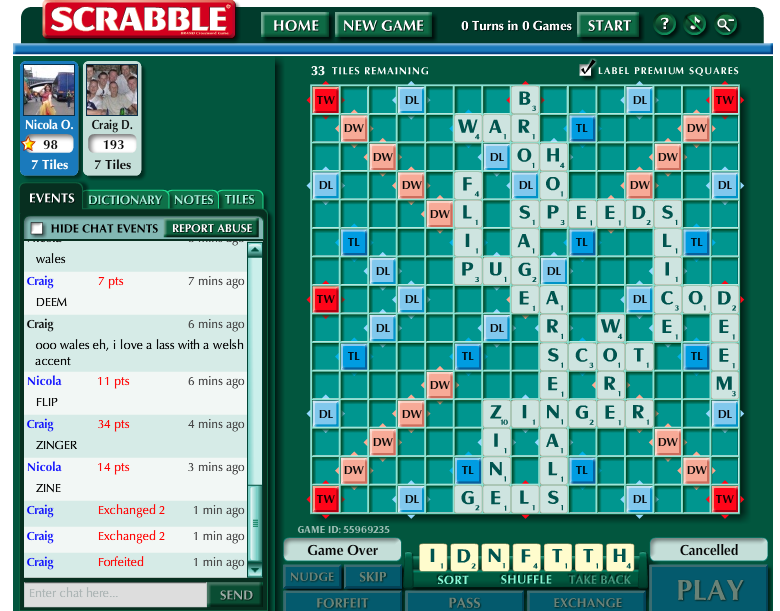

After that experience I was loath to return to Scrabble with strangers (if ever in the past I've longed for someone to play a game with I'm not sure I will again now). However in the course of playing online I note that a lot of the thrilling uncertainties are removed – the interface includes a dictionary (including the mystical Scrabble 2 letter word list) rather than a simple possibility of a rejected work; a timer is included in the casual game to discourage slow long term games and encourage quick mechanical games (something my super fan friends with love, something I don't play the game for); and friends are de-prioritised as competitors even though, even with anonymous opponents, there are chat and social features. Most upsettingly of all the Tiles tab lists every available tile – a view into the virtual bag and a breach of one of the nice Scrabble features – you can guess at probabilities of letters appearing but unless you have a photographic memory these are guesses (and always, in any case, assume no one has lost/eaten/changed/replaced any times. Addig all those practical functions takes away from some of the core gameplay aspects. Evidently the Scrabulous creators knew more about what it is to play scrabble and be engaged by it than the brand owners themselves. Really interesting.


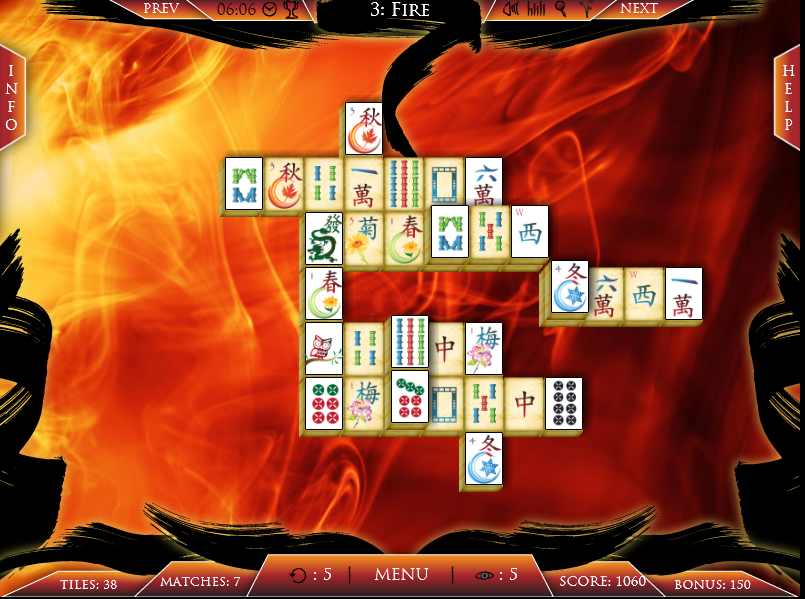
Mahjong is a complex strategic game I've been shown several times and like but struggle with. Mahjong (solitaire) on the other hand had me baffled at first. I'm not a big reader of instructions – particularly for online games (and yes, in Week 4's education games that is proving interesting) – so I was confused to see the tiles all face up and laid out in strange shapes. Whilst I couldn't remember the proper way to play Mahjong I knew this wasn't it. And then my partner looked over and said “It's a Mac thing. I used to play that years ago. It's just to do with matching pairs”. To that I looked disappointed but then proceeded to get very absorbed in spotting patterns and looking out for moveable/flipable tiles. There are some very minor nods to Mahjong (proper) but otherwise this is a memory and pattern recognition game with very enticingly attractive graphics. The game made lots of sense once I knew the basic goal but the guidance and introduction to the game – and especially the rather misleading optional login screen - wasn't really very helpful to establishing what those goals were but, after playing, I read the help text and it was actually pretty good – just why it wasn't labelled “How to Play” or “Rules” or something similar rather than “Help” was a bit of a mystery though. I'm not sure I learned anything at all but I enjoyed playing the game, I did progressively better and I was encouraged to go back and find my Mahjong tiles and play with them a bit. I'll probably also go back again as it was a very graphically sophisticated game, the music and sound cues were useful and fun, and the rules regarding nearby tiles, scoring, timing, tile layout etc. all added to the gameplay and strategies that were useful for completing a level. It was difficult but not too difficult and I liked that.


Finally I was trying out Bookworm this week. Of all the games it felt most educational and most frustrating. Firstly it required download which, in an era of browser based games, seemed quite old fashioned to me. The graphics were also a little out of date but squarely aimed at educational connotations.


Gameplay seemed like it was going to be great – there is an element of random chance, a need to match patterns and find words, and a good range of possible directions to create words in. What I found problematic in practice was the fact that the possible routes round tiles weren't entirely intuitive (some looked close enough but were not). I got very into the game though and headed at a score of over 40,000 moving from “Encyclopedia Salesman” up to “BookBinder”- they seem like odd sorts of level names though – the game is about books not literature. That is reflected in gameplay as well – you get points for flashing letters, strategies, avoiding burning letters (you have only one life in Bookworm!) etc. but the emphasis is on time and points rather than elegant word finding. This is not unlike Scrabble but in bookworm you cannot elect to play long words as easily as the choice and mixture of vowels and consonants tends to make shorter words more viable. Worrying I also got one of my highest scores with “Barf” - not the masters student level of verbal dexterity I fear.


The music and graphics were fun for play although the music quickly grew repetitive and, though it gave musical cues to the game action, only served to panic rather than focus me. Overall though this was an interesting counterpart to the other two games this week. It is an engaging game and the Bookworm character is quite charming – he even spouts explanations when a word looks especially interesting (“cud” was one of the words that triggered a definition in my game). And the high score feature at the end is quite a nice way of allowing you to compare your performance – in theory at least – and by setting the default comparison names to low scores it's quite encouraging too.


I think the puzzle game genre is a hard one to place. Though educational in the sense of improving your skills in both the game and, perhaps, your knowledge of words these games provide odd motivational opportunities as often the area of learning is not necessarily compatible with the highest scores – in Scrabble two letter words that can be used in many directions are often far higher scoring than a complex word and anything over 7 letters is rare and usually a compound of two words rather than, say, a technical or scientific term; in bookworm you are discouraged from looking for longer words by the time/burning challenges; in Mahjong the more numeric and strategic skills are exchanged for simple pairs play (only the season tiles challenge the simplicity of the game). Progress is rewarded in these games with speed or score challenges rather than building up activity to feed into some sort of reward or conclusion. All three games look attractive and have big usable buttons but in all three there is no compelling reason to start playing. Once you get going you are engaged but the motivation to engage in the first place seems to be expected to come from a place of boredom rather than interest (e.g. Scrabble's auto-selecting opponents) and that does not bode as well for serious educational goals. Additionally the downside of attractive games like these is that they look like games and that often neither feels nor looks like work/education to others since they are so associated with time-wasting patterns of use. The fantasy element in these games is also quite weak, particularly with regard to intrinsic fantasy since puzzles are, by their nature, artificially reliant on rules, restrictions and arbitrary goals.

Keywords: bookworm, facebook, IDGBL10, mahjong, scrabble, scrabulous

Posted by Nicola Osborne | 2 comment(s)

February 11, 2010

Pedagogy & Design

Motivation
(Whitton, 2010)

On a personal level, I value my free time – what little time is afforded to a secondary school teacher with a young family and who is undertaking two separate course of study at postgraduate level – any of which tries to contain elements of newspaper and short story/poetry reading.  I would categorise myself as one who would need to see an educational purpose or that the completion of domestic and academic activities on the peripherary were not being undermined by spending time at a console or PC playing a game.

According to Whitton (p. 37) motivation and purpose are paramount to digital games-based learning; users need to be in control, and for games in learning, users will accept them if they are the most effective way of learning – this is the most important aspect (p. 40-41).  Games have the ability to engage but must have sound educational principles in order that the play does not obfuscate the learning outcome(s).

Achieving the necessary immersion – whereby players (learners) are fascinated and increasingly challenged – relies on the authenticity of and identification with a particular context for a user.  This leads to the experience of ‘flow’ (as defined by Csikszentmihalyi) whereupon the player enters into the optimal state of learning, and is in complete control of this experience.   But motivation is seen as a complex process.  Students’ intrinsic motivations for school decline grades 3 to 9, as a result of extrinsic motivations – grades, expectations, etc. Fun, joy, meaning, challenge have been stripped out.  So what are the differences between this traditional school-based learning and digitial games-based engagement?

Malone & Lepper developed a taxonomy of four factors in intrinsic motivators when playing games: game challenge, curiosity, control and fantasy, with ten additional factors being defined by Tuzun (2004): identity presentation, social relations, playing, learning, achievement, helping, rewards, immersion, uniqueness and creativity.

Relating to the idea of the expectations place on appropriateness of a learning activity or game, the greatest potential is in developing high-level, transferable skills: autonomy, analysis, critical evaluation and team working.  Experience, discussion and application is the constructivist approach, a theory deployed by Vygotsky.  In order to support this optimized state of ‘active learning’ constructivism suggests:

- Situated cognition
- Cognitive Puzzlement
- Social Collaboration 

and I would suggest that many digitial games – specifically designed for learning or otherwise - offer such a constructivist learning environment:  "a place where learners may work together and support each other as they use a variety of tools and information resources in their guided pursuit of learning goals and problem-solving activities."

Honebein (cited in Whitton, 2010) presents 7 pedagogic goals of the design of constructivist learning environments: 

·          Responsibility for how/what they learn
·          Multiple viewpoints
·          Ownership of learning process
·          Authentic and relevant
·          Real-life activities
·          Support social learning
·          Multiple modes of learning

Additionally, game play must be offered in conjunction with periods of structured reflection, whereby the player can reflect on the activities just taken place with a view to tuning and restructuring their schematic models for use in further play or in transferable application.

At the heart is the learner or the player – the teacher acts merely as a learning facilitator, with opportunities for communities of practice (both bodied and disembodied) delivering additional critical support.  This ‘experiential learning’ (Kolb) requires feedback being given to the user in a timely and relevant format in order for the user to check their progress.


So, digital games can support the main educational theories of learning: active learning and constructivism, experiential learning, collaborative learning and problem-based learning.  

What succeeds is academic learning disguised as contextualized with important social issues, aesthetically-rich dramatic play.

Keywords: IDGBL10

Posted by Hugh O'Donnell | 0 comment(s)

February 10, 2010

Malone makes a distinction between toys and tools. He says that: A good game should be easy to learn but difficult to master.


Whereas: A good tool should be both easy to learn and easy to master. 

tool users should be able to focus most of their attention on the uncertain goal, not on the use of the tool itself p. 66


This distinction is relevant for my work – training and consulting in CAQDAS – tools that support the analysis of qualitative data (such as ATLAS.ti, NVivo, MAXqda etc.)  All these tools are difficult to learn – and many people who start to use these tools are new to analyzing qualitative data – so they are learning two new big areas at once.  But even those people who are experienced qualitative analysts need to learn what the new affordances a software package can offer qualitative analysis.  These tools are both difficult to learn AND difficult to master – which could explain why they have been slow to be adopted, even though they have been around since the 1980s. 

 Malone rightly identifies that one issue facing the designers of these packages is:conflict between desire to have the system to be easy to learn for beginners and the desire to have it be powerful and flexible for experienced users To overcome the above dilemma, Malone suggests that designers build in a logical progression of increasingly complex microworlds for users of different levels of expertise. The trouble with applying this principle to CAQDAS tools is that you need to understand most of the features as they work together in an integrated way to support an analysis.  However, I can see that in designing a game to teach qualitative analysis (as opposed to tool use), you could build in levels that correspond to the analysis process and you could use the CAQDAS software tools as an environment to play the game. And in an indirect way you would be teaching the tool use at the same time.Need to think more on this

Keywords: CAQDAS, IDGBL10, Malone, tools, toys

Posted by Silvana di Gregorio | 0 comment(s)

I just spent a couple of hours yesterday in Quest Atlantis (in the plague village - which is teaching about persuasive writing). I was totally immersed in this world and didn't notice the time go by. Barab et al talk about their learning engagement theory which they developed in QA - integrating learning, playing and helping in the context of social issues in an aesthetically-rich dramatic play. The plague story does this with students taking on the role of an investigative journalist trying to find evidence to persuade the community to either support or not Dr Frank(instein)'s experiment to find a cure for the plague. The story line is engaging (satisfying Malone's idea of fantasy and curiosity and uncertain outcome). QA seems to emphasize social responsibility as well - so there are moral issues interwoven in the story. I haven't finished all the activities but I think the storyline will let you argue both sides of the argument although there are nudges to re-consider your argument as you gather more evidence - but you only are suppose to use evidence that supports your argument (but I haven't finished it yet - so I don't know if there is scope to address counter-evidence in a way that supports your argument.)

Keywords: Barab, IDGBL10, Malone, Quest_Atlantis

Posted by Silvana di Gregorio | 2 comment(s)

This weeks games forced me to confront my own ideas about what is and is not a worthwhile game to play (indeed these are the types of games that make sympathetic to the negative arguments about games discussed by Gee [1]). My reaction seeing the games listed in the Casual Games section was to roll my eyes a little and wonder whether I needed to waste my time with them. I'd played both Solitaire and Tetris before but mainly as a way to avoid homework or fill gaps between lectures when I was an undergraduate student so this week, with work and readings to more than fill my time, why would I want to fritter away minutes on such trivial games?


Solitaire more than lived up to my memories. It has some appeal as a procrastination tool but I quickly grew bored of the game play. The challenge of the game comes from the speed and strategy of completion but otherwise the game is fairly easy to complete. The cards are randomly dealt but once you have completed a game the challenge is significantly diminished for later rounds (unless you start altering difficulty levels or attempting to beat your time). Once I had played a few abortive rounds of Solitaire I completed a game and that was my interest peaked. In game play it reminds me of something I used to do for a job: sorting library books into their Shelfmark. There is strategy and speed at play but ultimately you are simply mechanically obeying the rules and the novelty is quickly lost.


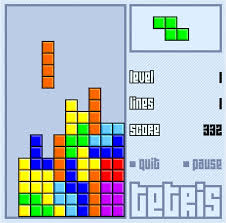
Tetris on the other hand (and less so the derivative Columns) held my attention for far longer than I was expecting. Tetris is a very simple game with just 6 shapes all dropping at increasingly fast speeds which can be rotated and slotted together. However the random order in which blocks drop and combine, the ability to rotate blocks, and the altering speeds make a huge difference to how absorbing the game becomes. It feels much more like a game of skills although, like Solitaire, there is a basic element of recognition and pattern matching (albeit quite a different game in Tetris – rotating blocks offers new possibilities for strategy and alternative approaches) but, unlike Solitaire it actually gets the pulse racing a bit. Every failure feels like you've just missed success by a tiny error and that encourages you to go back and try again and again.
 

Although the educational content of Tetris is clearly rather dubious (hand eye coordination and pattern matching but little else) I think there is something very educationally useful about what makes the game so captivating. Clearly any game that attempts to engage learners needs to be compelling and involving in order for any of the learning bound up with the game to be successful. So I think what I find really useful from this week's games is the idea of the great game mechanic:


I always think that the ideal game is the game where the winner thinks he's won because he's played it skillfully, and the losers feel that they've lost because they've had bad luck”

Steve Jackson, Games Designer (BBC 2009 [2])


So although this weeks games did not seem directly to the teaching and earning process I do feel that my dislike for Solitaire and my compulsion to continue with Tetris are both useful experiences for understanding learning games. I have previously sat in on web demonstrations from e-learning software companies and the stock learning games demo-ed by these sorts of software companies relate to matching images with phrases or pop quiz formats and, whilst some situations will suit these types of ideas I think the quick boredom that can occur in playing games that just make you go through the motions is important to note. I also have high hopes that some of the more sophisticated games coming up in the next few weeks will also start to include games that more educationally engage that simple but clever game mechanic that encourages you to go back again and again to perfect and prove your skill because you were just a few moves from getting it right... !


References

  • [1] Gee, J. P. (2003). Chapter 2, 'Semiotic Domains: Is playing video games a "waste of time"?'. In What video games have to teach us about learning and literacy, New York: Palgrave Macmillan. (core textbook)

  • [2] BBC (2009). Episode 2: Monopolies and Mergers. In Games Britannia. Accessed and viewed (via iPlayer) on 5th February 2010. http://www.bbc.co.uk/programmes/b00pf0rr.

Keywords: columns, gamemechanic, IDGBL10, solitaire, tetris

Posted by Nicola Osborne | 0 comment(s)

February 07, 2010

Week 3 – Update on game experience

While I did not enjoy the arcade games, I have enjoyed Solitaire, Tetris and Columns and this week Mahjong and Bookworm. I haven’t had a chance to play Scrabble yet but that is a game I have played since I was a child.  I also have always played Solitaire as well as puzzle games such as crosswords and sudoku.  I like to look for patterns and also having some time to reflect, although all the games had a timed element but I didn’t find them as frantic as the arcade games.

I didn’t realise how complex Mahjong was – I was concentrating on clearing all the tiles. I did notice the scoring but didn’t understand it. It wasn’t until Anna directed us to the link explaining the rules and the different suits you could make that I realised the complexity. But I am quite happy to play it on a simple level. I think I could get into it, and slowly learn the different suits you could make and think more strategically.

I never gave much thought before this course about defining what is ‘play’.  I think I just thought of it as a negative – the opposite of work. But I enjoyed the Kane and Sutton-Smith readings. I liked the focus on the different rhetorics of ‘play’ and situating them within their historical and/or scholarly context.  In particular, I find interesting the tension Kane points out between ancient (fate, chance and community) and modern rhetorics (freedom, progress and imagination).  As Kane says, there is a paradox:

To be a player is to try to live and thrive between freedom and determinism, chance and necessity. P. 40

vs.

I am not sure, though, how much the modern rhetorics are free of fate and determinism.  Progress can be seen as deterministic – particularly following Piaget - that there are stages of development that a child must go through.  Intertwining this developmental approach with play, turns play as something inherent in our genetic makeup, something we do not have control over.  Rather than being the ‘playthings’ of the gods, the child is a ‘plaything’ of his/her genetic make-up. Kane does touch upon this in saying that there is a tension between the modern rhetoric of play as progress –something that is hard-wired in our make-up and the modern rhetoric of play as imagination.  But Kane talks about our biological urge fusing with our creative imagination.  But where does our creative imagination come from? It comes back to the age old debate of nature vs. nurture.  But instead of posing fate and freedom or nature and nurture as oppositions, shouldn’t they be seem as a kind of continuum – in some areas we have more control than others. Or should they be visualized as concentric circles with freedom within fate/ or nature.  That we have certain ‘room for manoeuvre’ within a certain context.  Hence, our genetic composition or social circumstances at birth are fate or beyond our control.  But within that context, we have some freedom in the ‘raw material’ we have to start with.  And isn’t that what happens within game?  There are rules that are given but within the context of rules, we have some control over how we play the game.

Kane brings an interesting dimension into the discussion of play – considering what is ethical play. 

by dignifying our play with an ethical force, we can begin to create and act, rather than simply consume and spectate p. 62 

I think his choice of the term dignifying is revealing.  It seems he is countering the interpretation of play as being frivolous.  But there is also a moral dimension in his argument which is a critique of what he sees as the dominance of Western consumer-oriented society.

References

Kane, P. (2005) Chapter 2, 'A General Theory of Play'. In The Play Ethic : a Manifesto for a Different Way of Living. London, Pan. p35-6

Sutton-Smith, B. (1997) Chapter 1, 'Play and Ambiguity'. In The Ambiguity of Play. Cambridge, Mass: Harvard University Press.


Posted by Silvana di Gregorio | 0 comment(s)

February 06, 2010

Play

I enjoyed the Rousseau references in Kane’s work, which led to the idea of removing boundaries that would, as later indicated by Maria Montessori, allow children’s “natural urge to explore and hypothesize, compare and dramatized.”

In secondary schools, the connotations carried by the term ‘play’ are very much the domain of primary and pupils are expected to have left that behind.

This paper explored the ideas whereby ‘play’ allowed the player (children) to articulate and simulate ideas and imaginative constructs in the ‘real’ world; it facilitates the inevitability of ‘change’ that shapes our futures and destinies.

I now view ‘play’ as a powerful activity, which should underpin – wherever possible – educational activities and processes.  ‘Teaching to the test’ suits the passive, simply regurgitate content model of education – one born from the Dickens era and the Industrial Revolution.  If we are to produce critical minds, we must allow these minds to ‘forage’.

Keywords: IDGBL10

Posted by Hugh O'Donnell | 1 comment(s)

February 04, 2010

My University is involved in phase two of JISC's Institutional Innovation Programme:

"This programme represents a £13.08m investment aimed at supporting existing institutional strategies by providing solutions to institution-wide problems, based upon proven practices, technologies, standards and services. The solutions will act as exemplars to other institutions by demonstrating innovation and good practice, and building knowledge and experience, which can be shared across institutions."

One of those projects is the Academic Social Networking project which is being developed by the Centre for Applied Research in Educational Technologies (CARET) at the University of Cambridge. The project itself "aims to bring some of the affordances of consumer social networks to teaching and learning".

What is interesting to me, and possibly to other students on the research methods module is that CARET collaborated with Flow Interactive, an external company, to investigate whether commercial user-centric design (UCD) techniques could be transferable and be used within a Higher Education context.

As the research team suggest, user-centric design is different because:

"...it explicitly, constructively and actively includes users in the design process from a very early stage."

One of the key features of their particular methodology is the notion of "design personas" and how it enabled them to:

"...identified trends or patterns in user behaviours, expectations and motivations, through conducting a combination of diary studies and interviews, and how this formed the basis of our personas. Having these personas enabled us to focus the design effort on supporting user goals. Also, where traditionally a designer might have lists and lists of requirements, personas allow one to prioritize these requirements to the degree these personas would find them important, offering more clarity."

Moreover, the research team at CARET have published their UCD methodology into a rather useful and compelling handbook for us lucky reseachers to peruse and may even offer a new approach to conducting research with our key stakeholders.

Keywords: academic social networking, caret, design persona, flow interactive, institutional innovation programme, jisc, project, research methods, rmel2010, ucd, user-centric design

Posted by Wayne Barry | 0 comment(s)

This week we are looking at the theme of natives versus immigrants on the web, the technology being explored is twitter. I will leave the discussion about natives to my next blog but wanted to say a few words about twitter service/product which I have never felt comfortable with until now.


I will start with an admission – until this week I have never really used twitter. I explored it several times, run a few searches, looked at the discussions, but never contributed (or for that matter even set up a profile). My perception of it is is stronger than that of the BBC: “Twitter tweets are 40% 'babble'” (I believe that they were using a very lenient definition of 'babble'). In fact, a random screenshot taken from the twitter homepage shows the topics discussed:


Twitter trends


So, while war rages in Afghanistan and Iraq, cars in the US are losing their breaks (Toyota) and MPs in the UK are asked to pay back their expenses the main topics being discussed on twitter are – entertainment and boy bands (4/7 topics) and technology (2/7 topics), I tried reading the last thread “OhJustLikeMe” but still have no idea what it was about.


On the very first page of “the University of Google” by Tara Barbazon, I found the following quote: “Students, in these ruthless times, desperately wants to feel something – anything – beyond the repetitive and pointless patterns of the casualised workplace and the selection of mobile phone ring tones.” I have to admit that after following a few of the threads appearing as the most trendy in twitter (and I am really not a fan of boy bands) I found little evidence of this on Twitter. If anything this reminded me much more of the nihilism that Dreyfus mentions in “on the Internet”; Twitter encourages you to get lost in the crowd, commit to nothing but have an opinion about everything as long as, it is in less than 140 characters. Whereas some of my fellow students found Dreyfus' book to be disparaging and depressing I was actually encouraged when I ran into this headline: “60% Of Twitter Users Quit After A Month”. Some of the metrics behind that report may be flawed but the comments to the article (and others presenting the same data) all circle around “what is twitter for?”


I have to admit that I found twitter to be almost disabling - it seems to encourage the culture of “looking for”, no new idea was actually developed during our chat, things written by other people were simply recycled. So, is twitter the human-based search engine that Dreyfus believes is needed? Not in my mind, simply because - if you do not know to follow then you cannot find the “good stuff”.


On a final note, while I do find twitter to be of very limited use in the classroom (and more so in the corporate training environment) I did find the conversation that we had as a group to be very engaging. Saying that, this had more to do with the content of the conversation rather than the medium it was done through. This, along with the Skype conversation we had the week before is pushing me in the direction of synchronous communication – what if we could replace the corporate training 'flip books' with an hour-long chat were people from different locations guided by more experienced employees gets to develop and understand, truly understand, ideas and information. This will never be a tool to cover compliance requirements but in the information economy could be a very powerful, differentiating, tool.

Keywords: IDELJAN10

Posted by Asi DeGani | 1 comment(s)

February 02, 2010

I have been thinking more about my intended research project as well as bouncing ideas and talking to colleagues about it as well. One of the recurring themes was a person or a groups relationship to and between space (physical, virtual or both?). These relationships could occur between:

  • Student to Student
  • Student to Peer Group
  • Student to Tutor
  • Peer Group to Peer Group
  • Peer Group to Tutor

It reminded me of some journal articles that I read as part of my "Space, Place and Technology" wiki articles for the "Psychological and Social Contexts of e-Learning" module. Specifically, this regards Nova (2005, p. 119) who proposes that when "dealing with the concept of space in collective situations", it should be considered through the lens of a number of dimensions:

  • Person to Person
  • Person to Artefact
  • Person to Place
  • Space, Place and Activity
  • Space and Artefacts
  • Space and Time

The "Space, Place and Technology" wiki articles are now converted into an "as is" electronic paper version on Issuu, if you wish to find out more about these dimensions. We can represent these dimension using the following illustration.

Relationship between space, place, people and artefacts across time

What we are looking at are fixed physical spaces are depicted as solid circles whereas transient physical spaces are denoted with dashed circles. Each circle is inhabited by people with some form of information and communication device like a desktop computer, laptop, mobile phone or PDA; also present are a number of "artefacts" represented by the orange star and the green diamond - these "artefacts" could be a chair, table, books, or Interactive White Boards. As depicted in the diagram, some "spaces" can overlap and be shared. Each information and communication device is connected to one or more virtual spaces as depicted by the computer servers inside a blue dashed cloud formation. These virtual spaces could be blogs, wikis, virtual environments, web pages and such like.

In terms of thinking about methodology, some ethnographic approach could be considered, but as Cousin (2009, p. 109) warns us:

"At first sight, it might seem that anyone can do ethnography but doing it well requires familiarity with a theoretical field, a set of research skills and perhaps, above all, ... an 'enlightened eye'"

Cousin (ibid) goes to say that "ethnography is not so much about studying people as learning from them". In their joint Centre of Excellence in Teaching and Learning (CETL) in Creativity project called inQbate, the Universities of Sussex and Brighton have created "two creativity zones" which offers "exciting opportunities for students to work in spaces that foster collaborative, self-directed and experiential learning".

The methodology for capturing how students reacted to and interacted within the space and with eachother was to use Interpretative Phenomenological Analysis (IPA). This is a relatively recent qualitative approach developed specifically within psychology by Jonathan A. Smith, a Professor of Psychology at Birkbeck, University of London. IPA concerns itself by:

"...trying to understand lived experience and with how participants themselves make sense of their experiences. Therefore it is centrally concerned with the meanings which those experiences hold for the participants."

I am not really considering IPA but it does demonstrate some of the deep and rich approaches to data collection and analysis. What has caught my eye, however, is something called Theory of Planned Behaviour (TPB) which is a theory about the link between attitudes and behaviour. TPB is a quantitative approach developed by Icek Ajzen, a Professor of Psychology at Amherst, University of Massachusetts. It was Siragusa & Dixon (2009) paper for the Ascilite 2009 conference where they were using questionnaire items related to components of the TPB to determine students’ attitudes and planned use of ICT-based instruction. Like any methodology, TPB has its' advocates and detractors.

It has been suggested to me that I could develop a case study. But in the meantime, I think I will look into TPB to see if it has any real value.

References

Cohen, L., Manion, L. & Morrison, K. (2007). Research Methods in Education (6th Edition). New York, London: Routledge.

Cousin, G. (2009). Researching Learning in Higher Education. New York, London: Routledge.

Norton, L.S. (2009). Action Research in Teaching & Learning. New York, London: Routledge.

Nova, N. (2005). "A Review of How Space Affords Socio-Cognitive Processes during Collaboration". PsychNology Journal, 3(2): 118-148.

Robson, C. (2002). Real World Research (2nd Edition). Malden, MA; Oxford; Carlton, Victoria: Blackwell Publishing.

Siragusa, L. & Dixon, K.C. (2009). "Theory of planned behaviour: Higher education students'
attitudes towards ICT-based learning interactions". In Same places, different spaces. Proceedings ascilite Auckland 2009. Available at: http://www.ascilite.org.au/conferences/auckland09/procs/siragusa.pdf [Accessed 02.02.2010].

Keywords: case study, ethnography, interpretative phenomenological analysis, learning spaces, physical spaces, research methods, rmel2010, theory of planned behaviour, virtual spaces

Posted by Wayne Barry | 0 comment(s)

<< Back Next >>