Log on:
Powered by Elgg

Cecilia Goria :: Blog

March 05, 2010

Drawn: The Painted Tower
I thought that this was an utterly beautiful looking game. Although some of the narrative segments involved pauses, cryptic message and faintly naff voice over it was still surprisingly engaging. As I explored the game I did have to be quite strategic about what I picked up, what I used, how I chose to progress... There was a lot of looking through an area of a room in the Tower and then having to find the tools/items located elsewhere in or near other parts of the room. On the negative side all those beautiful graphics came with several pauses as areas loaded (and as the areas involve only small-ish amounts of game play this could get tedious). It also felt like quite a lot of clicking around at times - just guessing at answers where I didn't know what to do. Gameplay felt a lot more fluid as I got more used to the cryptic format and I was quite disappointed when my hour long trial ended. Not quite enough to pay $6.99 but almost. I am not entirely sure what the educational value of the game is exactly but there was certainly an aspect of analysis, pattern matching and problem solving that was engaging and got my brain working in an interesting way. But it did feel much more like a highly sophisticated puzzle game more so than an Adventure to me.

Tradewinds Legends
This strategy game was quite fantastically addictive. The concept is extremely simple: you have a ship, a certain amount of cash, and a certain amount of debt. You can increase your cash (and your savings which start out at zero) by buying and selling goods around the series of coastal cities. You can also take on missions and you have to, on occasions, take on pirates. At it's heart the game is a simple trade game but there are also extremely subtle and engaging layers of strategy and analysis: you have to monitor goods prices; you can borrow or save money at different interest rates; you can choose how to arm or protect your fleet and you can expand and repair it as you need. There are lots of choices to make and almost complete control (the random factors being the quasi-optional tasks and the pirate attacks though you come to expect the latter).

Training elements are well integrated into the game - there are a lot of help screens at first and there is always help available either through help text or funny comments that indicate you are looking in the wrong place for something. Pleasingly there is no block on selling goods below their worth - if you want to play a very differnt strategy around the game then you are free to do so. Visually Trade Winds is ludicrously old fashioned but it feels bright and lively, the game play is pretty quick if you want it to be and there are some fun comedy comments, silly catch phrases and virtual banter that gives the game an enjoyable personality. And although the game is clearly very educational - there are a good number of small business owners that could do worth than use it for training themselves in some basic principles of buying, selling and doing well - it is also clearly aimed at adults with the cynical comments and roles of religious figures etc. in the game.

At set up I deliberately picked the one female character available - there were very few female characters in the game and those that were there were mystics/assistants in religious buildings whilst all the bankers, traders, etc. were men. That fits the Arabian Nights theme but is a bit irritating as a female game player. In my one hour of game play I got my character out of debt, into profit and purchased her two new ships. I was delighted and was getting enormously excited about making good trades, getting a good interest rate on my savings, expanding my fleet... I think there is a fairly good likelihood that come the end of this module I may shell out the £17 for the full version. Although the format of the game also reminded me of more sophisticated looking games, particularly things like The Legend of Zelda: Wind Waker, the actual strategies were more grounded in reality and more rewarding to play. I could see huge educational potential here for conveying basic ideas around business strategies and investment. I also thought it was a more realistic way to get a first person "Around the World in 80 Trades" type experience. Overall I found it a very engaging enjoyable game.

SimCity Classic
Sadly SimCity was yet another game which was not compatible with my Mac. Which is disappointing. Having registered for the website the only game I could access with my home computer was a water skiing game which is more of a random element than a true example of game play.

However my partner's computer (also a mac) has a copy of Sims 2 installed so I had a wee look at this instead of the online game. Although my partner has become extremely engrossed in the Sims several times (playing several different families though only usually one at a time) it is not a game I've ever been able to feel as involved in. Although I respond well to the level of control you have over decisions and the personalities of your Sim I have never been wildly impressed with the level of basic knowledge your Sim arrives with. For instance not burning down the house, not using the bathroom when needed, not cooking when hungry... if you are playing an adult Sim these are all skills that are intensely boring to train into your character.

Interestingly I have also always failed to make my own Sims embody my own sexuality because I have confused the game with my choices. I have always found it intriguing that my Sims end up baffled and juggling unsuccessful chaste relationships whilst my partner has successfully created extremely functional same sex partnerships (with an appropriate level of "woo-hoo!") in the game and her characters have been able to also adopt children in the game. I think there is something about how well the game detects your style of play that actually makes it work better for some players than others since it is hard to feel invested and embodied by a character that is not behaving as you would like. I don't think my personal goals in life map conventionally enough for the games algorithms and I suspect this may be part of the problem with my Sims achieving those goals.

There is much talk in both Gee and Whitton books about whether simulation qualifies as a game in any sense. I think the Sims offers an interesting space to consider this as the Sims is very loose and free in form but there are goals and achievements that are imposed on Sims and there are uncontrollable elements that encourage game-like play. Still I don't think it is a game exactly, particularly if games must include an element of competition. Educationally it is an interesting game as whilst it involves various lessons about life and there are some aspects that have quite interesting possibilities. For instance players with mild Aspergers could find the game's rather unintuitive/mechanical analysis of emotions and the ways in which Sims maintain relationships quite a useful aspect of the game for understanding the real world. Teens facing their first experience of independent living might find the games messages about the balue of work and planning useful. And the game has an ongoing message that education and the reading of books and acquiring of skills is always useful which is clearly positive. Having said all of which I don't think there are profound educational lessons innately included in the game. It is the subversive or agenda driven plays of the game that can lead to really interesting learning outcomes - for instance the innovative and touching homeless Alice and Kev experiment in Sims 3.


Google Earth Games

Finally I wanted to pull together my experiences of the team games we built in Google Earth this weeks. Most of my comments here are adapted from my posting on the discussion boards/on the wiki but I felt these were worth recognizing in the blog here.

Team Lara
This was my team's game so I will not discuss my thoughts of it (see my blog post for weeks 5&6 for that), only link to it: http://goteamlara.wordpress.com/


Team Zelda
Team Zelda created a game using a PowerPoint introduction (which caused a few Mac hiccoughs but looked fantastic when I got it working) that explained a mission to identify camps for victims of the recent Haiti earthquake.

The tough part for me was trying to find any sort of site that might be suitable for a camp. I didn't get organised enough to contact my Team Lara colleagues and take part as a team mission - this was something encouraged in the game's introduction and I can see that this would be better was to play - but did lots of exploring on my own. I found the many Haiti layers (provided in a special package created for Google Earth after the earthquake) a little confusing but, more than that, I also found the material quite upsetting to view. It's one thing to see footage on the television but the sheer density of housing and the level of destruction of those buildings made the task at hand quite daunting.

I explored around for several hours as there was absolutely no issue of my not feeling engaged or involved in the game I just felt involved enough that I wanted to do a good job. The aftershock layer really concerned me - I felt I should be looking up further information on earthquake areas and long term damage as I really don't know much about this topic and the idea that my role in the game was taking responsibility for setting up a camp like this (even just within the realm of a game) made me feel under-qualified and nervous about cementing my choices.

In the end I went for sites that looked safe, clear, and relatively accessible:

  • 18°32'57.18"N, 72°20'50.86"W
  • 18°32'23.27"N, 72°20'59.49"W
  • 18°32'54.10"N, 72°20'53.82"W
  • 18°33'4.06"N, 72°20'49.63"W

I suppose it would have been good to have a better idea of the pluses and minuses of different sites (particularly those further outside town) in terms of long term issues but I think the bounds of the challenge were well set out in the mission document.

I really liked the game but it was tricky to find the time to do it justice. I could see it working really well in a classroom context as there was a huge number of really interesting and educational discussion points that would be raised by browsing the images and maps and trying to find a good site. I particularly found that the images allowed me to find out so much more about the poverty and organization of Haiti that made sense of subsequent news covefrage around international assistance and practical matters of delivering aid. I found this game a really interesting way to gain insight of a current event and part of the world I soon realized I only knew a tiny bit about. I thought it was also a clever way to leverage all the specially collated resources that wouldn't otherwise have been available for this part of the world.


Team Mario


The Team Mario Game revolved around Food Miles. It was a short simple game in which you watched a video about food miles and the origins of super market food and then had to select items for a stir fry with each decision a trade off between food miles and ethical points.

From the decisions I made I travelled 4609 foodmiles and scored 22 ethics points. A pretty good score based on the guidelines for the game.

I really liked the simplicity of the idea and the execution was beautiful. I did think there should be a more ambiguity in the choices though, perhaps allowing me to make choices before telling me the various good and bad points of each ingrediant. That way I would be more likely to be surprised and find the information memorable. The game's protein choices were prawns and beef but as I was playing my partner also suggested that a vegetarian option like Tofu would have raised a number of useful food miles, ethical and environmental issues that are interesting and useful to discuss. One observation of this game was that it didn't quite feel like a game but I did like that the game allowed the player to make their own choices and the difference in the miles/points clocked up by my coursemates showed how differently it was possible to play.

It would have been great to have a follow up and/or reflection activity to go with this game, particularly if it made you take a look at your own supper or fridge contents or shopping habits (how you get to the shops/waste etc) with a similar critical eye as this would help with the further discussion of grey areas in ethical shopping. In the game as it stood I did really like the contrast of food miles and ethics that was painted. The idea that there are positive ethical and economic benefits to consuming produce from developing countries is a nice touch since awareness of food miles and waste is more acute than awareness of complex agricultural issues at present.


Team Sonic

Team Sonic built their game on a Climate Change layer created by the Met Office. Game play involved undertaking a number of small tasks around the issues of climate change and requiring the reading of first person accounts from the developing work, completion of quizzes, etc. in order to find letters for an anagram that would complete the game.

I found this a really interesting game and the tools and accounts certainly help highlight risks and issues surrounding Climate Change. I think the anagram was a nice idea to bond the game together but I'm not sure if the path from the [final resolved meaning of the] anagram to the specific issues raised in the game is really that clear cut which is an issue in an educational game. Cause and effect are extremely complex in this context and although personal accounts and predictions illustrate the possible consequences of climate change I felt that there was scope here to highlight the problems inherent in such a grey area - say by bringing in issues of natural and man made carbon release, politics around renewables etc. In a classroom context and/or as part of a sound curriculum on the intensely complicated interplay of factors in climate change and the cost/benefit implications of various courses of actions I felt this could be a really useful game though.


Overall I found this a fantastically stimulating few weeks of game design and game play leaving me with huge food for thought.


Keywords: adventuregames, Drawn, Drawnthepaintedtower, IDGBL10, Sims, simulation, strategy, strategygames, TeamLara, TeamMario, TeamSonic, TeamZelda, TradeWinds

Posted by Nicola Osborne | 5 comment(s)

March 04, 2010

This is a very brief post to list the games I have been thinking about as possible subjects of my game review for the first assignment:

Keywords: assignment, gamereview, IDGBL10

Posted by Nicola Osborne | 1 comment(s)

This was a really challenging pair of weeks as we were designing our own games in Google Earth. I was working as part of "Team Lara" and it took some time to get a sense of what might be practical in the space in the time available. Google Earth looks beautiful but our team of three didn't have a lot experience with it and our schedules were rather out of synch so we needed to find a practical way to combine ideas into an engaging and coherent game. Having decided upon the theme of the Seven Wonders of the World (rather inspired by our team name and the Lara Croft Tombraider games) we turned to this week's recommended reading for advice on where to start.

Whitton (2010 [1]) was an incredibly useful and practical resource for designing a game. We decided to start sketching out our idea for the game - a sort of treasure hunt based on cryptic puzzles and using Google Earth to understand and explore the Seven Wonders - and clarify our learning objectives. We decided that the players would, through playing the game:

    •    Learn about the 7 wonders of the ancient world.
    •    Gain confidence in using Google Earth as a discovery tool.
    •    Practical experience of analysing a learning game.
    •    Use the internet to locate information based on a supplied brief.

Having had a real-time chat in Skype and various discussions about how the game could work and be built we turned our idea and learning objectives into a game specification (which can be seen in the password (which is: voncroy) protected part of our game) using the example offered by Whitton (as per Table 6.2 on p. 101 of 2010 [1]) as a template. Although we did take note of all the considerations highlighted in Whitton (2010 [1] and [3]), Gee (2003 [2]), and other readings we have encountered it proved, in practice, very challenging to build training elements, control, immersion, challenge, reflection etc. into a short game. Indeed as I was looking at the readings this week I initially assumed many of these principles applied primarily to games with complex structures and multiple levels - as per many of the games highlighted by Gee and Whitton - but in practical terms I am aware that many educational games are for quite specific purposes with only a few levels so it seemed to be a really appropriate to be trying to get the wider principles to fit within the constraints of a short focused game. 

Having said this a conversation did break out on the discussion boards about training levels in larger games but I felt that Gee (2003 [2]) was suggesting adopting some of the training techniques not just as stand alone levels in elaborate games but as a subtle element at the beginning of smaller/less complex games and/or a continuing way to pass knowledge on to the player/learner throughout the learning games. I may have interpreted this erroneously but it was what I felt he was suggesting. A lot of learning games are rather clunky to get going and the evolving level of help you see in commercial games (which I believe both Whitton and Gee acknowledge include learning points throughout) tends not to be as subtley or flexibly included. The question of motivation for completing training levels was also raised and I think that is an interesting issue. My own experience has rarely been frustration at training levels but I play games infrequently enough that I basically always need the assistance. Gee conciously draws parallels between the training and game play conventions of games that reveals that he is not only investigating these as an academic but is also predisposed to enjoy certain types of games himself and is playing each game with knowledge of games played before. These seems worth raising since "predisposition" includes factors of motivation, culture and gender and these are very important in understanding the expected training and gameplay skills in a new game. Subtle and flexible mentoring is certainly extremely difficult to replicate in any training level, even given the cleverness of the Tomb Raider training levels that Gee discusses at length.

It is actually really interesting, in thinking about this topic, to see what does and doesn't work when initially restricting access to a game to training levels only. When attempting to play Myst (several times) I found myself trapped in a training level which made me feel quite frustrated but also left me wholly unengaged. I had no motivation to try progressing since nothing seemed to happen - and I seemed unable to succeed - no matter what I did or clicked. If you pitch these things wrongly it can be utterly disheartening and lead to an abandoned game (as both Gee and Whiton observe - and as that Dara O'Briain clip [4] a few weeks back also observed). That type of frustration is annoying - and potentially unprofitable - in entertainment games but potentially near disastrous to the learning process for educational games. Perhaps the answer could lie in a vision of the future recently shared at the DICE conference [5] that the world will become points based and that you can jump levels through purchases? Points and purchasable level jumps are features of some games, particularly those built on social networking platforms, but the vision painted offers a radically different view of how the "real" and the gaming worlds could intersect and, in such a world, a training level that left you stuck in a gaming cul-de-sac would be profoundly unacceptable.

Collaboration does offer a (rather more realistic) potential compromise between what is possible within the algorithmic universe of the in-game training and what is possible in most teaching environments. Whitton (2010 [6]) mentions Vygotsky's Zone of Proximal Development (1978 [7] - also mentioned by Dr Hamish Macleod in Week 3 of this module) and those ideas of scaffolded learning - that others in a learning environment can help learners progress past a point they might other reach by assisting and referring them as needed - offer quite a nuanced form of collaborative working in gaming environments (where that is possible).  I think games that foster collaboration between peers - where, say, you might want an informal chat about how to do a particular move and/or where there may be a strong online community helps new players train and learn (things raised by Greenfield [8] but applicable to educational games too) - can be seen to have significant value (our own game fostered collaboration almost by accident as you'll see at the end of this post). This sort of peer collaboration around a game may also be more achievable than in-game social interaction which, as Whitton talks about herself, may be tricky to achieve especially with a niche games audience (indeed one of the games I found most frustrating in Week 4, Quest Atlantis, is in fact built to support synchronous in-game collaboration (though not apparently enabled on our test user accounts) and is intended to compliment classroom teaching with teacher participation so may, in a realistic context, work extremely collaboratively and rewardingly). 

Something that certainly challenged my previous understanding of games this week was the discussion in Gee (2003 [2]) of the unique linguistic styles of training levels and game narratives. I have always hated the video introductions to games and have seen them as very disruptive to game play but I have clearly missed a trick - and a lot of good advice about game play! Having said with this training approach it's not common to every game and I notice that a lot of puzzle games and a lot of games pitched at younger players roll out skills in levels in game hierachies that are just as complex but do so through less cryptic, often more visual training cues.

In building the Team Lara game, which we had now called "A Wonderful Quest", we tried to establish what sort of training and collaboration would suit the compact size and scope of the game. Because our target audience was expected to be our fellow IDGBL10 learners we decided that providing training on how to use Google Earth was not required as we had all been asked to look at and use the space for our games. I think in retrospect this was perhaps an error on our part because each team, having now seen all their games, clearly had quite different perceptions of the best ways to use Google Earth and some seemed far more experienced as users than others. We also limited our game to those willing to learn about Google Earth and, though we published our game on a public blog, this does mean that our audience is still relatively restricted. Indeed we had several tough decisions to make in setting up our game. The first was whether or not to explicitly state that the game was about the Seven Wonders of the World. Although this is not a hard to detect facet it certainly made the clues easier to solve. We decided not to tell players at the outset that all the clues pointed to a Wonder but we did use a Seven Wonders layer for Google Earth (since many of the Wonders are hard to locate on modern maps otherwise) and we included a simple How to Play section that showed players where to get this layer, which layers they should have switched on and the approximate format and goal for the game. We sort of assumed many people would see the name of the layer and make the connection to the Seven Wonders of the World but decided to leave that discovery as one of the early rewards of exploring the game.

Writing clues proved to be quite an unexpected art form. We thought we knew what we wanted to do: use the Seven Wonders to indicate seven letters that would form an anagram of the password to the treasure. Since we had picked a password that referenced both the source of our team name and the discussion in Gee [2] we thought it would be quite easy to guess and therefore tried not to give the clues in a straightforward order or provide any additional clues to what the password might be. In retrospect I see that this made the game more complicated but, at the same time, still think there was value in our initial fear that the game would be more fun if it was about exploring the clues and the themes - and more intrinsic rewards - than if it was more specifically focused on completion and final achievement - a more extrinsic motivation given that initial playing of this game would largely be triggered by course requirement rather than pure interest in the game. To try and encourage reflection and collaboration we encouraged players to comment on clues (taking our cue from a treasure hunt game, Hunt the Poem that was online for February's One City One Book initiative Carry a Poem) but we found that players actually chose not to do this - perhaps because they wanted to keep answers to themselves, perhaps so as not to share/reveal answers too early, perhaps because they did not want to be seen to get things wrong. No matter what the reason was I was delighted when Team Sonic not only cracked the clues and completed the game but also shared their collaborative efforts with us (Team Lara). It turned out that they had decided to share their findings with their group in their private area of the module discussion boards. By comparing ideas, thought processes and possible answers they were then able to explore possible passwords and work backwards to confirm their answers to the clue. This was actually a method we thought some players might take though the terms in which Team Sonic discussed their discovery of the answer indicated that they felt it was almost a cheat to find the password and then check their answers which suggests we failed to communicate that we wanted people to learn about the Seven Wonders (and about where they sit on a modern view of the world) much more than we minded how they did that. It also highlighted to us that our obvious-seeming clues were actually quit tricky. Perhaps the addition of an easier or example clue might have helped engage users and build their confidence for solving the clues, confidence certainly seemed to be  factor in how long players engaged with the game and how satisfied with their performance they were. Which is interesting as I don't feel Whitton or Gee fully address that subtle need to have someone (the games designer?) confirm that "no, you are on the right lines" or "good but have you considered..." or similar. I know for our game that would have been a super addition although Team Sonic's collaborative approach certainly enhanced the game play of our game and I think I would recommend working with a friend in the "How to Play" section if we were creating it again.

All of which confirms to me that "A Wonderful Quest" was a fantastic learning experience but that the user testing (which effectively our games launches acted as) was also essential as no matter how much theory is applied ultimately it is crucial to get direct feedback on how fun or engaging a game is to play. Knowing it does the right thing in terms of learning is no use if no one wants to play!


    •    [1] Whitton, N. (2010). Chapter 6, 'Designing a Digital Game for Learning'. In Learning with Digital Games: A practical guide to engaging students in higher education, London: Routledge.
    •    [2] Gee, J. P. (2003). Chapter 5, 'Telling and Doing: Why doesn't Lara Croft obey Professor Von Croy?'. In What video games have to teach us about learning and literacy, New York: Palgrave Macmillan.
    •    [3] Whitton, N. (2010). Chapter 8, 'Using Existing Digital Games for Learning'. In Learning with Digital Games: A practical guide to engaging students in higher education, London: Routledge.
    •    [4] "Dara O Briain - Charlie Brooker's Gameswipe". YouTube clip retrieved from eightySeventh's channel 1st February 2010. http://www.youtube.com/watch?v=eG3aHvPG6H8
    •    [5] Schell, J. (2010). "Design Outside the Box". Presentation given at DICE 2010. Accessed and viewed online on 1st March 2010. http://g4tv.com/videos/44277/DICE-2010-Design-Outside-the-Box-Presentation.
    •    [6] Whitton, N. (2010) Chapter 3, 'Understanding the Pedagogy of Digital Games'. In Learning with Digital Games: A practical guide to engaging students in higher education, London: Routledge.
    •    [7] Vygotsky, L. (1978). Mind in Society: The Development of Higher Psychological Fuctions. Cambridge, MA: Harvard Univeristy Press. 
    •    [8] Greenfield, P. M. (1984). Chapter 7, 'Video Games'. In Mind and media : the effects of television, video games, and computers. Cambridge, Mass: Harvard University Press.

Keywords: AWonderfulQuest, EducationalGames, IDGBL10, TeamLara, TeamSonic

Posted by Nicola Osborne | 0 comment(s)

March 01, 2010

"Pedagogy and Design" sparked quite an interesting cross section of discussions around the readings partly because of the quite different approaches taken by those discussing games design for school age children versus those designing for adults/older learners in Higher and Further education. I started with reading Whitton (2010 [1]) who specifically addresses the needs of adult and older learners drawing on Knowles' (1998 in [1]) key premises of adult learning theory/andragogy as a framework. I think it is quite interesting that Whitton addresses the difference between the needs of children and older learners - she questions the idea that "games are motivating" or that "all students like playing games to learn" - though she does not seem to recognise that this assertation is also likely to be flawed for some child learners as well. I actually think many of Knowles' premises also apply to a wider group of learners, in particular the idea that "Adults need to know why they need to learn something before they are willing to invest time and energy in learning it..." (Knowles 1998 as quoted in [1]).  Although children are certainly obliged to attend school I think this particular principle actually holds true for children, older learners and even training contexts. Motivation is a key factor to making any learning environment work so whilst I agree with Whitton's observations about adult learners - and her findings from studying leisure game usage even with non-gamer adults - I think that Whitton's comment that "It is crucial also that students are aware of the educational benefits of any game and feel that it has a true purpose in the context of their studies" (p. 41 in [1]) is thus applicable to the engagement of any learner regardless of age.

Whitton's highlighting of the fact that not all games will suit all types of gamers does, however, raise some interesting issues for including games into a teaching programme. There will, however, also be limitations of access in many games since the most immersive and engaging games are often slick and multimodal and that offers challenges ranging from game and learner style through to accessibility (e.g. compatibility with screenreaders etc.) through to the types of hardware needed to run a game. As a mac owner I have occasional but important problems gaining access to games that PC using gamers have access to. For instance games like The Sims - which explicitly advertises it's Mac version - can take months or years to port from PC to Mac though even this puts it in the minority of PC games since most do not bother to create a Mac edition at all. My Unix and/or Linux using friends also find themselves excluded from using various games. Since higher education students are increasingly expected to provide their own computing equipment (with institutions providing wifi and power points rather than a profusion of computing labs), that compatibility issue will form a (minor) part of learners' expectations along with the (major) issue of pedagogical justification.

In terms of motivations for playing, learning and learning through games I found Malone (1982 [2] and 1980 [4]) really interesting but very flawed. Malone's Heuristics for Designing Enjoyable User Interfaces (1982 [2]) for instance seemed to be based on examples where many more factors were at play than Malone chose to recognise. Discussion around this reading we have examined the role of gender in feedback and the construction of fantasy in learning games. Malone draws on a Darts game for his example here (a fairly male dominated sport/representation to use) and it's usage in a teaching analogy for math (a subject ) where a positive outcome results in destruction (balloon popping) and a negative outcome results in a numeric indicator (on what appears to be a more logical part of the number line than is actually shown if a positive outcome is achieved). It's a baffling visual analogy in terms of the maths it intends to illustrate and I have found myself failing to see either the fun or the achievement of  learning outcomes in the game

The intrinsic fantasy in the game may tie skills to plot but they do not provide much in the way of motivation if the popping of balloons (quite an odd reward) is not sufficient. In his experiment Malone found the addition of music (at the end as a reward for achievement) to be the most popular addition with his female subjects. This addition is an additional pay off for the balloon popping. For the boys observed I think the balloon popping was seen as a reward itself, much as is the case in first person shooter games where it is the process of violence (gory effects, sounds, etc) and the process of inhabiting the character than it is about the reward of reaching the end goal. I suspect in the Darts fantasy the girls may have seen the balloons popping as a form of feedback but not a reward in itself, making the addition of music that much more motivating. Indeed accounting for individual expectations, cultures and experiences is a difficulty for any teaching but particularly in games design I think as the immediacy and human interaction and feedback cannot always be taken for granted as easily as any more direct relationship between tutor and/or course designer and student.

Malone (1980 [4]) seemed stronger as a paper to me - despite being based on 'intuition" rather than experiment - as Malone highlights convincingly the importance of intrinsic fantasy in games as opposed to the extrinsic fantasy of unrelated goals and rewards. This sits really interestingly with research I have recently heard about that has been undertaken on the motivational effects of performance related pay which has shown financial incentives often do not map to better achievement and sometimes lead to worse performance - this would seem to be a wider confirmation that there is something innately more engaging about tasks and objectives that can be motivating in and of themselves than tasks where one is encouraged to perform only in order to receive some abstract reward one desires.

Finally this week I wanted to turn to Quest Atlantis and the two remaining readings Barab, Arici & Jackson (2005 [3]) and Barab, Thomas, Dodge, Carteaux & Tuzun (2005 [5]) where the authors, also co-creators of Quest Atlantis (QA), talk about their work on the project and their conception of a "Learning Engagement Theory" and, interestingly, the development of QA the brand, rather than the technology. I think what I found interesting about both papers was the background information on the evolution of QA through research and ethnographic observation of quite an eclectic mixture of schools and community groups and the co-creators immersion in existing childrens games and environments. This shows through in the game - it is clearly a well founded concept (though as a test user it is hard to experience the collaborative and social aspects (Turkle 1995 quoted in Barab et al 2005 [3])) but also perhaps a few years out of date and based on what is available rather than what might exceed expectations in quite new and different ways. Nonetheless the visual panache of the game is impressive even when game play seems, as a lone player of the game as a stand alone experience, rather constraining (see my earlier post for more on this).

What I would be interested to see after this week, if such a thing exists, is a paper outlining the design process of a successful commercial game that could be compared. I think a genuine issue with educational games and in making them fun is that the funding to test and iterate designs is simply not as viable in the education sector. Thus it is not the educational content that makes many educational games seem particularly dry but the more academically structured development process that seeks not only to embed pedagogy in design but also seeks to ensure that the design process is academically valid - which is an interesting restriction to place on a design process that needs to be creative and original as well as educationally valuable. It's certainly something that I will need to consider further before developing my idea for the final game assignment for this module.


    •    [1] Whitton, N. (2010) Chapter 3, 'Understanding the Pedagogy of Digital Games'. In Learning with Digital Games: A practical guide to engaging students in higher education, London: Routledge.
    •    [2] Malone, T.W. (1982) Heuristics for designing enjoyable user interfaces: Lessons from computer games. Proceedings of the 1982 conference on Human factors in computing systems table of contents. Gaithersburg, Maryland, United States. (pdf)
    •    [3] Barab, S., Arici, A., & Jackson, C. (2005) Eat your vegetables and do your homework: A design-based investigation of enjoyment and meaning in learning, Educational Technology, 45(1), pp.15-20
    •    [4] Malone, T.W. (1980) What makes things fun to learn? heuristics for designing instructional computer games. Proceedings of the 3rd ACM SIGSMALL symposium and the first SIGPC symposium on Small systems table of contents. Palo Alto, California, United States.
    •    [5] Barab, S., Thomas, M., Dodge, T., Carteaux, R., & Tuzun, H. (2005) Making learning fun: Quest Atlantis, a game without guns, Educational Technology Research and Development, 53(1), pp.86-107

Posted by Nicola Osborne | 0 comment(s)

I have found this week to be really frustrating in a way that I think reveals some of the weaknesses of educational games. The first problem this week was that although there were only two games flagged up as core examples it was near impossible to find a way to play them. This was a two part conundrum. Both Quest Atlantis and Thinking Worlds appeared to be PC-only. Though it transpired that Quest Atlantis (QA) actually was newly available for Mac (and worked fine) all my efforts to install Thinking Worlds (TW) on the PC I have regular access to (my work machine) failed – on start up TW would simply break down and state that there was an “error” but no indication of what was wrong, how it could be fixed or reported or how I could move past it. I was at least able to download and install software on my PC which is something many PC users on institutional machines are not given access to do, and thus a concern for any educational usage of a game.


Frustration number two (again before I even got to play any games) was that I had to wait to get a login for both games. In the case of QA this is a case of good practice to ensure new users are kept separate from school age children who use the game as part of the curriculum. I am not entirely sure why there isn't a test world clearly signposted as such that you could set up instant access for but I do respect their core aim to keen QA safe and friendly. TW required a login for the very different reason of commercial interest – which is fine but I was a bit put off to get an email from a representative. This is probably a bit perverse – humans should be better than machine responses I guess – the problem is that educational games/tools seem to, unlike commercial web tools, tend to directly contact you so it feels a bit like giving a salesperson your phone number rather than just being on an email list. The pitch is often the same but somehow it feels less invasive in in-service reminders or e-newsletters.


So, anyway, I have finally managed to have a play now that I am all set up.


Quest Atlantis is, I think, a rather weird beast. Although it is genuinely innovative in appearance, ambition and pedagogical scope I found it very problematic. Now I have to say that I realise I am not the core QA audience. For a start I am neither a kid nor a teacher so I am used to services and spaces pitched at Higher Education audiences or public audiences. I was also not experiencing the game in the context of a tailored QA-specific teaching experience and this seems to be the sort of context it is expected that people will interact with QA in. With those important provisos stated on we go...


At first I was really impressed with the look and feel of QA. When I first tried it it was on my work PC after I had closed all my usual programmes for the night. This meant it ran fast and the graphics – after a few weeks of fFogger and the like – looked slick. A few minutes in (as I started moving in the direction of my first quest) I started to wonder why the main area of play was such a small part of the screen estate.


I found Quest Atlantis hugely dictatorial and difficult to become immersed in. Though there were numerous choices to be made they were all predefined for you and highly signposted at every turn. You could not, for instance, pick the "wrong" choice and follow the game on this route, you cannot ask background characters for help unless they are preprogrammed to answer questions. It is an incredibly frustrating environment to operate in as you have open options to move and explore but almost no choice in the order you complete tasks, the way you gain new information, etc. I can see that the game would work in it's intended environment - a structured classroom context - but as a stand alone game it is not the high quality of the animation but the inflexibility of play that holds up most poorly against commercial offerings. However I am acutely aware that I am very much older than the core QA audience and that I was playing the game on my own - it is a more social affair including teacher participation in it's intended context - which may have made a substantial difference to my experience of the game.


Both QA and Thinking Worlds did leave me wondering whether the development of separate dedicated educational gaming environments can ever or should ever try to compete with sophisticated commercial games when it comes to capturing attention outside a structured classroom playing environment. Thus using commercial games as learning experiences seems to offer many pluses, though there are of course disadvantages to the type of content and game goals inherent in such games particularly for creating games suitable and pedagogically sound for older/adult learners. It is certainly interesting to move from these educational games to looking at designing our own games (using Google Earth).

Keywords: IDGBL10, QuestAtlantis, ThinkingWorlds

Posted by Nicola Osborne | 0 comment(s)

February 25, 2010

I woke up the morning after I posted Team Sonic’s game and suddenly wondered – but is it a game?  We were so focused on getting it done within the time constraints and our own limited time that not only did we not work out our learning objectives in advance but we did not think through what elements of a game we were using. We just assumed it was a game.

It is only now, having tried to construct a game, that the reading we did early on as to what constitutes play and what constitutes a game is starting to come together for me.  Initially, before this course, I never thought what constituted a game was problematic.  After I did the initial reading, I started to realise the multi-faceted nature of games and the different cultural, historical, and theoretical perspectives on play.  But my understanding was in the abstract.  Having now tried to construct a game, I realise how slippery the whole idea of a game as – especially when trying to use it in education.  What is the difference between a learning activity and a game? Was it a game we constructed or a learning activity?

During my chat session with Anna and Fiona, I started to rattle through Whitton’s characteristics of games, listing the characteristics that I felt was lacking in our climate change game.

·         It is not competitive (but I added that I thought competition was not necessary in a game)

·         There is no winner – linked to their being no competition above

·         There is no indicator of progress during the game (no scoring etc.)

On the positive side I said:

·         The fantasy element made it game-like

·         And collaboration was done outside of Google Earth in the reflection piece which was to consolidate the learning that was achieved during exploring climate change on Earth – the fantasy element was carried over into the reflection piece to keep the continuity with Google Earth; in fact, while the reflection piece was outside of Google Earth and in a wiki, it was part of the game – as the reflection is the goal – the ‘report’ to be given to the Mission Chief

Anna asked if there was an element of challenge – and yes, there is a challenge in working out the clues which start easy but get progressively harder (to be honest we did not deliberately design it that way – it just worked out that way) but I think the reflection at the end is the most challenging piece.

There was a goal, as mentioned above, the report to the Mission Chief on evidence of climate change on Earth.

The game allowed exploration – players could explore and read the other Met Office reports which we did not specifically direct them to – they could play with the timeline – to see how climate change will impact some parts of the Earth before other parts, etc.

There is no interaction with other players during the Google Earth part of the game. However, the reflection piece was designed so there would be interaction in that a) players could see each other’s reports and b) each team, in the end, would have to compile a final report collaboratively.

The reactions to playing the game have been very positive. Everyone said they enjoyed it. And some people have been writing reflective reports on their experience.

So it does have characteristics of a game – despite my initial doubts.  I think the cohesiveness of the fantasy is what holds it together as a game. Nicola, in her report, said the anagram, while cute, should have been more meaningfully tied to the narrative we constructed in Google Earth.  I agree but given the time we had, we had to make a quick decision on the anagram.


Posted by Silvana di Gregorio | 1 comment(s)

February 19, 2010

I like Whitton’s view that games can be seen as a constructivist learning environment  - probably because a constructivist approach to learning fits well with the kind of teaching I am involved in – teaching and facilitating the qualitative data analysis process.  In fact, Whitton feels that games have greatest relevance to higher education learning in the development of high level transferable skills.  She defines these as:

·         Analysis

·         Critical evaluation

·         Autonomy

·         Team working

All the above are relevant to the research process and I hope to develop a game that can demystify the qualitative data analysis process. 

Whitton places a high value on collaborative learning. She quotes Wilson:

"a place where learners may work together and support each other as they use a variety of tools and information resources in their guided pursuit of learning goals and problem-solving activities" Wilson 1996:5

However, she stresses that the collaboration does not have to be part of the game but can be incorporated as part of the learning package for a particular set of learning outcomes.

Last year I took the Effective Course Design module and constructed a 10 week online course on qualitative analysis aimed at doctoral students or researchers new to qualitative analysis.  While each student on the course would come with their own research project, I constructed an initial collaboration activity where they were working together on the same material which was followed by individual AND cooperative work. They were developing analysis on their own individual project but the activities were structured so that on a regular basis they would report back their analysis-in-process to the small group they were assigned to.  And they would comment on each other’s work –as well as learn from each other.  I am thinking of designing a game for the collaborative activity part of this course where they are all working on the same material which either could replace the current collaborative activity in this course or could form part of new course aimed at those people who do not have a research project yet but who would like to learn about analyzing qualitative data. 

Whitton points out that while games are good at providing experiences and applying theories, they are not very good at providing meaningful reflection and abstract conceptualization.  For the kind of analysis game I would want to construct, reflection and conceptualization are very important.  Whitton specifies a number of additional activities that can support reflection and abstract conceptualization.  The ones I can see supporting developing an analysis include reflective diaries, small group work and production of artefacts such as presentations. 

Of course, I am jumping the gun here.  Whitton recommends starting with the learning objectives of a course and consider how you would normally meet them.  As I have already created an online course specifying my learning objectives, I intend to start with that.  At the moment, I think I can see how a game could fulfil the initial collaborative element of my learning objectives.  But I need to reflect on this further.  Then I can move into developing what Whitton calls a game concept specification:

·         Learning objectives

·         Genre

·         Brief description

·         Plot

·         Gaming activities

·         Constraints

·         Collaboration

·         Reflection

Reference

Whitton, N. (2010) Chapter 6, 'Designing a Digital Game for Learning'. In Learning with Digital Games: A practical guide to engaging students in higher education, London: Routledge.


Posted by Silvana di Gregorio | 0 comment(s)

February 17, 2010

I feel we have gone into constructing our learning activity rather back to front.  We were given Google Earth as a platform to design a game and my initial response was - ??? – what kind of a game can we construct using Google Earth? This was a bit exasperated by the fact that I had already a long weekend away booked so I knew I would have less time to think about this. Luckily the deadline was extended – thank you Fiona and Anna.

I already had Google Earth on my computer and I have played with it before – mainly exploring different parts of the world – tracking my daughter when she went to Chile, last year – that sort of thing. But I have never created anything in Google Earth – although I have read placeholders and information that other people had put on it.

Before going away I was quite focussed on the reading for the week (see previous blogs) and doing some preliminary research to find out a) what games have been developed using Google Earth, b) educational resources using Google Earth and c) technical information, online tutorials etc on creating placemarks etc.

I was surprised by the number of educational resources (as well as other types of resources) that has been created with Google Earth.  One of them was a resource created by the UK Met Office on the effect of climate change on the Earth – with a timeline from 1999-2099.  Helen had mentioned climate change as a possible theme for our game and this Met Office climate change ‘skin’ seemed a good platform to build a game.  My Sonic Group team members liked the idea.  I immediately focussed on learning the technical aspects of creating placemarks etc and so did my team members.  I wasn’t focussed on what the learning objectives of the game were. I had a hazy idea that the players would learn about climate change from traversing the information the Met Office had already put in the climate change Google Earth ‘skin’.  I started to think about how game players could interact by taking on different roles in different parts of the world – with the idea that problems in one part of the world would also have impacts on other parts of the world – but quickly realised that was too ambitious.  Wesley showed us how we could create a quiz in Google Earth and that seemed a more realistic approach. So we have divided up the work in constructing the quiz but haven’t set out our learning objectives yet – although I can see we can do that retrospectively.  Given the time constraints and the skills we had to learn, we had to do this backwards.

However, I think we needed to first understand the affordances of Google Earth and what was possible before we could think of what kind of learning outcome would be best achieved within Google Earth. And I think the process I described above was doing that. So maybe it was not really so backwards.  This game is a first exploratory attempt to see what is possible using Google Earth. And our climate change topic is something that does uses the affordances that Google Earth offers.

Keywords: game_design, Google_Earth, IDGBL10

Posted by Silvana di Gregorio | 1 comment(s)

February 15, 2010

This was an enormously challenging and fruitful week and this is one of the reasons that it's taken me a bit longer to write about. Dr Hamish Macleod (senior lecturer in the School of Education, University of Edinburgh) was guest tutoring around the multifaceted areas of play and playfulness and really got discussion going although I think we actually strayed off the core areas we were asked to consider, namely:


  • Why does play have such a bad wrap with grown ups?

  • Why an opposition between work and play?

  • Do we aspire to enjoy *our* work?

  • Do we take ourselves too seriously?


So I'm going to start by saying that I have always struggled with the idea that work is a separate compartmentalised part of life and that work is not fun. I have not always had the most exciting jobs in the world (a summer at Domino's Pizza as a student being the lowest point) but I have always found something to enjoy in them so the idea that work could be seen as the opposite of play by anyone feels quite alien to me making this a really fascinating week.


Kane (2005 [1]) was a great paper to start with as it was, in it's format and outlook, hugely playful in exploring play and theories of play. Kane talks about two key rhetorics of play and humanity: a modern vision build around ideas of human freedom as embodied by an ideal of imagination, passion and confidence (I think Brown (2008 [8]) is a really interesting example of this rhetoric); and an ancient vision which “sees players as determined by forces largely beyond their control” which, to me, also suggests a form of play more allied with social, religious and superstitious practice (so not always that ancient). These are not mutually exclusive rhetorics and most actual experiences of play can't be neatly pigeon holed into either category and nor can work be separated neatly off to the side. Thus I can't agree more with Kane's comment that “Once properly investigated, there's no going back to a simple definition of play”.


Kane goes on to examine a range of theories of play. “Play as progress”, which focuses on play as a/the core early development process. In evoking this Kane refers back to to the Enlightenment, to Rousseau's Emile (1759) and to the invention of taking “childhood” seriously as a phenomenon in the early industrialised west. However whilst Kane talks about the role of play – the idea of play as an opposite force to work in Victorian society - in the creation of the notion of childhood I think that he rather skips over the role of religion (after all the ultimate Christian art works – unlike religious icons in many other religions – frequently centre on the idea of Jesus as a perfect playful child – precocious but poised), as well as the role of myth and the idea of play that pre-existed in those particular creation myths. Although there are certainly art works that testify to the extent that privileged children were presented as mini adults there are also childrens toys – rattles in particular – that pre-date Victorian culture and indicate play and playfulness as important to raising children long before the “seriousness” of childhood was established. For me what is gained in accepting and embracing childhood in Victorian society – which, after all, saw a huge move from rural to city living conditions and living expectations leading to shocking brutalisation of children (often unwanted) in grim factory settings – is also the simplification and mythification of childhood as a protective innocent space. Playfulness is one side of this but saccharine behavioural and physical expectations build up (and thus a whole wave of literature about societies underdog unwanted children emerges) and the idea of taking children seriously – other than as innocent spiritual barometers to be romanticised – all but disappears. Play has not been discovered but it has, in fact, been de-clawed. Greek myth might have youthful gods making mistakes and playful hi-jinks but Victorian play myths see creativity and play as wonderful traits only in the young and innocent. And I think it is these ideas of the ideal child able to play so long as innocence is retained (and those of the ilk of Maria Montessori – also quoted in Kane) that leads to the modern juxtaposing of work and play – and the relative barriers to inducing adult play - to perhaps even greater extent than the industrialised structured play identified by Kane. Those industrial ideas of work-life balance (for this is what they are – early experiments in identifying work as so unpleasant that play is required as an offsetting force.


The study of mental health and medicalisation culture also emerges around the same time as these new ideas of play and I don't think that it is any co-incidence that many psychologists and psychiatrists use playful methods of diagnosis and treatment to encourage patients/subjects to voice ideas, memories, fantasies (by the time Freud appears a repressed populace is ready to see most of the world in terms of sex and death) through a safe prism of innocent child like wonder. But that is to presume that children are innocent and I think any hour spent with an 8 year old will reveal that children are actually far more complex and aware of the world and whilst nieve are unlikely to be wholly innocent. It is a rare western child that will reach secondary school without exposure to swearing, urban legends of horrible and/or sexual things, bullying, peer and parent pressures, loss and sadness, bad and/or immoral behaviours etc. Indeed I think the Victorian's play legacy here actually includes the commercialisation of emotion and nostalgia and the establishment of unreal ideas based on a past that never was.


As Kane moves on to Play as Imagination and the work of the surrealists I cannot help but wonder why he does not pick up on the role of play in oppressive scenarios. The surrealist movement emerged out of complex, often highly repressive, political times where statements of narrative art could be seen and punished as criticism but surrealism provided an under-the-radar way for subversive content to be communicated, shared or simply enjoyed. Surrealism has remained a popular form of artwork precisely because the outrage it often sparks is in fact a decoy that raises attention for the free and critical comment often embodied in the work. The work of Jake & Dinos Chapman, for instance, capitalise on shock and awe to make surreal nightmares that critique the grotty realities of war, or, most notoriously, mock public obsession with the sexualisation of children and the fetishisation of their innocence. These are artworks whose warnings and notoriety are almost as powerful as the work itself. They are surreal and playful but without the arousal of shock and outrage the appeal of these critical works would be restricted to those already well aware of the dark horrifying works of Goya, El Greco and, indeed, Salvidor Dali that are all referenced in the Chapman's work. Play is used here as a front for dual subversion – a critique of the very audience that will be appalled into viewing the works and a very traditional nod to the long western history of art that focuses on the dark underbelly of human desires, particularly humanity's lust and violence.


The use of playfulness through surrealism in advertising meanwhile is both a nod to art which has moved from subversive cult to mainstream ubiquitousness and an efficient means of capturing attention. A straightforward advertising message is rarely the most effective, in part because the cost of advertising space is prohibitive and, in part, because any advertising must differentiate it's product from all the compeitors. Surrealism is about adopting a series of flexible codes that must be cracked – this in itself constitutes not only playfulness but also a small subconcious game. The famous Silk Cut ads of the 80s (some are included here) were instantly recognisable, instantly popular not because of the product (cigarettes) but because they were visual games – huge advertising hoardings filled with abstracted images in which one must identify the brand colour (purple), some sort of sharp edge (often scissors which come loaded with their own symbolic meanings) and, of course, silk in some form. This game draws attention and attentive eyeballs are the key goal of any advertiser. It also – as with the original surrealists – neatly side stepped increasing restrictions on the advertising of cigarettes. But surrealism and abstraction only work when the game is recognisable. If you know you are playing Where's Wally? It can be fun. If you just see just part of an image with no indication of the goal you will certainly not give the ad significant repeat attention. Attention has currently moved to playful but less abstracted viral ads – or viral style ads – where product labels are clearly in view, prices are stated etc. Surrealism wasn't purely a mid 1990s trend but that period did seem to mark a peak of abstracted surreal ads perhaps because advertising was a very lucrative business at the time and the number of media channels was expanding but only in usefully limited directions (perhaps also the advertising executives at this time had been raised on the drug and hypnagogia induced surreal art and LP sleeve work of the 1960s and '70s) . In a worldwide online marketplace it is harder to build knowledge of a brand enough to build a familiar game between advertising product and consumer and thus more transparent methods of communication – particularly in print ads - are favoured over surreal and playful campaign games.


Kane, in talking of Play as Selfhood, raises issues for me around the idea of “free play” since this idea of playfulness also relies on some distintly non free, non casual, non playful preconditions. Core drivers that enabled hippies to tune in and drop out include the movement's grounding in the secure middles classes (one can only drop out when one has the resources to opt out); the invention of the birth control pill substantially contributed to the “free love” movement (later to also lose it's free veneer with the rising rates in sexual diseases). So as long as you had medical insurance, a structured calendar of birth control pill consumption, and enough money to engage you could take part in “free play” of a sort.


However as Kane develops his theory of play I find his idea that society is both defined by work and is thus inherently unplayful to be rather difficult. This is not what I see in my own experience of the world. My sector – effectively educational technology – is an intensely creative and playful space and, as universities look to boost commercialisation of ideas developed in their bounds, the spaces to play and experiment are increasing exponentially (e.g. University of Edinburgh's Informatics Ventures initiative). At the same time BarCamps, unconferences, etc. all contribute to a much more playful culture and the rise in participative playful hobbies – geocaching, knitting groups, Maker Faires, World of Warcraft, the rise of burlesque, community participation in Wikipedia (motivation for which is very nicely described in Pink (2009 [7]) – all help highlight playful natures whilst stories of individuals leaving jobs they don't like to become ebay sellers, Second Life sellers, etc. also hint at the bridging between work and play that is possible in an affluent (even in these straightened times) and well educated society. Indeed our videos for this week both highlighted the impotance in modern society of a streak of subversive play that cuts through the normality of a day - though both Piano Stairs [5] and Pacman in the Library [6] could, perhaps, be seen to highlight a lack of playfulness in normal routine they certainly reveal a huge reciptiveness to play. That they could be made possible also shows the humour and space already allowed for playfulness in work and study spaces. 


There is also a bizarre paradox at work in the idea of respect and play. Although we respect academic and intellectual achievement we also often quantify success and standing in the world in terms of money and power. Thus is it peculiar to note that the greatest thinkers, intellectuals, academics, politicians, inventors, etc. are actually not the highest paid or most influential people in the world. Instead it is the film stars, the sports stars, the television personalities, and even the people famous for being famous. We may say that we do not respect play but actually our society puts those who play (whether through acting, games, or purely fun intuitive on-camera pursuits) for a living. If that is not an indicator that play is respected very highly indeed I don't know what is. But the fact that we ourselves prefer to maintain an idea that seriousness, that “work” must not be fun but must be respected indicates a tremendously interesting sociological construct of the notion of proper and improper ways to use time. And yet, as highlighted by Pink (2009 [7]) play can be a more productive and motivating form of activity when it is not classified as a thing that must be done, as something that is “work”, as something with intrinsic rather than extrinsic motivators.


The Sutton-Smith (1997 [2]) paper on play and ambiguity brought me back to thoughts of Gee (2003[9]) and his “semiotic domains” since both authors talk about the fluidity of meaning and the relationship of meaning to context, domain and playfulness. Although I very much liked the insight of the Sutton-Smith paper – particularly the depth of ambiguity that can be explored in any notion of play - I found that it was most useful for opening up my mind and triggering my own further thoughts on what constitutes play. However both Sutton-Smith and Callois (2001 [3]) slightly exasperated me with their blend of quite fascinating discussion of play – and the difficulties of play being open, playful, full of diverse and often difficult to grasp meaning– since it was accompanied by what felt, to me, to be oddly arcane attempts to classify this amorphousness into impossibly limited categories. That seems to me to help with the semantics of discussing play but not the matter of understanding play any more deeply – it is the short discussion and not the specific terms and theories being forwarded that offered most in terms of addressing how play can be understood and usefully harnessed for learning. Callois's instinctive paidia and more chewy ludus do seem robustly defined and informative but it is hard not to question whether cognitively the need to solve complex puzzles for their own fun (ludus) is, in fact, rewarding only because it is as much an instinctive, child-like force as making a loud noise in a quiet building (paidia). I think it would certainly be interesting to know how the definitions of play – from all of the readings we have been looking at – map to the function of the brain since inherent in Callois's opposing play types is the idea that pleasure is derived and enjoyed in different ways depending on the type of play and I do not know if that is cognitively accurate. Sutton-Smith's rhetorics of play overlap and combine - though this is self-conciously the case with Sutton-Smith making reference to Pepper (1961) and the usefulness of arbitrary distinctions in philosophical scholarly discourse.


I also unsure how the role of external factors – such as the process of being observed - can be properly accounted for in these categories. One of the continued themes of discussion board activity this week revolved around the self-consciousness of play in adults and the different qualities of play (even in the least self-conscious people) that occur alone, in social situations, and with audiences of any type. There are specific forms of of play around audiences but I think, putting on my former scientist hat, that if you are to identify categories, you must also be able to define the variables, the margins of error for those categories.


However as a final word I have to say that, whilst I deplored the quality of writing in Juul (2001 [4]) I was left with a great sense of curiosity to explore Sutton-Smith's 1959 work Kissing games of adolescents in Ohio. I do wonder if Juul's claim that the study of play is repeatedly lost is more a matter of specifically psychological discussion of the topic since I am aware that there is a long standing social anthropology interest in play and social play in particular. At this point in the course I am starting to wonder how many disciplines can be constructively combined to form a theory of play since it seems clear that psychology, history (and specifically history of science if the work on intrinsic motivation is to be recognised), social anthropology but also cognitive science – and that is just for a start – must all be combined to form any sort of “universal” theory of play. I think this is one of the reasons that I fear the use of categories that create a layer of opacity between disciplines and discourage playful sharing of ideas.


To play and to consider how we play in all aspects of daily life has been a rewarding week for me and is certainly useful going forward. Sutton-Smith's comments on the use of play as a form of defining identity is particularly interesting to bear in mind as we move into educational games and thus the use of avatars, social play and other more performative and more constructed forms of play and selfhood.


References

  • [1] Kane, P. (2005) Chapter 2, 'A General Theory of Play'. In The Play Ethic : a Manifesto for a Different Way of Living. London, Pan. p35-64

  • [2] Sutton-Smith, B. (1997) Chapter 1, 'Play and Ambiguity'. In The Ambiguity of Play. Cambridge, Mass: Harvard University Press. 

  • [3] Caillois, R. (2001) Chapter 2, 'The Classification of Games'. In Man, Play and Games. Illinois: University of illinois Press.

  • [4] Juul, J. (2001) The repeatedly lost art of studying games; Review of Elliott M. Avedon & Brian Sutton-Smith (ed.): The Study of Games. Game Studies 1:1 (July 2001).

  • [5] "Piano on the stairs" video

  • [6] "Pacman in the library" video

  • [7] Pink, Dan (2009) Dan Pink on the surprising science of motivation. TEDGlobal. Accessed 14th February 2010. http://www.ted.com/talks/dan_pink_on_motivation.html

  • [8] Brown, Tim (2008) Tim Brown on Creativity and Play. Serious Play 2008. Accessed 14th February 2010. http://www.ted.com/talks/tim_brown_on_creativity_and_play.

  • [9] Gee, J. P. (2003). Chapter 2, 'Semiotic Domains: Is playing video games a "waste of time"?'In What video games have to teach us about learning and literacy, New York: Palgrave Macmillan.

Keywords: advertising, games, IDGBL10, Kane, play, surrealism

Posted by Nicola Osborne | 0 comment(s)

February 12, 2010

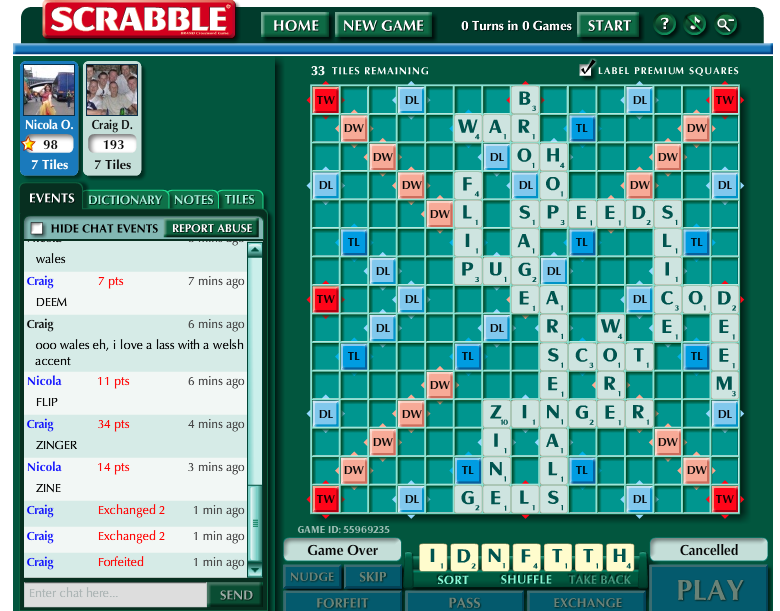
This weeks games felt more educational than last week's <Casual Games> although I think in part this may be leisure snobbery. Scrabble is a game I'm very familiar with as a boardgame but also online in it's unlicensed form (on Facebook) of “Scrabulous”. I like a word game and see it as a more worthwhile waste of time than Tetris or Solitaire because it is about words and patterns and, for right or wrong, I feel that words are somehow more worthwhile than visual patterns (which is an odd sort of bias now that I think about it). What I was not prepared for was the social aspect of Scrabble in the Hasbro version of the Facebook app. What was immediately disconcerting was the fact that I was presented with a huge wall of possible players who I don't know at all. It looked most like one of those late night “There are girls in your area!” type ads which I found immediately off-putting – I've never thought of boardgames as the online equivalent of a dubious Wednesday night in a particularly low rent pub but that was about the vibe listings like “Theresa – 2 player – casual – 2 mins” gives. The effect was compounded by the chat from my automatically (and with no opt out) found opponent Craig D. (Games: 187; Won 38%; Top Score 429):

Thus, as I played the game my concentration was largely consumed with avoiding either offending or leading on my opponent (rather easier said than done) rather than on the gameplay itself. Actually social interaction is part of the game I suppose, I was just more interested in the word part of play than the social play here. I found myself pining for my dusty old cardboard and plastic set to avoid Craig D. However when his chat up lines failed he, despite having double my score (see image below), forfeited the game to me. Which explains the stats in his profile actually – a score of over 400 is a good score (or so my scrabble obsessed friends always inform me) so his 38% win rate, especially given he was playing casual games, seemed odd. However if he is seeing the game as a game of flirtation around Scrabble rather than the Srabble itself as the game I can see why his win rate is less you might expect – perhaps it is more a representation of his flirting success than a reflection of his Scrabble skills.


After that experience I was loath to return to Scrabble with strangers (if ever in the past I've longed for someone to play a game with I'm not sure I will again now). However in the course of playing online I note that a lot of the thrilling uncertainties are removed – the interface includes a dictionary (including the mystical Scrabble 2 letter word list) rather than a simple possibility of a rejected work; a timer is included in the casual game to discourage slow long term games and encourage quick mechanical games (something my super fan friends with love, something I don't play the game for); and friends are de-prioritised as competitors even though, even with anonymous opponents, there are chat and social features. Most upsettingly of all the Tiles tab lists every available tile – a view into the virtual bag and a breach of one of the nice Scrabble features – you can guess at probabilities of letters appearing but unless you have a photographic memory these are guesses (and always, in any case, assume no one has lost/eaten/changed/replaced any times. Addig all those practical functions takes away from some of the core gameplay aspects. Evidently the Scrabulous creators knew more about what it is to play scrabble and be engaged by it than the brand owners themselves. Really interesting.


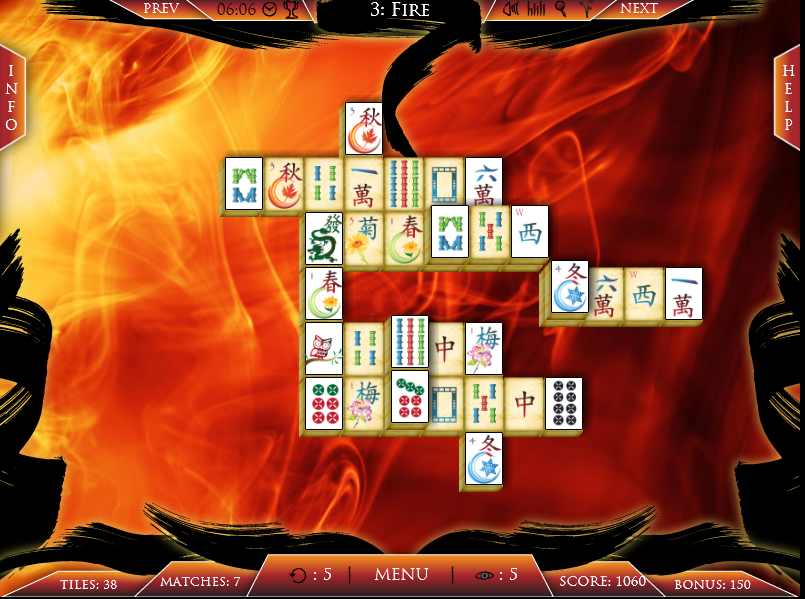
Mahjong is a complex strategic game I've been shown several times and like but struggle with. Mahjong (solitaire) on the other hand had me baffled at first. I'm not a big reader of instructions – particularly for online games (and yes, in Week 4's education games that is proving interesting) – so I was confused to see the tiles all face up and laid out in strange shapes. Whilst I couldn't remember the proper way to play Mahjong I knew this wasn't it. And then my partner looked over and said “It's a Mac thing. I used to play that years ago. It's just to do with matching pairs”. To that I looked disappointed but then proceeded to get very absorbed in spotting patterns and looking out for moveable/flipable tiles. There are some very minor nods to Mahjong (proper) but otherwise this is a memory and pattern recognition game with very enticingly attractive graphics. The game made lots of sense once I knew the basic goal but the guidance and introduction to the game – and especially the rather misleading optional login screen - wasn't really very helpful to establishing what those goals were but, after playing, I read the help text and it was actually pretty good – just why it wasn't labelled “How to Play” or “Rules” or something similar rather than “Help” was a bit of a mystery though. I'm not sure I learned anything at all but I enjoyed playing the game, I did progressively better and I was encouraged to go back and find my Mahjong tiles and play with them a bit. I'll probably also go back again as it was a very graphically sophisticated game, the music and sound cues were useful and fun, and the rules regarding nearby tiles, scoring, timing, tile layout etc. all added to the gameplay and strategies that were useful for completing a level. It was difficult but not too difficult and I liked that.


Finally I was trying out Bookworm this week. Of all the games it felt most educational and most frustrating. Firstly it required download which, in an era of browser based games, seemed quite old fashioned to me. The graphics were also a little out of date but squarely aimed at educational connotations.


Gameplay seemed like it was going to be great – there is an element of random chance, a need to match patterns and find words, and a good range of possible directions to create words in. What I found problematic in practice was the fact that the possible routes round tiles weren't entirely intuitive (some looked close enough but were not). I got very into the game though and headed at a score of over 40,000 moving from “Encyclopedia Salesman” up to “BookBinder”- they seem like odd sorts of level names though – the game is about books not literature. That is reflected in gameplay as well – you get points for flashing letters, strategies, avoiding burning letters (you have only one life in Bookworm!) etc. but the emphasis is on time and points rather than elegant word finding. This is not unlike Scrabble but in bookworm you cannot elect to play long words as easily as the choice and mixture of vowels and consonants tends to make shorter words more viable. Worrying I also got one of my highest scores with “Barf” - not the masters student level of verbal dexterity I fear.


The music and graphics were fun for play although the music quickly grew repetitive and, though it gave musical cues to the game action, only served to panic rather than focus me. Overall though this was an interesting counterpart to the other two games this week. It is an engaging game and the Bookworm character is quite charming – he even spouts explanations when a word looks especially interesting (“cud” was one of the words that triggered a definition in my game). And the high score feature at the end is quite a nice way of allowing you to compare your performance – in theory at least – and by setting the default comparison names to low scores it's quite encouraging too.


I think the puzzle game genre is a hard one to place. Though educational in the sense of improving your skills in both the game and, perhaps, your knowledge of words these games provide odd motivational opportunities as often the area of learning is not necessarily compatible with the highest scores – in Scrabble two letter words that can be used in many directions are often far higher scoring than a complex word and anything over 7 letters is rare and usually a compound of two words rather than, say, a technical or scientific term; in bookworm you are discouraged from looking for longer words by the time/burning challenges; in Mahjong the more numeric and strategic skills are exchanged for simple pairs play (only the season tiles challenge the simplicity of the game). Progress is rewarded in these games with speed or score challenges rather than building up activity to feed into some sort of reward or conclusion. All three games look attractive and have big usable buttons but in all three there is no compelling reason to start playing. Once you get going you are engaged but the motivation to engage in the first place seems to be expected to come from a place of boredom rather than interest (e.g. Scrabble's auto-selecting opponents) and that does not bode as well for serious educational goals. Additionally the downside of attractive games like these is that they look like games and that often neither feels nor looks like work/education to others since they are so associated with time-wasting patterns of use. The fantasy element in these games is also quite weak, particularly with regard to intrinsic fantasy since puzzles are, by their nature, artificially reliant on rules, restrictions and arbitrary goals.

Keywords: bookworm, facebook, IDGBL10, mahjong, scrabble, scrabulous

Posted by Nicola Osborne | 2 comment(s)

<< Back Next >>