I found Royle (2008 [1]) an interesting lens through which to view the last few months of thinking on digital game based learning. Royle touches on many of the themes which have persisted across game genres and approaches, such as the conflict between educationally focused games and commercial releases (particularly around verisimilitude (e.g. de freitas (2008)[11]), gaming cultures, and the tension between what makes a good educational experience and what makes a good - and entertaining - game experience. One of the factors he identifies is the time that a game should take, something that is particularly interesting at this stage of the course.
Over the last 12 weeks I have tried and played and looked at dozens of games but the engagement has largely been as part of short lived experiences. This may resemble many pedagogical experiences of games - which might occupy a single week of study or be restricted to demonstrating a particular concept - but this style of engaging with games poorly represents the experience of playing games for leisure. Puzzle games, often the very shortest in terms of narrative and challenge, might occupy a regular portion of a players time every day, week or gameplay may last over many years of regular short play. Complex games across many other genres can occupy weeks or months of committed game play: regular gamers I know will easily spend 3-5 hours a night on a game for the first few weeks they own it, in a few feverish cases gamers will simply play a game from start to finish only pausing to sleep and eat. It would be unreasonable and undesirable for learners to play for long bursts every day on a game - no matter how educational - but Royle argues that an educational game can scarecly claim to be a "game" unless it sustains a long and rich play period. He ties this style of play with notions of learning as rehersal as a sort of "virtual apprenticeship" an argument I see significant validity in:
"The original conception of Racing Academy was that through the game play and collaboration with other game players there would be an opportunity to act as a community of scientists and engineers, and use the language and practices of scientists and engineers. It was as much about developing identity as scientist or engineer as learning science or engineering."
Such long form games present significant challenges for assessment and reflection since such assessment would require either for gameplay to be a non assessed part of learning or an enormous amount of tutor and support time. Whitton (2010 [2]) and Prensky (2001 [7]) both take pragmatic and practical approaches to integrating games into education and it is interesting to thus see how both differ, to an extent, from Royle's idealistic take on what may realistically be possible, and also from Gee's (2003 [3]) ambitioous expectations around the of 36 Learning Principles for digital game based learning that he defines. However on the whole Whitton, Gee and Royle all agree that fun and engagement are increadibly important qualities in any educational game and this is also supported by theories around the value of intrinsic motivation in learning games (e.g. Malone (1980) [8], Barab et al (2005) [9]) and notions of flow (Nakamura, J and Csikszentmihalyi (2002) [10]).
"While real content is a good thing, it should not disrupt gameplay; the content presentation must be believable within the context of the game. If a believable backstory and mission have been established, real content can be inserted seamlessly into the environment. It's the crucial balance between real content and narrative that works, and the gameplay should drive this. "
"cheating should be both intrinsic and extrinsic to the game"
Royle claims that these are established parts of the games community and should be used in learning games also. However Some players in an educational setting will not be part of that community and cheating may be culturally problematic to them. Open structures of participation, whilst often ultimately more rewarding, can meet some resistance and, with games in particular, rules may be unsettlingly unclear compared to anticipated structured forms of learning (Jackson 2009). Whilst I agree with Royle that:
"The search for cheats is itself pedagogically important; the moment a player searches for extra knowledge, an independent learning strategy is invoked."
I am unconvinced that simply giving a student a problem will trigger this behaviour and Gee (2003) indicates that such ingenuity may be expected only at a very advanced level of mastering gameplay and experimental hacking, unless acceptable cheating is introduced in training levels (as in Gee's discussion of Tombraider training levels). Thus some sense tutor approval needs to be conveyed to indicate acceptable cheating mechanisms to those students more used to adhering to rules. Crucially there may also be cheating bounds to be set at the other end of the spectrum - a student may be able to hack the result of a game so that they succeed without the pedagogically important steps of gameplay and this may well be an unacceptable level of cheating within the curriculum.
The idea of building a cheat site in addition to a learning game is an intriguing concept, particularly in the current educational environment which is particularly focused on clarifying and eliminating plaigurism that coincides with the growth of written-to-order assignment web services. Cheating of any sort can indicate great intelligence and independent thought from a student but there are conventions and reputation systems within academia which rely on the principle that honesty and originality is to be respected and revered (even if the reality can occasionally include inconsistancies and compromises such as inequalities in the sharing of credit for work or competition to "scoop" research colleagues). Thus an attempt to merge educational and academic cultures - a merger whose history Royle criticizes - must face a distinct moral complexity introduced by encouraging certain types of cheating but discouraging others.
The cultures of appropriate game structures, behaviour (including cheating) and player expectation are problematized by many factors, not only those of educational vs. commercial. The discussions in the comments section surrounding a particularly critical article by Adams (2010 [4]) on cultures of conduct, commerce and cheating in Chinese Free-to-Play online games are fascinating as they reveal substantially different expectations and cultural prejudice (both comments and article are tinged by prejudices around Chinese games culture) from a random cross section of digital games players. The notion of fairness is particularly in the contrast of Royle's comments about cheat sites and lively quasi-commercial communities to support pedgagical aims since such communities can be very cliquey and communication is not always made public - potentially allowing some learners greater advantage than others.
By contrast Royle's concept that narrative, social reflection spaces and personalisation should be important to educational games design seems obvious and well informed by current pedagogical thinking around personal reflection and student centred learning
The centrality of narrative to engaging gameplay is evidenced by the popularity of games that build on the success of games that build on popular film and television properties. These are familiar characters and narrative arcs and thus enable players to enter the game fully aware of characters, relationships and game goals before engaging in gameplay. For instance the successful series of Harry Potter games or the upcoming interactive Doctor Who games (Stuart 2010 [5]). Though not specifically considered over the last few months such games offer a simple model on which to build educational customisations. Royle cites "DoomEd", an attempt to include educational science content into the familiar Doom game narrative, but there is no reason why the current popularity for "brain training" and quasi-educational games cannot be combined with popular mainstream entertainment narratives and more credible pedagogy to create something genuinely educational and fun. Whitton (2010) and Royle (2008) both highlight the important role that educators can play in the process of creating and developing commercial learning games. This partnership working also resonates with current funding arrangements around educational technology (e.g. JISC (2010) [12]) and it will therefore be exciting to see if a new generation of fun learning games begins to emerge are more educators engage in the creative process of game design.
Concluding Thoughts on the last 12 weeks
There is something compulsive and alluring about games and the playful visual aesthetics of digital gaming. They are engaging, visual, transliterate and frequently social. They can be directly educational, accidentally educational or be cleverly made into authentic learning moments. The challenges of actually introducing digital games into educational practice are, however, numerous and range from simple to foresee (though not always to resolve) matters of hardware, cost, fitness for purpose, accessibility and time through to more unexpected complexities such as in-game etiquette, sustained engagement and the positive and negative impact that fun game based activities may upon more traditional learning activities.
I came into this module an enthusiastic newbie to gaming with limited but positive and negative experiences. I have found this an immensely thought provoking topic but, at the end of 12 weeks of reading, discussing and, above all, playing digital games I still find myself distinctly uncertain about the best ways in which to deploy a game in a learning context though I feel well armed with theories and practical guidance (particularly from Whitton (2010)) on the subject. I find the cost and speed of commercial production an intimidating prospect for educators looking to support and entertain learners through game based learning experiences. I think I have come to the conclusion that digital game based learning can only take place when an educator is directly and personally passionate about the game(s) they use, and who is willing to be open and responsive to calls for support or criticism from learners. Games must also be fun on some sort of level in order to work as educational spaces since, to be frank, any form of education must be engaging and fun (to an extent) in order for learning to be retained, particularly when learning takes place in unconventional spaces.
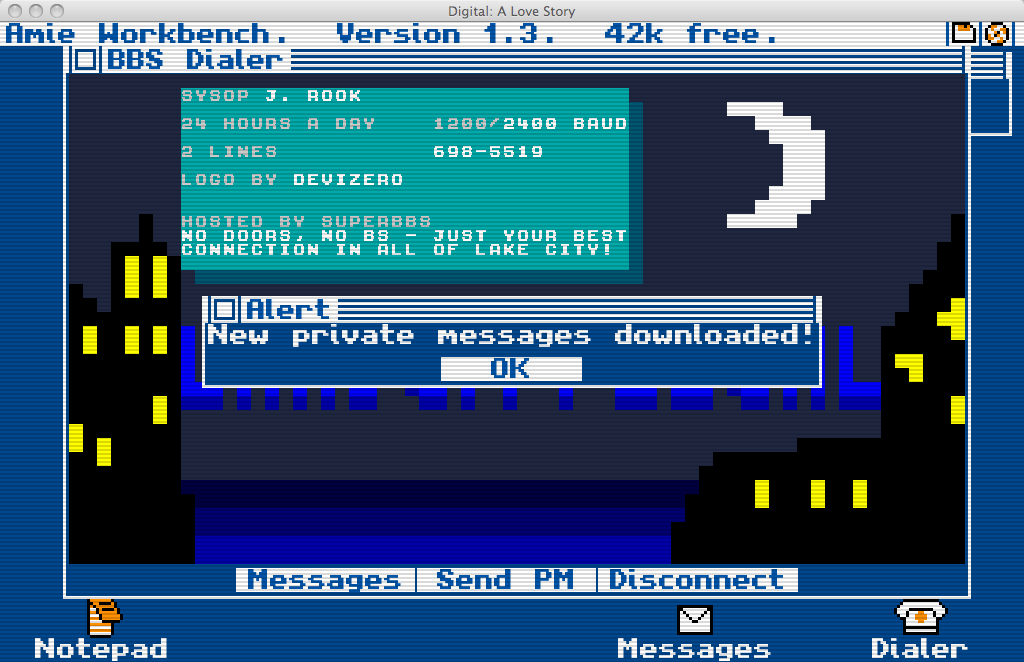
In the spirit of fun I will therefore close on a video that draws on the appealing aesthetics and conventions of retro gaming and brings them to life. Such creative blurrings of fantasy and reality are, after all, one of the most beneficial aspects that gaming brings to educational experiences.
References
• [1]. Royle, K. (2008). Game-Based Learning: A different perspective. Innovate 4 (4)
• [2]. Whitton, N. (2010). Learning with Digital Games: A practical guide to engaging students in higher education, London: Routledge.
• [3]. Gee, J. P. (2003). What video games have to teach us about learning and literacy, New York: Palgrave Macmillan. (core textbook)
• [4] Adams, Ernest (2010). The Designer's Notebook: Selling Hate and Humiliation. Gamasutra, 8th April 2010. Retrieved 8th April 2010. http://www.gamasutra.com/view/feature/4319/the_designers_noteboo
• [5] Stuart, Keith (2010). Doctor Who Adventures - and the future of cross-platform entertainment. Guardian Unlimited Technology section, 8th April 2010. Retrieved 8th April 2010. http://www.guardian.co.uk/technology/gamesblog/2010/apr/08/doctor
• [6] Jackson, Janna (2009). Game-based teaching: what educators can learn from videogames. Teaching Education, 20 (3). pp. 291 — 304. Retrieved 10th April 2010. http://dx.doi.org/10.1080/10476210902912533
• [7] Prensky, Marc (2001). Digital Game-based Learning. (USA: McGraw-Hill)
• [8] Malone, T.W. (1982) Heuristics for designing enjoyable user interfaces: Lessons from computer games. Proceedings of the 1982 conference on Human factors in computing systems table of contents. Gaithersburg, Maryland, United States.
• [9] Barab, S., Thomas, M., Dodge, T., Carteaux, R., & Tuzun, H. (2005) Making learning fun: Quest Atlantis, a game without guns, Educational Technology Research and Development, 53(1), pp.86-107
• [10] Nakamura, J and Csikszentmihalyi, M. (2002) Chapter 7, 'The Concept of Flow'. In The Handbook of Positive Psychology by C.R. Snyder and S.J. Lopez. Oxford University Press.
• [11] de Freitas, S. (2008) Emerging Technologies for Learning. BECTA research report, March 2008, Volume 3 (2008).
• [12] JISC (2010). Business and Community Engagement. JISC website page. Retrieved 10th April 2010. http://www.jisc.ac.uk/whatwedo/themes/bce.aspx.
 The popularity and business models of MMOGs, RPGs and MMORGs makes them a fascinating possibility for education. Though television shows, sports and home console games all have a significantly more visible leisure presence in current popular culture there are huge numbers of people quietly living our complex personal and social fantasies in these rich online games. Many of these games (indeed most of those I have seen) are significantly expensive to participate in and yet