Log on:
Powered by Elgg

James McLuckie :: Blog

February 15, 2010

This was an enormously challenging and fruitful week and this is one of the reasons that it's taken me a bit longer to write about. Dr Hamish Macleod (senior lecturer in the School of Education, University of Edinburgh) was guest tutoring around the multifaceted areas of play and playfulness and really got discussion going although I think we actually strayed off the core areas we were asked to consider, namely:


  • Why does play have such a bad wrap with grown ups?

  • Why an opposition between work and play?

  • Do we aspire to enjoy *our* work?

  • Do we take ourselves too seriously?


So I'm going to start by saying that I have always struggled with the idea that work is a separate compartmentalised part of life and that work is not fun. I have not always had the most exciting jobs in the world (a summer at Domino's Pizza as a student being the lowest point) but I have always found something to enjoy in them so the idea that work could be seen as the opposite of play by anyone feels quite alien to me making this a really fascinating week.


Kane (2005 [1]) was a great paper to start with as it was, in it's format and outlook, hugely playful in exploring play and theories of play. Kane talks about two key rhetorics of play and humanity: a modern vision build around ideas of human freedom as embodied by an ideal of imagination, passion and confidence (I think Brown (2008 [8]) is a really interesting example of this rhetoric); and an ancient vision which “sees players as determined by forces largely beyond their control” which, to me, also suggests a form of play more allied with social, religious and superstitious practice (so not always that ancient). These are not mutually exclusive rhetorics and most actual experiences of play can't be neatly pigeon holed into either category and nor can work be separated neatly off to the side. Thus I can't agree more with Kane's comment that “Once properly investigated, there's no going back to a simple definition of play”.


Kane goes on to examine a range of theories of play. “Play as progress”, which focuses on play as a/the core early development process. In evoking this Kane refers back to to the Enlightenment, to Rousseau's Emile (1759) and to the invention of taking “childhood” seriously as a phenomenon in the early industrialised west. However whilst Kane talks about the role of play – the idea of play as an opposite force to work in Victorian society - in the creation of the notion of childhood I think that he rather skips over the role of religion (after all the ultimate Christian art works – unlike religious icons in many other religions – frequently centre on the idea of Jesus as a perfect playful child – precocious but poised), as well as the role of myth and the idea of play that pre-existed in those particular creation myths. Although there are certainly art works that testify to the extent that privileged children were presented as mini adults there are also childrens toys – rattles in particular – that pre-date Victorian culture and indicate play and playfulness as important to raising children long before the “seriousness” of childhood was established. For me what is gained in accepting and embracing childhood in Victorian society – which, after all, saw a huge move from rural to city living conditions and living expectations leading to shocking brutalisation of children (often unwanted) in grim factory settings – is also the simplification and mythification of childhood as a protective innocent space. Playfulness is one side of this but saccharine behavioural and physical expectations build up (and thus a whole wave of literature about societies underdog unwanted children emerges) and the idea of taking children seriously – other than as innocent spiritual barometers to be romanticised – all but disappears. Play has not been discovered but it has, in fact, been de-clawed. Greek myth might have youthful gods making mistakes and playful hi-jinks but Victorian play myths see creativity and play as wonderful traits only in the young and innocent. And I think it is these ideas of the ideal child able to play so long as innocence is retained (and those of the ilk of Maria Montessori – also quoted in Kane) that leads to the modern juxtaposing of work and play – and the relative barriers to inducing adult play - to perhaps even greater extent than the industrialised structured play identified by Kane. Those industrial ideas of work-life balance (for this is what they are – early experiments in identifying work as so unpleasant that play is required as an offsetting force.


The study of mental health and medicalisation culture also emerges around the same time as these new ideas of play and I don't think that it is any co-incidence that many psychologists and psychiatrists use playful methods of diagnosis and treatment to encourage patients/subjects to voice ideas, memories, fantasies (by the time Freud appears a repressed populace is ready to see most of the world in terms of sex and death) through a safe prism of innocent child like wonder. But that is to presume that children are innocent and I think any hour spent with an 8 year old will reveal that children are actually far more complex and aware of the world and whilst nieve are unlikely to be wholly innocent. It is a rare western child that will reach secondary school without exposure to swearing, urban legends of horrible and/or sexual things, bullying, peer and parent pressures, loss and sadness, bad and/or immoral behaviours etc. Indeed I think the Victorian's play legacy here actually includes the commercialisation of emotion and nostalgia and the establishment of unreal ideas based on a past that never was.


As Kane moves on to Play as Imagination and the work of the surrealists I cannot help but wonder why he does not pick up on the role of play in oppressive scenarios. The surrealist movement emerged out of complex, often highly repressive, political times where statements of narrative art could be seen and punished as criticism but surrealism provided an under-the-radar way for subversive content to be communicated, shared or simply enjoyed. Surrealism has remained a popular form of artwork precisely because the outrage it often sparks is in fact a decoy that raises attention for the free and critical comment often embodied in the work. The work of Jake & Dinos Chapman, for instance, capitalise on shock and awe to make surreal nightmares that critique the grotty realities of war, or, most notoriously, mock public obsession with the sexualisation of children and the fetishisation of their innocence. These are artworks whose warnings and notoriety are almost as powerful as the work itself. They are surreal and playful but without the arousal of shock and outrage the appeal of these critical works would be restricted to those already well aware of the dark horrifying works of Goya, El Greco and, indeed, Salvidor Dali that are all referenced in the Chapman's work. Play is used here as a front for dual subversion – a critique of the very audience that will be appalled into viewing the works and a very traditional nod to the long western history of art that focuses on the dark underbelly of human desires, particularly humanity's lust and violence.


The use of playfulness through surrealism in advertising meanwhile is both a nod to art which has moved from subversive cult to mainstream ubiquitousness and an efficient means of capturing attention. A straightforward advertising message is rarely the most effective, in part because the cost of advertising space is prohibitive and, in part, because any advertising must differentiate it's product from all the compeitors. Surrealism is about adopting a series of flexible codes that must be cracked – this in itself constitutes not only playfulness but also a small subconcious game. The famous Silk Cut ads of the 80s (some are included here) were instantly recognisable, instantly popular not because of the product (cigarettes) but because they were visual games – huge advertising hoardings filled with abstracted images in which one must identify the brand colour (purple), some sort of sharp edge (often scissors which come loaded with their own symbolic meanings) and, of course, silk in some form. This game draws attention and attentive eyeballs are the key goal of any advertiser. It also – as with the original surrealists – neatly side stepped increasing restrictions on the advertising of cigarettes. But surrealism and abstraction only work when the game is recognisable. If you know you are playing Where's Wally? It can be fun. If you just see just part of an image with no indication of the goal you will certainly not give the ad significant repeat attention. Attention has currently moved to playful but less abstracted viral ads – or viral style ads – where product labels are clearly in view, prices are stated etc. Surrealism wasn't purely a mid 1990s trend but that period did seem to mark a peak of abstracted surreal ads perhaps because advertising was a very lucrative business at the time and the number of media channels was expanding but only in usefully limited directions (perhaps also the advertising executives at this time had been raised on the drug and hypnagogia induced surreal art and LP sleeve work of the 1960s and '70s) . In a worldwide online marketplace it is harder to build knowledge of a brand enough to build a familiar game between advertising product and consumer and thus more transparent methods of communication – particularly in print ads - are favoured over surreal and playful campaign games.


Kane, in talking of Play as Selfhood, raises issues for me around the idea of “free play” since this idea of playfulness also relies on some distintly non free, non casual, non playful preconditions. Core drivers that enabled hippies to tune in and drop out include the movement's grounding in the secure middles classes (one can only drop out when one has the resources to opt out); the invention of the birth control pill substantially contributed to the “free love” movement (later to also lose it's free veneer with the rising rates in sexual diseases). So as long as you had medical insurance, a structured calendar of birth control pill consumption, and enough money to engage you could take part in “free play” of a sort.


However as Kane develops his theory of play I find his idea that society is both defined by work and is thus inherently unplayful to be rather difficult. This is not what I see in my own experience of the world. My sector – effectively educational technology – is an intensely creative and playful space and, as universities look to boost commercialisation of ideas developed in their bounds, the spaces to play and experiment are increasing exponentially (e.g. University of Edinburgh's Informatics Ventures initiative). At the same time BarCamps, unconferences, etc. all contribute to a much more playful culture and the rise in participative playful hobbies – geocaching, knitting groups, Maker Faires, World of Warcraft, the rise of burlesque, community participation in Wikipedia (motivation for which is very nicely described in Pink (2009 [7]) – all help highlight playful natures whilst stories of individuals leaving jobs they don't like to become ebay sellers, Second Life sellers, etc. also hint at the bridging between work and play that is possible in an affluent (even in these straightened times) and well educated society. Indeed our videos for this week both highlighted the impotance in modern society of a streak of subversive play that cuts through the normality of a day - though both Piano Stairs [5] and Pacman in the Library [6] could, perhaps, be seen to highlight a lack of playfulness in normal routine they certainly reveal a huge reciptiveness to play. That they could be made possible also shows the humour and space already allowed for playfulness in work and study spaces. 


There is also a bizarre paradox at work in the idea of respect and play. Although we respect academic and intellectual achievement we also often quantify success and standing in the world in terms of money and power. Thus is it peculiar to note that the greatest thinkers, intellectuals, academics, politicians, inventors, etc. are actually not the highest paid or most influential people in the world. Instead it is the film stars, the sports stars, the television personalities, and even the people famous for being famous. We may say that we do not respect play but actually our society puts those who play (whether through acting, games, or purely fun intuitive on-camera pursuits) for a living. If that is not an indicator that play is respected very highly indeed I don't know what is. But the fact that we ourselves prefer to maintain an idea that seriousness, that “work” must not be fun but must be respected indicates a tremendously interesting sociological construct of the notion of proper and improper ways to use time. And yet, as highlighted by Pink (2009 [7]) play can be a more productive and motivating form of activity when it is not classified as a thing that must be done, as something that is “work”, as something with intrinsic rather than extrinsic motivators.


The Sutton-Smith (1997 [2]) paper on play and ambiguity brought me back to thoughts of Gee (2003[9]) and his “semiotic domains” since both authors talk about the fluidity of meaning and the relationship of meaning to context, domain and playfulness. Although I very much liked the insight of the Sutton-Smith paper – particularly the depth of ambiguity that can be explored in any notion of play - I found that it was most useful for opening up my mind and triggering my own further thoughts on what constitutes play. However both Sutton-Smith and Callois (2001 [3]) slightly exasperated me with their blend of quite fascinating discussion of play – and the difficulties of play being open, playful, full of diverse and often difficult to grasp meaning– since it was accompanied by what felt, to me, to be oddly arcane attempts to classify this amorphousness into impossibly limited categories. That seems to me to help with the semantics of discussing play but not the matter of understanding play any more deeply – it is the short discussion and not the specific terms and theories being forwarded that offered most in terms of addressing how play can be understood and usefully harnessed for learning. Callois's instinctive paidia and more chewy ludus do seem robustly defined and informative but it is hard not to question whether cognitively the need to solve complex puzzles for their own fun (ludus) is, in fact, rewarding only because it is as much an instinctive, child-like force as making a loud noise in a quiet building (paidia). I think it would certainly be interesting to know how the definitions of play – from all of the readings we have been looking at – map to the function of the brain since inherent in Callois's opposing play types is the idea that pleasure is derived and enjoyed in different ways depending on the type of play and I do not know if that is cognitively accurate. Sutton-Smith's rhetorics of play overlap and combine - though this is self-conciously the case with Sutton-Smith making reference to Pepper (1961) and the usefulness of arbitrary distinctions in philosophical scholarly discourse.


I also unsure how the role of external factors – such as the process of being observed - can be properly accounted for in these categories. One of the continued themes of discussion board activity this week revolved around the self-consciousness of play in adults and the different qualities of play (even in the least self-conscious people) that occur alone, in social situations, and with audiences of any type. There are specific forms of of play around audiences but I think, putting on my former scientist hat, that if you are to identify categories, you must also be able to define the variables, the margins of error for those categories.


However as a final word I have to say that, whilst I deplored the quality of writing in Juul (2001 [4]) I was left with a great sense of curiosity to explore Sutton-Smith's 1959 work Kissing games of adolescents in Ohio. I do wonder if Juul's claim that the study of play is repeatedly lost is more a matter of specifically psychological discussion of the topic since I am aware that there is a long standing social anthropology interest in play and social play in particular. At this point in the course I am starting to wonder how many disciplines can be constructively combined to form a theory of play since it seems clear that psychology, history (and specifically history of science if the work on intrinsic motivation is to be recognised), social anthropology but also cognitive science – and that is just for a start – must all be combined to form any sort of “universal” theory of play. I think this is one of the reasons that I fear the use of categories that create a layer of opacity between disciplines and discourage playful sharing of ideas.


To play and to consider how we play in all aspects of daily life has been a rewarding week for me and is certainly useful going forward. Sutton-Smith's comments on the use of play as a form of defining identity is particularly interesting to bear in mind as we move into educational games and thus the use of avatars, social play and other more performative and more constructed forms of play and selfhood.


References

  • [1] Kane, P. (2005) Chapter 2, 'A General Theory of Play'. In The Play Ethic : a Manifesto for a Different Way of Living. London, Pan. p35-64

  • [2] Sutton-Smith, B. (1997) Chapter 1, 'Play and Ambiguity'. In The Ambiguity of Play. Cambridge, Mass: Harvard University Press. 

  • [3] Caillois, R. (2001) Chapter 2, 'The Classification of Games'. In Man, Play and Games. Illinois: University of illinois Press.

  • [4] Juul, J. (2001) The repeatedly lost art of studying games; Review of Elliott M. Avedon & Brian Sutton-Smith (ed.): The Study of Games. Game Studies 1:1 (July 2001).

  • [5] "Piano on the stairs" video

  • [6] "Pacman in the library" video

  • [7] Pink, Dan (2009) Dan Pink on the surprising science of motivation. TEDGlobal. Accessed 14th February 2010. http://www.ted.com/talks/dan_pink_on_motivation.html

  • [8] Brown, Tim (2008) Tim Brown on Creativity and Play. Serious Play 2008. Accessed 14th February 2010. http://www.ted.com/talks/tim_brown_on_creativity_and_play.

  • [9] Gee, J. P. (2003). Chapter 2, 'Semiotic Domains: Is playing video games a "waste of time"?'In What video games have to teach us about learning and literacy, New York: Palgrave Macmillan.

Keywords: advertising, games, IDGBL10, Kane, play, surrealism

Posted by Nicola Osborne | 0 comment(s)

February 12, 2010

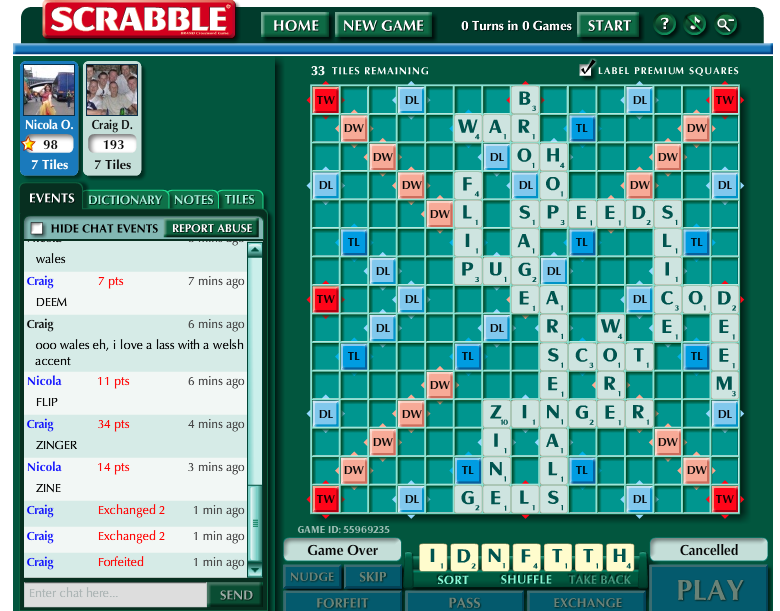
This weeks games felt more educational than last week's <Casual Games> although I think in part this may be leisure snobbery. Scrabble is a game I'm very familiar with as a boardgame but also online in it's unlicensed form (on Facebook) of “Scrabulous”. I like a word game and see it as a more worthwhile waste of time than Tetris or Solitaire because it is about words and patterns and, for right or wrong, I feel that words are somehow more worthwhile than visual patterns (which is an odd sort of bias now that I think about it). What I was not prepared for was the social aspect of Scrabble in the Hasbro version of the Facebook app. What was immediately disconcerting was the fact that I was presented with a huge wall of possible players who I don't know at all. It looked most like one of those late night “There are girls in your area!” type ads which I found immediately off-putting – I've never thought of boardgames as the online equivalent of a dubious Wednesday night in a particularly low rent pub but that was about the vibe listings like “Theresa – 2 player – casual – 2 mins” gives. The effect was compounded by the chat from my automatically (and with no opt out) found opponent Craig D. (Games: 187; Won 38%; Top Score 429):

Thus, as I played the game my concentration was largely consumed with avoiding either offending or leading on my opponent (rather easier said than done) rather than on the gameplay itself. Actually social interaction is part of the game I suppose, I was just more interested in the word part of play than the social play here. I found myself pining for my dusty old cardboard and plastic set to avoid Craig D. However when his chat up lines failed he, despite having double my score (see image below), forfeited the game to me. Which explains the stats in his profile actually – a score of over 400 is a good score (or so my scrabble obsessed friends always inform me) so his 38% win rate, especially given he was playing casual games, seemed odd. However if he is seeing the game as a game of flirtation around Scrabble rather than the Srabble itself as the game I can see why his win rate is less you might expect – perhaps it is more a representation of his flirting success than a reflection of his Scrabble skills.


After that experience I was loath to return to Scrabble with strangers (if ever in the past I've longed for someone to play a game with I'm not sure I will again now). However in the course of playing online I note that a lot of the thrilling uncertainties are removed – the interface includes a dictionary (including the mystical Scrabble 2 letter word list) rather than a simple possibility of a rejected work; a timer is included in the casual game to discourage slow long term games and encourage quick mechanical games (something my super fan friends with love, something I don't play the game for); and friends are de-prioritised as competitors even though, even with anonymous opponents, there are chat and social features. Most upsettingly of all the Tiles tab lists every available tile – a view into the virtual bag and a breach of one of the nice Scrabble features – you can guess at probabilities of letters appearing but unless you have a photographic memory these are guesses (and always, in any case, assume no one has lost/eaten/changed/replaced any times. Addig all those practical functions takes away from some of the core gameplay aspects. Evidently the Scrabulous creators knew more about what it is to play scrabble and be engaged by it than the brand owners themselves. Really interesting.


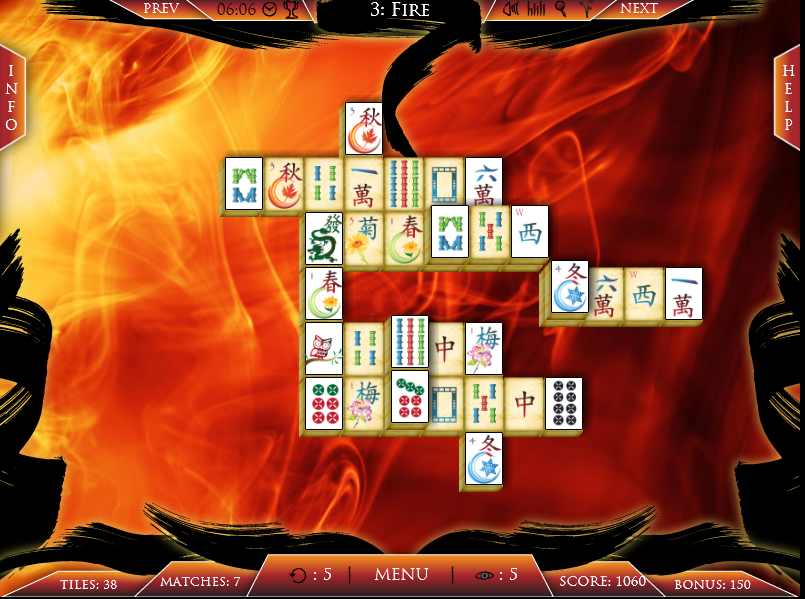
Mahjong is a complex strategic game I've been shown several times and like but struggle with. Mahjong (solitaire) on the other hand had me baffled at first. I'm not a big reader of instructions – particularly for online games (and yes, in Week 4's education games that is proving interesting) – so I was confused to see the tiles all face up and laid out in strange shapes. Whilst I couldn't remember the proper way to play Mahjong I knew this wasn't it. And then my partner looked over and said “It's a Mac thing. I used to play that years ago. It's just to do with matching pairs”. To that I looked disappointed but then proceeded to get very absorbed in spotting patterns and looking out for moveable/flipable tiles. There are some very minor nods to Mahjong (proper) but otherwise this is a memory and pattern recognition game with very enticingly attractive graphics. The game made lots of sense once I knew the basic goal but the guidance and introduction to the game – and especially the rather misleading optional login screen - wasn't really very helpful to establishing what those goals were but, after playing, I read the help text and it was actually pretty good – just why it wasn't labelled “How to Play” or “Rules” or something similar rather than “Help” was a bit of a mystery though. I'm not sure I learned anything at all but I enjoyed playing the game, I did progressively better and I was encouraged to go back and find my Mahjong tiles and play with them a bit. I'll probably also go back again as it was a very graphically sophisticated game, the music and sound cues were useful and fun, and the rules regarding nearby tiles, scoring, timing, tile layout etc. all added to the gameplay and strategies that were useful for completing a level. It was difficult but not too difficult and I liked that.


Finally I was trying out Bookworm this week. Of all the games it felt most educational and most frustrating. Firstly it required download which, in an era of browser based games, seemed quite old fashioned to me. The graphics were also a little out of date but squarely aimed at educational connotations.


Gameplay seemed like it was going to be great – there is an element of random chance, a need to match patterns and find words, and a good range of possible directions to create words in. What I found problematic in practice was the fact that the possible routes round tiles weren't entirely intuitive (some looked close enough but were not). I got very into the game though and headed at a score of over 40,000 moving from “Encyclopedia Salesman” up to “BookBinder”- they seem like odd sorts of level names though – the game is about books not literature. That is reflected in gameplay as well – you get points for flashing letters, strategies, avoiding burning letters (you have only one life in Bookworm!) etc. but the emphasis is on time and points rather than elegant word finding. This is not unlike Scrabble but in bookworm you cannot elect to play long words as easily as the choice and mixture of vowels and consonants tends to make shorter words more viable. Worrying I also got one of my highest scores with “Barf” - not the masters student level of verbal dexterity I fear.


The music and graphics were fun for play although the music quickly grew repetitive and, though it gave musical cues to the game action, only served to panic rather than focus me. Overall though this was an interesting counterpart to the other two games this week. It is an engaging game and the Bookworm character is quite charming – he even spouts explanations when a word looks especially interesting (“cud” was one of the words that triggered a definition in my game). And the high score feature at the end is quite a nice way of allowing you to compare your performance – in theory at least – and by setting the default comparison names to low scores it's quite encouraging too.


I think the puzzle game genre is a hard one to place. Though educational in the sense of improving your skills in both the game and, perhaps, your knowledge of words these games provide odd motivational opportunities as often the area of learning is not necessarily compatible with the highest scores – in Scrabble two letter words that can be used in many directions are often far higher scoring than a complex word and anything over 7 letters is rare and usually a compound of two words rather than, say, a technical or scientific term; in bookworm you are discouraged from looking for longer words by the time/burning challenges; in Mahjong the more numeric and strategic skills are exchanged for simple pairs play (only the season tiles challenge the simplicity of the game). Progress is rewarded in these games with speed or score challenges rather than building up activity to feed into some sort of reward or conclusion. All three games look attractive and have big usable buttons but in all three there is no compelling reason to start playing. Once you get going you are engaged but the motivation to engage in the first place seems to be expected to come from a place of boredom rather than interest (e.g. Scrabble's auto-selecting opponents) and that does not bode as well for serious educational goals. Additionally the downside of attractive games like these is that they look like games and that often neither feels nor looks like work/education to others since they are so associated with time-wasting patterns of use. The fantasy element in these games is also quite weak, particularly with regard to intrinsic fantasy since puzzles are, by their nature, artificially reliant on rules, restrictions and arbitrary goals.

Keywords: bookworm, facebook, IDGBL10, mahjong, scrabble, scrabulous

Posted by Nicola Osborne | 2 comment(s)

February 10, 2010

This weeks games forced me to confront my own ideas about what is and is not a worthwhile game to play (indeed these are the types of games that make sympathetic to the negative arguments about games discussed by Gee [1]). My reaction seeing the games listed in the Casual Games section was to roll my eyes a little and wonder whether I needed to waste my time with them. I'd played both Solitaire and Tetris before but mainly as a way to avoid homework or fill gaps between lectures when I was an undergraduate student so this week, with work and readings to more than fill my time, why would I want to fritter away minutes on such trivial games?


Solitaire more than lived up to my memories. It has some appeal as a procrastination tool but I quickly grew bored of the game play. The challenge of the game comes from the speed and strategy of completion but otherwise the game is fairly easy to complete. The cards are randomly dealt but once you have completed a game the challenge is significantly diminished for later rounds (unless you start altering difficulty levels or attempting to beat your time). Once I had played a few abortive rounds of Solitaire I completed a game and that was my interest peaked. In game play it reminds me of something I used to do for a job: sorting library books into their Shelfmark. There is strategy and speed at play but ultimately you are simply mechanically obeying the rules and the novelty is quickly lost.


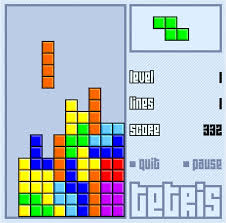
Tetris on the other hand (and less so the derivative Columns) held my attention for far longer than I was expecting. Tetris is a very simple game with just 6 shapes all dropping at increasingly fast speeds which can be rotated and slotted together. However the random order in which blocks drop and combine, the ability to rotate blocks, and the altering speeds make a huge difference to how absorbing the game becomes. It feels much more like a game of skills although, like Solitaire, there is a basic element of recognition and pattern matching (albeit quite a different game in Tetris – rotating blocks offers new possibilities for strategy and alternative approaches) but, unlike Solitaire it actually gets the pulse racing a bit. Every failure feels like you've just missed success by a tiny error and that encourages you to go back and try again and again.

 

Although the educational content of Tetris is clearly rather dubious (hand eye coordination and pattern matching but little else) I think there is something very educationally useful about what makes the game so captivating. Clearly any game that attempts to engage learners needs to be compelling and involving in order for any of the learning bound up with the game to be successful. So I think what I find really useful from this week's games is the idea of the great game mechanic:


I always think that the ideal game is the game where the winner thinks he's won because he's played it skillfully, and the losers feel that they've lost because they've had bad luck”

Steve Jackson, Games Designer (BBC 2009 [2])


So although this weeks games did not seem directly to the teaching and earning process I do feel that my dislike for Solitaire and my compulsion to continue with Tetris are both useful experiences for understanding learning games. I have previously sat in on web demonstrations from e-learning software companies and the stock learning games demo-ed by these sorts of software companies relate to matching images with phrases or pop quiz formats and, whilst some situations will suit these types of ideas I think the quick boredom that can occur in playing games that just make you go through the motions is important to note. I also have high hopes that some of the more sophisticated games coming up in the next few weeks will also start to include games that more educationally engage that simple but clever game mechanic that encourages you to go back again and again to perfect and prove your skill because you were just a few moves from getting it right... !


References

  • [1] Gee, J. P. (2003). Chapter 2, 'Semiotic Domains: Is playing video games a "waste of time"?'. In What video games have to teach us about learning and literacy, New York: Palgrave Macmillan. (core textbook)

  • [2] BBC (2009). Episode 2: Monopolies and Mergers. In Games Britannia. Accessed and viewed (via iPlayer) on 5th February 2010. http://www.bbc.co.uk/programmes/b00pf0rr.

Keywords: columns, gamemechanic, IDGBL10, solitaire, tetris

Posted by Nicola Osborne | 0 comment(s)

February 01, 2010

It was lovely to start this week with Dara O'Briain's [4] great overview on the problem of content from the point of view of a gamer forced through uninteresting but difficult entry levels before the main advertised action of a computer game commences.


Gee [1], almost as a second introduction to What Video Games Have to Teach Us About Learning and Literacy, starts addressing the core criticism of gaming in general – what is the point of playing them? I was quite taken by how Gee compared the cynicism over gaming to the attitude taken to visual content in academic contexts and the lack of acceptance of more transliterate approaches to scholarly practice communication – formal text is still king and any sort of game will therefore thus appear particularly alien.


Although I am not from a linguistic background I found Gee's concept of the semiotic domain of gaming to be quite helpful as, as a very occasional gamer, any interaction with gaming websites, magazines etc. feels like dipping into a wholly new domain. I recognise some of the symbols and their meaning but there others that entirely pass me by because I am not sufficiently versed into this domain to be able to decode even some quite basic features. In particular my unfamiliarity with the social as well as game play practices of current gaming platforms is a key gap in my understanding of current gaming culture and practices.


I was thus pleased that Gee had focused on Pikmin, a GameCube game from 2001 which I spent many weeks playing not long after release, to further explore the ways in which games could provide learning opportunities far more sophisticated than their basic narrative at first suggests. Pikmin amply illustrates the level of concentration, time and commitment needed to complete many apparently cute but daft games – every action in any vaguely creative, complex or involving game will involve some elements of problem solving, of sustained imagination, of efforts that far outweigh the actual reward of the game. Framed in this helpful context it becomes easy to see Gee's view that:


“The problem with the content view is that an academic discipline (or any other semiotic domain, for that matter) is not primarily content, in the sense of facts and principles. It is primarily a lived and historically changing set of distinctive social practices”

Gee (2003[1] p. 22)


Indeed during the same week that I was reading Gee a senior colleague was telling me the very same thing about my own studying process – reminding me to do well but also warning me that it was not the content per se, nor the grades, that makes the MSc but the communication and research skills and the understanding of the work process at the expected level that really counts.


If that disconnect between what is often assessed (the content) and what the actual focus of learning should be (skills, process, social practice) is accepted then there some interesting questions to ask about gaming. What, for instance, are the skills of first person shooter games and, if content is immaterial, is there any moral restriction on what might be reasonably played for learning? In some regards content can, in fact, be a driver for interest in learning a new skill but at the same time there are few literacy courses teaching adults to read English with violent thrillers or erotica and I think there would be some concern if learning games were to fully adopt some of the morally grey areas in which many of the most popular computer games sit.


However there is, as was briefly addressed on the boards this week, a gender element as well. Some content and playing styles will instantly be more appealing to female players, others to male players. In the commercial sector the choice of focus for games designers may be rather skewed but in the educational sector gender must be handled in a more balanced way and that may offer challenges in finding both game formats and content (as a driver rather than the focus of learning) that will motivate both learners sufficiently to progress and learn from a game.


But I digress...


Gee's concept of Semiotic Domains and the processes of active learning seem to have synergies with the ideas of Threshold Concepts (Meyer & Land 2006 [5]) and the transformation of a learners identity from distanced outsider to increasingly skilled novice to equipped insider to qualified practitioner. It is at this latter stage of working through threshold concepts that Gee's Affinity Groups also ring true. Once one can prove one's literacy in a semiotic domain then one becomes eligible for memberships of affinity groups. At the time of writing I find the World of Warcraft (WoW) conversations on the course discussion boards quite obscure and, if not excluding, then certainly detached from meaning for me as I am not versed in this quite specific semiotic domain and cannot thus be part of the course's own affinity group of WoW players. I do however know some of the external grammars of WoW as I have friends who are players so I am, at least, able to recognise and understand the broad tone of messages about the game.. I could not bluff more specific internal grammars but neither am I a total outsider. If I wanted to enter that domain more fully then I could call upon my own knowledge and that of my friends' and gradually blend these interrelated internal and external grammars to reflect my changing experience of the game.


Gee sees Critical learning as a natural add on to active learning. But whilst most games offer some sort of space for critical reflection I think the use of the word here is quite loaded. Analysis, critique and reflection are, of course, possible in computer games but I am not compelled that formulating a multitude of strategies for completing/succeeding at a game are born of entirely conscious intellectual reflection. Greenfield (1984 [2]) too examines in detail the clinical detail of a game (Pac Man in this case) establishing a very rational outline of the discoveries made by gamers. But Greenfield takes not the players of PacMan but a cheat guide as her source whilst Gee attributes complex thought processes to a six year old's game strategy – in neither case do the players articulately relate their experience of the game in a way that shows a particular understanding of the process of game design. In critical thinking around cinema there is one level at which one recognises and can articulate a cinematic trick, convention or feature but there is also a much more critical level at which one can stand back and analyse the way in which such a feature has been used, or subverted, or referenced, etc. and I am not convinced either Gee or Greenfield entirely convince me that the players they describe are equipped to properly critically evaluate the games they play from the perspective purely of insiders within those games.


Playing of related and/or competing games and the social aspects around gaming certainly provide greater possibility for critical learning and comparison but these forms of criticism and analysis are, perhaps, equivalent to affinity groups around genre novels: a group of murder mystery fans may be extremely well placed to compare genre novels, their use of references and conventions, the most successful and inventive plotting etc. but that same group may not be equipped to compare their book to a broader palate of literature sources and compare conventions and ideas from wider contexts.


For gaming to be taken seriously as a semiotic domain I think it is essential to ensure that gamers and learners are equipped with extended critical skills that inform not only their own learning but also allows for reflection on the selection and use of a given gaming-learning spaces as well as how these relate to other semiotic domains – both gaming and non gaming domains. This in turn brings us back to Gee's fifth learning principle of Metalevel Thinking About Semiotic Domains [1].


One of the more interesting aspects of Wood [3] is the fact that it seems to be a lack of public (and medical) acceptance of gaming as a legitimate leisure pursuit that drives the move to radicalise and classify heavy usage of games as a problem. Greenfield [2] raises the peculiar disparity between the acceptance of television versus video games. It seems that the wider the experience, the more acceptable the pursuit although some of both Greenfield and Wood's observations hint at some of the most subjective problems in dealing with the arguments over digital game addition. Greenfield was writing at a time where use of video games was more visibly centred around specific gaming venues – although much more gaming took place at home – and these spaces carry their own baggage. Wood points to the difficulty in measuring time spend on games and how this relates to other activities.


However both Wood and Greenfield do not address other cultural aspirations challenged by computer gaming. As far back as gladiatorial combat the idea that competition is based on physical prowess and achievement and one of the most complex aspects of attitudes to computer gaming is the idea that there is something unusual, perhaps even perverse, in a virtualised or screen based form of play and competition. Television competitions are all conducted via some sense of real physical achievement – whether quiz contestants or Olympic athletes we see a human embodiment rather than a pixellated or stylised avatar – and it may be that that feels inherantly less unsettling than the bigger imaginative leap required in most computer games (no matter how good the graphics). Perhaps this is the reason that puzzle games are never raised as the cause of addictive game playing whilst highly animated virtual worlds are most often highlighted by the media as potential causes for concern. Puzzles can relate to an offline play paradigm and this is reassuring no matter how peculiar or potentially disruptive to normal life 3 hours of Scrabble per night (say) may be. More alien spaces such as Virtual worlds, first person shooters, MMOPGS, etc. all look and feel more like the niche pursuit of battle re-enactment and are seen with similar disdain perhaps, in part, because of the confidence and imagination inherant in choosing to be an active part of a community in preference to fully inhabiting one's own (real) world space. Perhaps it is merely a sense of rejection or abandonment that fuels concerns about addiction – it is not the actual number of hours spent in a game space but, as Wood indicates, the potential flaws in real life a high level of usage may highlight. Personally I think it is interesting that most of the media and academic debate on games addiction revolves around the use of games by teenagers. This is an age group who are biologically programmed to exhibit boundary testing, provocative, experimental and independent behaviours no matter what form such activity may take. Their parents, as their long term carers, protectors, etc. are therefore equally naturally likely to be concerned about whatever form teenage distancing takes and to blame the form, not the function - from Rock and Roll in the 50s to games “addiction” at present. Teenage years also coincide, in most countries, with the taking of genuinely important academic milestones – exams, transitions to college, university, work etc. - thus heightening the anxious tone of any debate on the consequences of gaming. I have many friends who spend substantial time playing computer games but this (aside from virtual world shock pieces) is not an age whose possible gaming addition is scrutinised nearly as closely. I do not think this is a reflection of the fact that older individuals spend less time on games but that at the age of 30 most people have proved that, alongside whatever their leisure pursuits might be, they manage to hold down a job, and/or attract and retain a mate, and to conduct a socially recognised pattern in their life. Teenagers however must face a world of possibility and parental and societal fears that goals will not be achieved, distractions will prove damaging etc. I think that disparity in studied communities is as important to Wood's argument as are his own interviews with functioning games “addicts” whose problems reflect other issues.


References

  • [1] Gee, J. P. (2003). Chapter 2, 'Semiotic Domains: Is playing video games a "waste of time"?'In What video games have to teach us about learning and literacy, New York: Palgrave Macmillan.

  • [2] Greenfield, P. M. (1984). Chapter 7, 'Video Games'. In Mind and media : the effects of television, video games, and computers. Cambridge, Mass: Harvard University Press.

  • [3] Wood, R. T. A. (2008). Problems with the Concept of Video Game “Addiction”: Some Case Study Examples. International Journal of Mental Health Addiction, 6, 169-178.

  • [4] "Dara O Briain - Charlie Brooker's Gameswipe". YouTube clip retrieved from eightySeventh's channel 1st February 2010. http://www.youtube.com/watch?v=eG3aHvPG6H8

  • [5] Meyer, J. and Land, R. (2006). Threshold concepts and troublesome knowledge. Overcoming barriers to student understanding: threshold concepts and troublesome knowledge. J. Meyer and R. Land (Eds.). (London, Routledge): pp. 3-18.


Keywords: addiction, content, Gee2003, IDGBL10, pikmin, skills, Solitaire, Tetris, thresholdconcepts

Posted by Nicola Osborne | 0 comment(s)


So this is my first post about the course content directly. The reason I wanted to start, before, with posts about my background in gaming was that I think game aesthetics and expectations are based a great deal on what you already know. That's not just about the digital games you already know but the larger context of games and gameplay. I find very violent games quite disturbing but then I was also bullied at school so only find very physical tomboy play quite threatening. I know friends who have grown up with in boistrous families (with lots of brothers or lots of cousins or lots of sports played by the whole family) find physical games quite fun and playful so perhaps also have a different take on their digital equivelents. Anyway.... On with the more course content specific bit.


Week 1 has been all about platform games, the definition of which immediately clashed with my own idea of platform games. Although I knew that the early games with static or moving platform games fitted the label I've always seen games with a similar structure – lots of small hierarchical levels – as also being platform game. This appears to have been a little way off so it's interesting to think about how limiting/limitless classifying a game based on certain elements of screen layout and play in this way. I guess it is no better or worse from calling films “action” or “comedy” or “romance” in terms of how much it tells you about play. For me the games this week seem to be about beating the clock and perfecting simple speedy key combinations to progress. The fact that they feature platforms seems to be of lesser or equal importance to these playing features.


This week was all about game definitions and characteristics and it was an interesting starting point for looking at digital games. Whitton [1] approaches this by looking at what might be a game in general and what characteristics a game has in order to be classified as such. This sounds like an obvious thing to do but personally I think it is difficult to classify lots of forms of playful gamelike behaviour. When I attempted Whitton's activity to identify what I think of as a game all of my initial answers were sports and, specifically, games I had played with other people in the past (lacrosse, tennis, etc.) and as well as being fun, challenging, competitive and social I also thought that to work they must be easy to start, where enjoyment depends on play with well-matched competitors and where absorption in the game was crucial. Whitton's own 10 characteristics seem to capture some of the same criteria as well as some interesting additional characteristics but there are a few that I am not sure I agree with.


Whitton includes Fantasy, Safety, and Rules as being key characteristics and I think there are some problems there. Of course Whitton allows for games that have only one or several characteristics but I am not sure that Fantasy is a key game characteristic. Few games have truly fantastical possibilities - there are peripheral fantasy elements but most computer games follow conventions that are very much based on the real and traditional media world in terms of gender, aesthetics, behavioural options (there are few adventure games that are wholly non combative for instance), etc. I think Safety, in the sense of a lack of real world consequence, seems to have huge overlap with Fantasy as a characteristic since the benefit of fantastical elements is surely escapism both in terms of escaping broad constraints of reality (gravity, financial possibility etc.) as well as personal physical, social and cultural limitations and embodiments (gender, sexuality, race, physique, etc.). So I think I feel that Safety and Fantasy are really one characteristic in most game scenarios.


Rules is an odd one. I agree that it's important to the notion of a game – particularly the sports games I identified – but I'm not sure why they are important. The parts of the games I identified reading Whitton were neither the goals nor the limitations of rules but the game play itself. However much of that game play is dictated or shaped by the nature of the rules. For instance I was a keen Lacrosse player for many years and it was the social and analytical elements of the game that I found fun. I wouldn't have found the game fun if there had been aggressive tackling or if I'd been playing attacking roles in the game and those were perks of having rules to shape the game. The thing is that in digital games, especially those in which learning explicitly takes place, I find it less frustrating to be allowed to make mistakes (and learn why they are mistakes) than being restricted to completing a task one specific way and/or being able to make mistakes without any indication of why something has not worked. One of the great advantages of learning from other people rather than interactive games is that feedback can be paced to meet a learners need. Some learners are happier to try over and over again and learn the answer themselves whilst that will be incredibly demotivating for some learners who would rather be guided through after a few early attempts. The problem with any learning process based upon complex algorithms is tailoring educational elements of play to the learning style of the student. Rules, rightly or wrongly, is a phrase that brings back to my mind the inflexibility of many gaming spaces.


It was actually quite challenging for me to see de Freitas' definition of computer based learning (p. 22 in Whitton 2010) which, if I am reading it correctly, assumes that learning can only take place in environments where education is the intent. I am not sure I agree with that. Learning cane take place at any time regardless of the intent of a given space I think though knowing de Freitas' background at the Serious Gaming Institute I suspect that this may be quite a tailored perspective on a particular type of computer based learning.


I do agree, however, with Whitton's non-Game activities. I am perplexed when Second Life is defined as a game as, whilst there are game spaces within the space, it is a space and a mechanism to create new spaces and activities but not a game itself. The idea that role play is not a game is a little tricky. I largely agree but the difference between that hybrid Safety/Fantasy element and role-play seems extremely subtle to me. There is something innately playful and removed about role play and, since “fun” is not in the list of characteristics, I wonder how playful and “game” intersect as terms since in terms of learning the “play” part of both would seem to be the most crucial element.


Newman [2] baffled me at first by insisting on the term “videogame” which I'd long ago associated only with the earliest days of Pong type games so I think I am going to stick with “computer game” or “digital game” in my post here as that, to me, sums up a wider array of gaming options.


I also found Newman's discussion of why players engage in games quite interesting especially given the current trend for extremely performative forms of game play. Singstar, GuitarBand, RockBand, etc. are all games based around a Kareoke style mixture of participation and voyerism in a way few previous games have been focused. Whilst there was always an element of watch-ability to games that allowed them to be played in social settings these new music-focused games are about, to an extent, recreating both traditional notions of community and performance and modern concepts of reality television. With a microphone, console and a series of classic hits you too can be a legend in your own living room and even friends or family members who are not physically participating in game play are invested and participating as a real audience to augment the on-screen fans. Their passive role is, nonetheless, an active part of the game whilst game play is all about practice and performance and not (only) goals related to control (Livingstone 2002 quoted in Newman 2004), progress and completion of the game.


Indeed games that make use of internet capable consoles add a further aspect to the player/viewer balance in that saved games are not only shared with those physically near a console but also those further afield whilst additional game material is acquired through free or paid online shops directly form the gaming environment. This is quite a disruptive idea to the notion of what a game can be. If you play Singstar and upload your video to the Singstar community are you a player of the game or an internet performer? If you create a level on Little Big Planet and share it with other gamers is that act of level creation part of game play or something else?


Fig 1. Screenshot of the Singstar performance gallery


How can competitive notions of being a winner or a loser properly defined in networked expandable and viewable games? Frasca's (1999 quotes in Newman 2004) modifications Caillois' (2001) “paidea” and “ludus” only seem to go part of the way to addressing this. Paidea, a term to define enjoyable but not goal or rule orientated games does not, as Newman suggests, seem to adequately describe the activity in playing The Sims since that game, whilst not exhibiting hierarchical goals, is structured around a defined narrative and can be (easily) lost. You can not be defeated, perhaps, but you can certainly win or lose. The goals are even stated, albeit in fuzzy terms, by the desires of the created character at a given time and by their needs to be fed, cleaned, etc. in order to live. If it were just about pleasure and no achievement (as Paidea would seem to suggest) then surely game play would not include such sophisticated levels of skills or achievement.


Whilst Church (2000 quoted in Newman 2004) identifies that players exert their own Ludus rules on The Sims I dispute that these are the only goals or achievements that are set. What is more complex in The Sims is the fact that many of the goals which are both implicitly and explicitly stated are based on traditional social constructs that are subtley introduced into game play. It is a mundane goal to eat, sleep and shower each day but it is an explicit feature of playing The Sims and is as crucial to your avatar's survival as mission achievement may be in more adventure-based titles. I don't want to dwell too much on The Sims (though I note it's repeated mention as one of the very few games played by women across various readings) but I am merely wanting to highlight that to split gameplay into enjoyment (Peidea) and achievement (Ludus) is, to my mind a rather bizarre way to split up types of game. Surely achievement and goal orientated play is not enough to motivate players through a game they are not enjoying? And surely enjoyment without progression is not enough to keep a player entertained? One of the curious features of this week's Platform games was a version of Donkey Kong that restarted rather than progresing at the end of a successfully completed level. This led to confusion and frustration because even something playful and simple needs to move on and exhibit some sort of change to hold attention. Thus I am not sure Ludus and Peidea, as I understand them (through the lens of Newman) can ever actually be separated as mutually exclusive terms. Any good game should, surely, include both elements?


On another classification note it was interesting, especially after reading Whitton, to see the fantastically restrictive set of elements of a videogame from Howland (1998a in Newman 2004 [2]) to add a little perspective on just how tricky it is to identify, categorise and classify a computer game. I think, in some ways, this is a good sign of how culturally assimilated gaming is since I think many people could be presented with a game and know it as such but defining why it is a game seems, like the definition of “Life” used by biologists [3], to collect only symptomatic information not the character or essence of what is being examined. This is perhaps why both Whitton and Newman both refer back to definitions of what a game is not as part of their definition of what a game may be.


I think this week we have come to the course with our own expectations and ideas of what constitutes a game from our own past experience (or relative lack of experience) so it is a very challenging notion to start by reflecting on the meaning of what we are yet to more fully explore. But then for Whitton and Newman even a long period of study and reflection cannot prepare any characteristics or definition of a game that they might make automatically stand up to the future technological and societal changes that will follow. I think one of the reasons that both give a flexible range of characteristics and qualities is precisely to allow a little space for gaming to adapt and change as it will, inevitably do. Whether my own sense of what a game is moves a little faster I think we shall see over the next few weeks...


So, finally to comment on this week's games a little. I was astonished to find that all three games were games I had, at some point, encountered before. Donkey Kong was, when I was a child, my least favourite of this week's three and I was surprised to find that it was still tremendously frustrating and irritating for me. In part this was because I wasn't very good at the game – I (Mario) died quickly and repeatedly. However there were several aspects that I found interesting after several attempts. Firstly I was surprised by how quick gameplay was. In around 45 minutes of attempts to complete the level I had probably played 40 times. This is astonishingly fast though not massively out of step with the other platform games this week. In part I think this reflects the fact that I only really completed a level or two of any of the games but I think it also reflects some of the access and social constructs in which this games were expected to work. Arcades, as noted in one of the week 2 readings on addiction (see later blog post for reference) actually taxes inexperienced players most disproportionately since your coins buy you only a few seconds or minutes of play. Similarly early games consoles were expected to sell to families and be used as social devices with friends, siblings etc. Games could not usually be saved and you were, in all likelihood, playing in a group and each taking turns. Short and simple game play is a perk to both platform game scenerios.

Pattern matching was discussed during the week across coursemates and Donkey Kong was the game where I found predictable patterns most quickly as I became aware that certain moves would trigger specific barrel movements. This was quite exciting – it rewarded my observation and skill – but also irritating as it made waiting as crucial a move as running and jumping. In fact I came late to the jumping part of the game. My most recent gaming experiences have all relied on either mice or console controllers so the idea of keyboard controls had rather passed me by and, instinctively, I had failed to read the instructions to discover that the space bar had a crucial role in the game. It was only when I was failing to get anywhere in the level that I realised I must be missing something important and went back to check. I also found the (unstated) rules about where Mario could jump quite perplexing as there was no audio or visual cue to make sense of why jumping only worked at certain platform distances. Again my game playing style was conditioned by games with complex audio signals and I was rather missing this clues as I played. Finally the one thing I really found odd about Donkey Kong was the infantalised hysterical girl I was supposed to be rescuing. For a start I could not work out why she needed rescuing rather than being able to make progress herself (certainly she seemed to be in the very prime running away position) but secondly her screaming seemed, to me, highly counterintuitive. Were she really in danger of an angry violent mammal she would, surely, be looking to lie low rather than rocking back and forth screaming at the world. Honestly I felt she was just too unwilling to get her hands dirty. And I also felt like the particular gender stereotype that sees a plucky plumber David fend off a giant gorilla Goliath in order to save a hysterical infant woman just too clichéd. I was really not feeling any sort of interest in contining any further with the game.


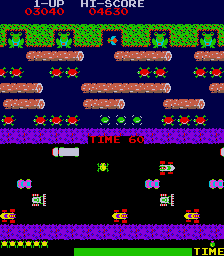
Frogger was a much more enticing prospect. I liked the basic premise as it was simple but infuriatingly reliant on quick button taps and very very good timing. I found the movements very intuitive to control but was particularly impressed by the simple but highly disorientating effect of having a game road function almost but not quite like reality – the changes in direction were tremendously unsettling and the variant speeds of cars quite challenging. Once you knew the general rules of what happened where it was fairly easy to play but one of the interesting conceptual elements was the fact that the screen was the universe. Should your frog float on a log off screen he was a gonner. Which is in stark contrast to the conceptual space in most games that, as in most television and film constructs, encourages you to believe there is a whole world beyond that which can be seen.


Pacman, our final game this week, had an alternative but again novel approach to structuring it's 2D game play with a layout that provides a tunnel from one side of the screen to the other suggesting that the screen is your universe but that it is, at least, a fairly smart space with it's own peculiar rules of time and space. Pacman proved to be the most addictive game of the week for me. It was intensely fast, baffling, but fun. Audio clues were minimal but helpful and it was aesthetically the best game because it was built around clear engaging highly abstract visuals that worked in a low resolution context whereas Donkey Kong and Frogger both required big leaps of faith to believe that the pixellated detail on screen were worth becoming engaged with. I did not, sadly, find all the clever little patterns and twists (more on this next week) but I did feel, of all three games, that there was a noticable difference between playing at initial skill level and, after a few hours, playing at a more developed level. I completed level 1 of Pacman and found it a really compelling game to return to to see if I could again reach (and this time conquer) level 2. I think part of what made it so playable was the option to play vertically or horizontally. Working bottom to top in Frogger and Donkey Kong seemed peculiar especially as email, blogging and most internet sites order content to avoid scrolling making top to bottom as key a default reading style as left to right. Which makes me wonder how much the structuring of these games depends on other conventions of players. For instance are some games (particularly those with complex status information shown on screen) easier to play with those used to scripts that write from right to left rather than left to right? Is the vertical game play in puzzle and platform games easier for those used to vertical kanji rather than western scripts? I'm not sure but I have a feeling those expectations do definitely influence enjoyability and the success of the first few plays of a game.


References

  • [1] Whitton, N. (2010). Chapter 2, “Recognising the characteristics of digital games”. In Learning with Digital Games: A practical guide to engaging students in higher education, London: Routledge.

  • [2] Newman, J. (2004). Chapter 2, “What is a video game? Rules, Puzzles and Simulation”. In Videogames, London: Routledge.

  • [3] Wikipedia. (2010). Section 2.1, “Biology”. In Life. Accessed 31st January 2010. http://en.wikipedia.org/wiki/Life#Biology


Keywords: DinkeyKong, frogger, IDGBL10, Newman2004, pacman, Singstar, Whitton2010

Posted by Nicola Osborne | 3 comment(s)

January 31, 2010

By the time I reached university I had reached the point when I had not only access to networked computers but also a PC in my own room so I brought myself the Monty Pythons the Meaning of Life game as a way to expend spare time. It was all based around the film and included additional Terry Gilliam animation it looked incredibly slick. It ran off a CD Rom and included lots of clips of film between a progressive series of puzzles and daft trivia games. It appealed to me because I liked the Monty Python TV show and films but I returned to play it as it had several entry points and the games were fairly random and witty: it was entertaining even when you did badly.


At university I found myself trapped at a campus out of town for lots of lunch hours with little to do so joined my peers in playing Light Bikes and, when flash started powering lots of online games, things like Tetris and Solitaire but played online (wisely the university did not include the games in the standard Windows installs on computer lab machines). I was still on the whole more interesting in writing, blogging and starting to edit websites most of the time but remember reviewing films one festival with a team of video and flash producers. At the time flash games were starting to be used particularly on brand websites (as they still are) to create lively slick looking add ons to the site (rather than as the core style of presenting the whole website as is the case with lots of brand sites now). The process of creating them was, however, fairly complex and time-consuming (though, at the time, less taxing than trying to capture and deliver video to a good standard online) and the team I'd been working with went off to lucrative work in London as every company was starting to need a website and starting to want something slick and playful to draw people in.


A few other games started popping up as well. A friend lent me his copy of Incredible Machines, a rather geeky game based on building wonderful surreal gadgets and vehicles to solve peculiar puzzles on screen. Of the games I'd played this was one of the most educational feeling – although since I was studying engineering in between games I knew that this was more puzzle than study – and one of the most engaging as it was quite analytical, very creative and there were multiple ways to find a solution. 

I enjoyed Incredible Machines but, when I complained how much I wanted an even more freeform game – something where I could create and build and control what I wanted, I found myself receiving a box set of the Myst series for Christmas. I tried to fathom the game but whilst it was the most graphically glorious game I'd encountered it was also terribly frustrating. It did take creative skills to master but it seemed to need a psychic connection to the games developer to find the goals and solutions to progress. I gave up quite quickly as I grew tired of reading obtuse text introductions and then playing baron (but beautiful) game areas where only a few areas had any type of (obscure) functionality. It had the aesthetic I'd been hoping for but the “creative” game play aspect felt too regimented.


I started working part time in a computer lab and, since the job amounted to babysitting the room and filling the printer, I found myself with long shifts to fill with things that could be regularly interrupted. GemMine and various other deeply daft puzzle games kept me entertained as gameplay only took a few minutes on the whole.


 But it was when I moved into a shared flat with a console (and subsequently several consoles) that I really started to play computer games. I spent hours and hours playing Tony Hawk's Pro Skater 4 with my flatmates. There felt like a real progression of skill in the game and, as I perfected my grinds, I felt like I was really progressing through the game. Key to this sense was the fact that the flatmate I played with most often was of a similar skill level so a slight difference in skill or experience from playing individually made shared game play that much better. Both of us, however, were regularly shown tips and masterful play by two casual experts of the game who came round for parties and video nights and trounced our scores. One night we decided that we should play with the custom settings on game and decided to create players for our games that looked just like our real life experts. This new bizarre embodiment in the game actually made it much more fun to play – suddenly our skaters had a name, a look and a personality as well as some custom skill points to match our best playing skills. The game kept us entertained for months and months – and cleverly blended the ability to save long term progressive games with short unsaved party modes - and felt really sociable so I have very fond memories and reached probably the highest level of game skills of any game I've played before or since. I really felt like I knew what I was doing. And years later I was amazed to find that the realistic landscapes used in the San Francisco levels of the game had been so good that I was able to guide my partner (who grew up near the city and had often visited) round the areas she hadn't visited before. In fact Alcatraz was so like the game that I had flashbacks to specific favourite moves as I walked around and felt like I had been there before. It was wonderful and very bizarre.


Computer game sessions at the end of video nights become the standard end to the night in the flat with Bishi Bashi, Super Monkey Ball/Monkey Tennis, TimeSplitters 2, Grand Turismo, and Tekken Tag Tournament were all very popular.


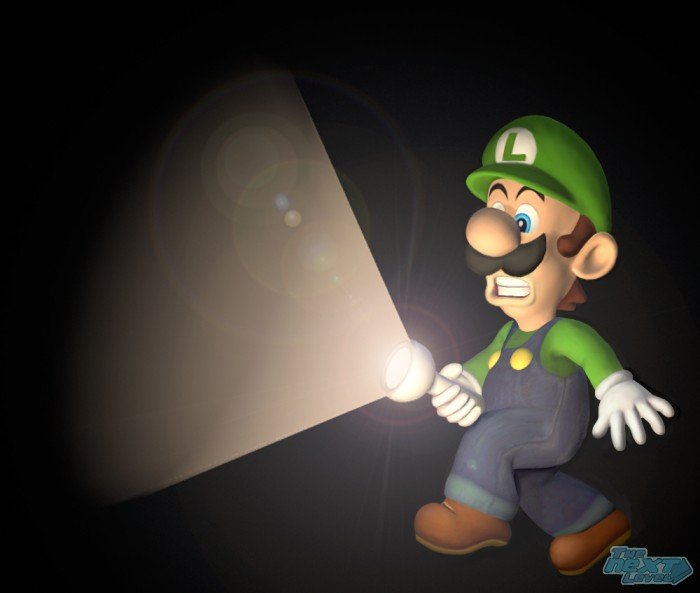
My flatmate also brought a few more slow burn titles so we both attempted Pikmin - which was highly enjoyable if not wildly exciting and Mario Sunshine, a game we again traded off tips and progressive game play in. Luigi's Mansion didn't entertain for long but was silly and fun but The Legend of Zelda: Wind Waker proved to be an even more compelling experience than Tony Hawks since it combined slick animation and a whole rich complex universe. It was, however, definitely a solitary game and the most social it ever reached was in the exchanging of tips or new level info between game play sessions.


My flatmate also acquired GTA: Vice City for his PC at about the same time as a whole raft of our (male) friends did. After hearing about some of the notorious features of the game – freeform gameplay was the most enticing element but the idea of a game where you scored points for killing, mugging and using prostitutes had a certain amoral charm – that I requested a wee play on the game. Again I was wowed with the graphics and I did enjoy the custom cars and their multiple radio stations. I didn't really get the goals (perhaps the point if Games Britannia [1] is to be believed) but I enjoyed the openness of the space – Tony Hawk's and GTA were the first two games where I could go in the wrong direction, do something purely for entertainment or craft my own narrative and they were both much more enticing for this. The animation and, most particularly, the soundtrack packed with great well known tracks that set the mood were key to the games' success. However the progressing goals and narrative scenes of GTA, though slick, seemed to interrupt more explorative play and I never quite got the hang of taking part in these missions and areas of the game where you were taken out of game play to view important information. I do know friends who wanted to progress through the game in a much faster more goal orientated way though and I think these sequences (longer but not unusual in any video game) felt less disruptive in this style of play.


The rather warped moral code in the GTA gameplay didn't bother me too much at the time but then I was an adult woman playing the game. As subsequent titles have come out in the franchise I've been interested to see how they are marketed as I think the same subversion that makes these edgy and witty games has some odd implications for who plays them and how really committed players may view other people. I am astonished, for instance, how few protagonists in any modern computer games are women. Lara Croft may have been designed to look great to male gamers but that at least meant that she was a tough and multi faceted character (and led to the hyper feminist and equally quite exploitative Bits[2], a female fronted answer to Games Master[3] ) and gamers of all genders played the game in the embodiment of a woman (although more often as voyeur than through her eyes). GTA had men cast as various characters – gang members and bosses, taxi drivers, irate by standers, police men radio shock jocks etc. - but women seemed only to appear very peripherally and as prostitutes and mob girlfriends (which may or may not effectively equate to the same thing in the game). That actually means the game had more women in it than more random aggressive games – such as Halo, a game I played only a few times but found fairly dull (though exquisitely rendered) - but is, nonetheless, quite an odd experiential landscape.


When I moved out of that flat a few years ago my partner and I sat down and talked about buying a games console. We'd both gotten used to playing a lot of games quite regularly and the Game Cube seemed the most enticing option. Indeed I still occasionally look into the windows of second hand gaming shops and ponder a discounted bundle of console and games to relive my gaming student days. At that time we decided to leave it for the time being. I lost track of what games were coming out and decided I was fine without a gaming console. However with several friends in the industry I do waver quite often and when the WII came out both my partner and I thought it looked like it could be a fun console to get. We haven't got one yet but that's mainly because we look at the price, we look at the amount of free time we have and we generally decide that we'd rather use the money on knitting, crochet, beading and cooking equipment – things that we tend to do together. Spare time is at more of a premium than money so my partner currently plays The Sims 2 on and off (very obsessively at times) when she has free time but, partly because of studying for this course, and partly because of other hobbies that tend to be my first choice of time filling activity, I've been pretty much off games for a few years.


Although I never think of it as a game I have flirted with Second Life both for this course and for general entertainment. As a space it ticks many of those boxes that Myst never did but it is really a social space and for that reason it tends only to capture my attention when I have a social use for it. The most compelling element of Second Life for me is the ability to create things but the tie to cash for importing and housing any items or textures in SL feels very alienating to me. I might be happy to pay a one off fee for software/a game but I don't use the space enough to subscribe (as I do to Flickr and PodBean) and really use it as an alternative space to be. What I would love it to be able to take out some of that SL experience and share it in other spaces.

OpenSim is interesting as a possibility and I also like the type of Machinima that comes out of SL as a way to share experience and creativity to those who do not want to register and take part in the same virtual world. I have also looked at World of Warcraft but have not been terribly tempted yet, in part because of the fantasy element of the game (not a style of game play in any format that has ever terribly inspired me) but mainly because the cost barrier is fairly high to get started and I'm just not sure I have the time to make the most of the game and thus get the value out of paying (even if I liked the game play). Those I know who do play a lot of WoW have existing groups of peers who already play in the space and this, in part, is a motivating factor as it allows them to play some fun challenging situations with old friends in areas near and far – as well as friendly strangers. And I cannot argue that WoW looks immeasurably more slick than Second Life.


Although I'm not gaming at the moment it seems that more and more of my friends do. Singing games show up at parties, WII Fit seems to be regularly mentioned as a modern alternative to the fitness videos and DVDs that used to be ubiquitous at this time of year. Given this upturn in gaming I'm surprised gaming doesn't appear in mainstream media and most particularly doesn't feature on TV outside of the adverts. When I started to take an interest in computers Knightmare (for a taster have a look at this (realplayer) clip) was on TV. By the time I had a PC and was wondering what I could eventually do with the technology Cyber Zone was on TV suggesting that we'd all be playing virtual reality games in the near future...


And by the time I actually played console games I was watching the excellent Bits and I felt like I had a connection to what was going on in gaming. But at that point gaming was gaming, as in a particular hobby with a fairly geeky connotation...


At the moment I see ads for gaming – more often than not featuring A list actresses or footballing dynasties. The emphasis is on games as a leisure pursuit for all – not just geeks but older players, women, and families – to play in sociable group contexts (the big screen TV acting like a roaring fire at the heart of a modern living room).


Particularly interesting are the brain training games ads – a particularly enthusiastic attempt to get older consumers to buy hand held gaming devices that seems, if the cafes and commuter routes of Edinburgh is anything to go by, to have had a fairly successful impact. Oddly this is marketing pitch claiming that games are educational but in such a way that the ads almost play like dietary supplement infomercials. It adds credibility to learning through games but only in the context of Sudoku style puzzles that are specifically labelled as learning games.


So, after looking back at all those gaming encounters a few things are highlighted for me. Firstly I am a hard gamer to capture. Although I seem to have played a lot of games and can be easily absorbed in many types of game it actually takes a great deal for me to become properly invested in playing a game. The long term games that allow the saving of positions and more freeform explorations work best for me and I learn skills in these. I like creative spaces but I get a little lost when there is no structure at all. Choice is good, infinite choice is quickly baffling. And finally I am quite price sensitive to games. I will happily try a free or inexpensive game but I am wary of entering a game that may prove expensive to continue. This is not because I could not afford to play (generally) but more to do with where value lies for me: virtual goods have limited value to me and regular payments must represent decent value for money. For educational games this last element would not, on the whole, be an issue but game play would. I have seen demos of “Serious Games” and these look fantastic but very much based on following a specific response. There are good reasons for this but the idea of free choice that traps you in a single level until you make the one approved move is a tricky one – it can feel like Groundhog Day.


Notes

[1] Games Brittania is a BBC 4 Series from late 2009 tracking the history of computer gaming. More information on the shows website: http://www.bbc.co.uk/programmes/b00pddc6

[2] Bits was a games review and news show running in the late '90s and early 00's and hosted by three female games journalists/presenters. Websites about the show are sparse but Charlie Brooker gives the show mention in his own review of gaming shows on TV.

[3] Games Master was a Channel 4 computer gaming show which began in 1992. A detailed page about the series can be found here:http://www.gamesmasterlive.co.uk/gamesmaster/gamesmaster.php.

Keywords: Bits, gamecube, GamesBrittania, GamesMaster, gaming, IDGBL10, tonyhawks, zelda

Posted by Nicola Osborne | 2 comment(s)

January 26, 2010

Things had started to get pretty sophisticated in the home console market pretty quickly as I got near to finishing primary school and although my mum certainly wasn't enthused by computer games we started to hear about them through friends and, I suppose, the media. The Sega Mega Drive came out and we started occasionally renting consoles and games when we went to the village shop to rent video cassettes. Sonic the Hedgehog became the first game my sister and I both got pretty good at playing and I remember spending hours and hours of the weekend with my sister and I lounging on my mum's big squishy bed playing Sonic on the second telly. We never plugged it into the big TV downstairs as it wasn't seen as appropriate to play games in the lounge as it would be visible, would interfere with visiting adults and, in our wee house, would have meant us getting under my mum's feet. Gaming was to be done in relative privacy.

There was all of one Sega console in the village shop so we'd also rent and play Super Mario Brothers on the NES. In fact I can't recall which we started out with but Sonic felt rather more energised and entertaining to play and certainly had the showier graphics of the two. However all of the visual shorthand and game play tactics learned in Super Mario would turn out to be handy in later Nintendo titles from Mario Party to Super Mario Sunshine and Luigi's Mansion. And no matter which console was available for hire, these occasional weekends of gaming felt like a pretty special and unusual activity.


All of the games played to date were fun but were marked by extreme frustration. Not just over understanding controls and goals of the game but mainly over getting a chance to play at all. Access to just about all the machines or gaming devices was rationed in the extreme because they weren't owned hugely widely and were expensive to buy.


For instance Frogger had been used as a (learning free) reward at school – a carrot for finishing work on time or doing well but even then maybe 5 people would be crammed into the (open) cupboard awaiting their turn the moment you killed your frog.


Having just replayed the game this week I can see why it was so frustrating – a very unsuccessful player can burn through froggy lives in about 2 minutes, controls are fiddly and reaction speed is a part of the challenge all of which, in a room full of enthusiastic 9 year olds, means it's very easy to kill your frog(s) with the smallest delay in reaction. Then one was left sitting there waiting the next turn exasperatedly for maybe half an hour.


I knew that arcade games existed out there in a sort of parallel urban universe but programme like Blue Peter, Press Gang and Grange Hill ran stories about how addictive and dangerous they were with little differentiation between One Armed Bandits and other types of arcade games. News Round highlighted people thieving money and bunking off school to support arcade playing habits. All of the above are surely the precursor to the current array of gaming scare stories though I'm sure there was a small kernel of truth there also. But, in any case, this was all very academic as we were living in a small village so an arcade seemed like a bizarre scary place. I think anything from sky diving clubs to film sets to strip bars probably all seem less bizarre and much more accessible to the average 10 year old growing up in the same place today. At the time though such establishments seemed very “There be dragons!” to us. Watching Ferris Bueller's Day Off I remember thinking how very mature and bad-ass the girl who is mistaken for Ferris in – gasp! - an arcade must have been. To this day I see arcade gaming machines as pricey, for other people, and pretty much equivalent to gambling thanks to all those media warnings about their addictiveness.


Some diversionary arcade-ish gaming was, however, permitted in the palace of tackiness that was the Laser-quest venue that opened up in Cardiff in the early 90s. Amongst my favourites here were the games that were hybrids of electronic and physical games – I particularly remember a basketball game where you threw real balls and the points were electronically totted up. It wasn't that clever but – like Laser-quest itself - it felt very high tech and gave you a very physical sense of feedback and sense of accomplishment – oddly the natural successors to these types of games are probably the WII and Project Natal (for Xbox). Indeed very few of the video/computer/digital games I encountered till the late '90s had anything to do with beating other people, most were about beating your own high score or a previously set high score. This was very different to the other types of games I was playing – from catch to bowling (bowling being the highlight of an 11 year olds life) or laser-quest (all very performed forms of play) to the many varieties of board games played with friends.
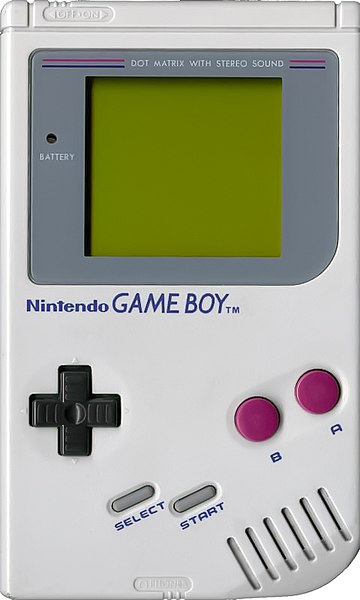
 

Next into my gaming life wandered the Nintendo Game Boy. It seemed like an excessively expensive treat and it was thus not me (busy with crafts) but my sister who asked for/part paid for a shiny new Game Boy to entertain her into her teens. Tetris was almost the only thing anyone in the house ever played on her Game Boy, in part because it had been bundled free but, in larger part, because it was a very simple and very addictive game to play. Although my sister also acquired such classics as Bill & Ted's Excellent Game Boy Adventure the gameplay rarely contended with Tetris. Indeed not only did I start poaching the Game Boy to play a few levels but so did my mum who became sufficiently addicted to get, if I recall correctly, the highest score in the house (when I mentioned this course the other week she commented on how addicted she had been to Tetris in fond but baffled terms).


I never got interested enough for my own GameBoy but I did become fascinated with making pretty shapes on screen and, having just gotten access to my dad's very old Amstrad, I was largely entertaining myself trying to find ways to draw random pictures with text (also fun, of course, on typewriters) and experimenting with watching his vast archive of old films. Other digital games and entertainment largely passed me by as I really wanted more freedom and creativity in my gaming and platform games and puzzle games of the time were fairly dictatorial about how you could play the game. It was great to get absorbed in beating the clock but wasn't terribly satisfying.

Having said this a few games offered some short term distractions. A leisure centre near us offered a very underused and cheap Tekken arcade game and that, on a pleasing visceral level, became a good way for my sister and I to beat each other up in an acceptable and entertaining manner.

 At school the one room of PCs also had but one exciting game available. Snake, in all it's basic glory, looked vaguely like it could be a bit mathematical and somehow slipped through the academic net. Thus the room was oft packed with school peers playing for extended periods. I enjoyed it but found the opportunity to write up and format actual pieces of work more exciting in terms of the hours I would spend on the computers. Snake was fun but writing let me express myself rather than fill time. This, as you may notice, is a bit of a theme with my enjoyment of computer games and some of my attitude about what makes good games and thus good learning games. Reflecting on my previous gaming experience feels like a useful part of a process of understanding what would and could have truly engaged me as a learning gaming process. Graphics and interactivity has moved on substantially but conceptual elements of what makes a good game seem important even in the lowest tech computer games experiences.


As PCs were getting more sophisticated they started to be the main space I encountered games (leaving consoles to others at this point) including Solitaire, MineSweeper, Hearts (which I never did or have understood), and the curious Mavis Beacon touch typing game. It's only in recent years that I realise what a handy primer the latter game was. It didn't teach me to touch type but it did focus me, after years of watching my mother type like lightening when working from home, on thinking about which keys should do which keys when I actually learned speedy touch typing some years later through enthusiastic use of chat rooms on AOL when we finally got a (modern) PC at home.


PCs also brought gaming to an older friend in my neighbourhood which also meant I started to see games that much more closely resemble what the term “computer game” means to most people these days. These were games like Doom, Civilisation, and Tomb Raider and, noticeably, these were adult games with gore or ridiculously proportioned stars or complex goals and game play. They were a world away from Mario or Tetris but, at the time, they looked both more life like and more disappointing – the bright garish animation of kids games suited the screens better and the power of the computers meant that Solitaire or minesweeper could move fast but games like Doom could move quite choppily with parts of the screen barely rendering in time for you to play them.

However by the time we had that first Windows machine at home the internet existed. Indeed we'd gotten the PC, in part, to allow my mum access to email for work. So my first experiments with the PC were about the enormous package of bundled CDs roms (including creative but random titles like an Alan Titchmarsh Gardening program), those included Windows 95 games and, most excitingly of all, very slow dial up internet explorations which would take me away from games for several years as I met new people across the world and read and wrote and chatted – all activities that seemed terribly exciting compared to gaming for hours to a teenager who was more than ready to move out of a small village and wanted to explore lots of things that school and friends weren't offering me about films, about my identity. It was a revelation and just couldn't compare with any other leisure pursuit for most of my late teens. But when I reached university the internet was plentiful, the real life opportunities greater and the call of games was thus a little stronger...


Keywords: gaming, IDGBL10, Mario

Posted by Nicola Osborne | 0 comment(s)

January 25, 2010


Last week, getting myself set for looking at computer games for this module, I started to think about what games I'd played before and was staggered by the variety and number of games I had, at some point, come into contact with.

Because both of my parents had computers purely for work at a time when Apricots and early Amstrads just didgn't come with any sort of game I probably started with Frogger on the BBC computer at school. There was one other game too but early Frogger is what I properly recall playing badly in the broom cupboard (where all the primary school computers used to be kept/used).


Around the same time as Frogger appeared I took possession of a little purple portable Snoopy Tennis game which, despite being effectively Pong with even less potential for game variance, kept me entertained for hours. This was the same portable gaming device (with only one pre-loaded game and fixes labelled buttons) that other people had Donkey Kong on but that was never my bag (playing it again this week it still isn't). I also vividly recall having, in parallel with Snoopy Tennis, small (but not as small) water games – you pressed a button to push balls around a water maze. They were fun too but they got broken or accidentally drained far faster than Snoopy Tennis' batteries died.


In the next few years several friends started getting various games. One friend had what, in retrospect, must have been one of the early (and expensive) Sinclair machines. I remember tapes, I remember baffling minutes of loading and finally blotchy graphics on a small colour telly. I have absolutely no recollection of the game or gameplay. Friends of my sister had Paperboy (an Atari game) involving a paper boy cycling his route – although I remember watching at least 4 rounds of people playing before realising that this was the plot as the graphics were very basic. As these friends got consoles (because that was pretty much what you played games on at the time) they became experts at the games they had available. But they pretty much all had different games. This meant visits to these friend's houses might involve watching them play but inevitably, if you had a turn, you would be dead in seconds and have to watch your friend gloat as they showed off their skills. There was a little peer learning and support but many of these kids assumed you would know all about the game too and some revelled in their status as an expert player. That said not many friends had games at all partly because of the cost (my home village is now well funded and very middle class but in the 80s incomes were modest and computer games prohibitively pricey) and partly because most of my sister and my friends were little girls. Memory of play at that age involved toys, various hours spent styling hair, making up dance steps to the Reynolds Sisters and doing little craft projects and Brownie badges. Computer games were just not a mainstream activity for anyone under 10 and most of the girls I knew just weren't that excited by them. Those that were tended to have brothers or lots of cousins that they were keen to keep ahead of.


My dad had been the sort to buy small robots and VCR machines (we always had two, the better for making amateur records of classic movies to remove Channel 4 ads) when he saw them but he was always more into things like Scalelextric, things with a physical note, but it probably wouldn't have been long until we would have had computer games or a console of our own in the house had his death not intervened when I was about 9. This pretty much ensured we wouldn't be in the mood, nor in any way able to afford much in the way of new technology for a while. My dad would go out and spend money in occasional overenthusiastic bursts on things that looked new and shiny, my mother however had always been less impressed with expensive gadgets and with cash short she certainly wasn't about to focus on games as a spending priority. She was working from home pretty much full time though and using a computer and laser printer to do so. Her boss occasionally came round with early laptops and, once, a very early modem so as friends started to get used to computers as gaming devices we were learning that computers were hugely powerful publishing tools. I think in the long term this probably fared both myself and my sister fairly well – when we first got access to PCs at secondary school we both found it easy to use them for work and research whilst peers seemed unable to tear themselves away from basic games like Snake. But that was later...


Keywords: 80s, games, IDGBL10, ItWasAcceptableInThe80s, Mario, SnoopyTennis, Sonic

Posted by Nicola Osborne | 0 comment(s)

January 15, 2010

This is a very brief blog post to kick off my blog for the Introduction to Digital Game Based Learning module which kicks off on Monday. Since I haven't used the Holyrood Park blogs since IDEL it's going to be quite weird returning here to post updates. (Right now it's also a little challenging - my home broadband has given up the ghost and my new provider/line problems may take a while to correct so I may seem unnaturally shy online for the first week or so since I'll probably still be posting after work from the office.) 

At this stage I'm tremendously excited about beginning the course having started to read through Gee (with Whitton lined up for next week) and having seen all the wonderful nostalgic gaming references in the introductory posts to the WebCT discussion boards. It's been a long time since I played games regularly but for a while now I've been wanting to dust off my thumbs and see what's new so the idea of doing this and learning how to use games for learning seems fantastic. I'm especially keen to find out how I can take learning objectives and training ideas and make those into a compelling and fun computer game so I'm already thinking about possible ideas for the final assignment even if it is jumping the gun a little.


Keywords: gaming, IDGBL10

Posted by Nicola Osborne | 1 comment(s)

July 14, 2009

i hope this links up ok

Posted by Sian Bayne | 0 comment(s)

<< Back Next >>